

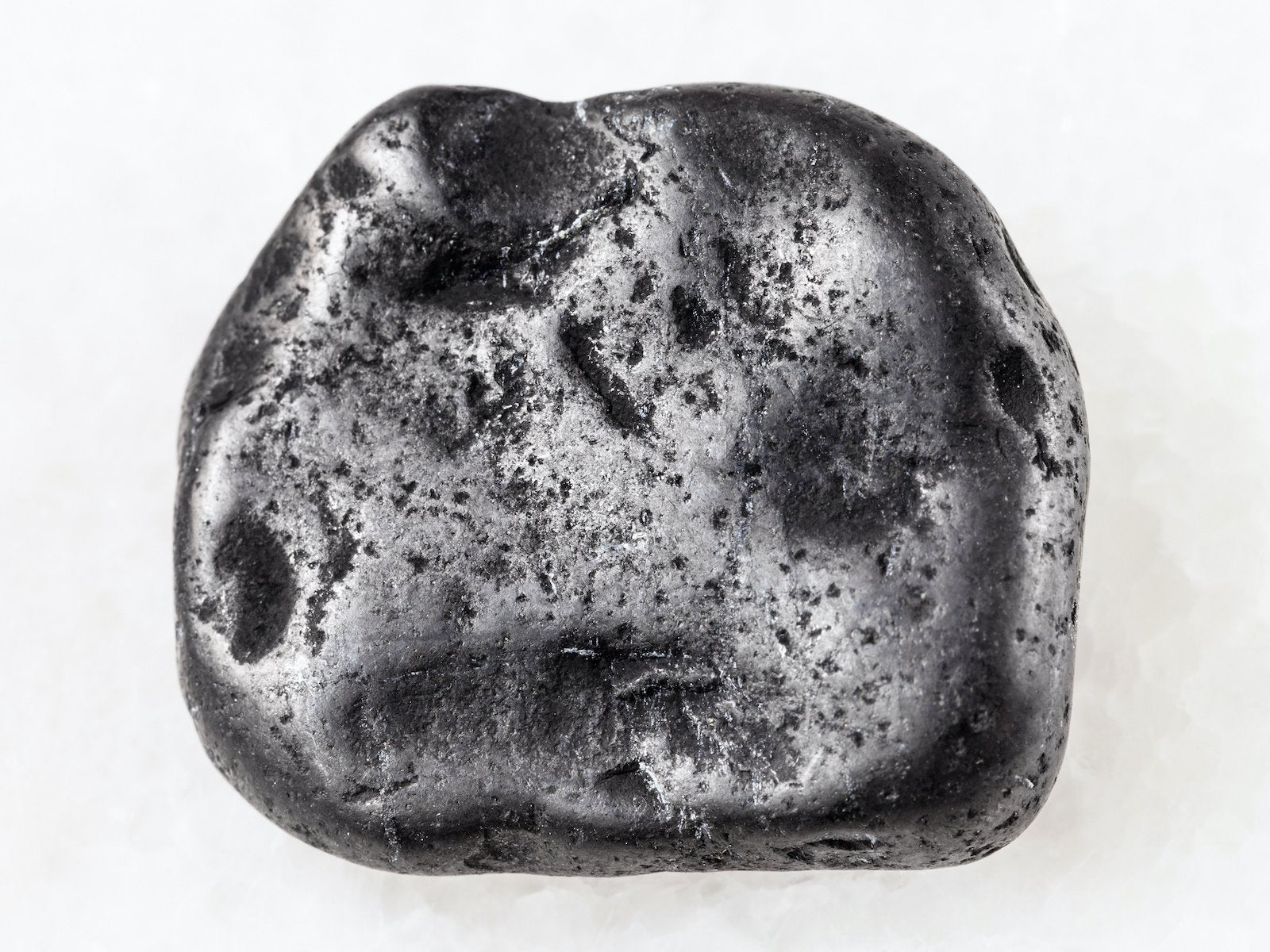
Whether you're a crystal buff or you're just starting your crystal healing kit, you need to add a shungite stone to your collection. In fact, over the last few years, this mineral has become one of the most interesting and sought-after stones in both the holistic community and the scientific world.
Known as a "wonder stone," it has been extensively researched by Russian experts, since the most important and most significant source of shungite in the world is located in Karelia, Russia. And, this stone has been used for centuries for its healing powers and protective qualities.
Shungite has a strong connection with the Earth and the physical world, which makes it a powerful chakra stone to balance the root chakra. Crystal aficionados call it the great protector and claim it's the best energetic bodyguard one can ask for. It absorbs negative vibrations and protects your auric field from other people's heavy energy and everyday negativity.
In this essential guide, you'll learn about shungite's healing properties, how to pick the perfect variety for you, and the many different uses of this truly versatile and unique gemstone.
Origins and Sources of Shungite
Even though shungite was named and categorized in 1879, ancient lore about this stone goes back to the reign of Ivan the Terrible — the first proclaimed tsar of Russia in 1547. Back then, shungite rocks were used as water purification tools and were simply referred to as "local slate."
However, it was during the empire of Peter the Great that this dark stone finally got the recognition it deserved. The emperor was drawn to this stone and established the first Russian Healing Spa in 1719 on the shores of Lake Onega, where the stone occurred abundantly, close to Shun'ga village, hence the name shungite.
The Russians' fascination with this dark gemstone was such that soldiers were advised to carry a piece of shungite with them during military campaigns, believed to purify water in the field. They called it the stone of life — a representation of their faith in this healing crystal. Russians used it successfully in diverse areas like ecology, agriculture, medicine, filtration, chemical production, and construction industries.
Recent studies hypothesize that shungite is one of the oldest rock formations in the world, possibly over 2 billion years old, and that it may have originated from a biological process that broke down organisms in ancient oceans. In 1996, two scientists — Robert Curl and Richard Smalley — discovered a crystallized form of carbon called "fullerenes," which earned them the Nobel Prize in Chemistry. It was later uncovered that the only known source of this compound on Earth is shungite.
Because shungite has a carbon-based nature, similar to ours, many people feel a strong bond with this old-as-time rock, and treasure it as a companion for the mind and spirit. According to legend, shungite was a protection amulet against negative people, and ancient mystics believed its energy could cloak its wearer in darkness so that bad luck could not find him.
The scientific community around the world is actively researching the possible uses of this amazing stone and how they could be implemented in technology, electronics, and nanotechnology.
Although the most famous source of this mineral is the Russian Karelian region, more shungite deposits have been found in other areas of the country. Smaller sourcing areas exist in Austria, India, central Africa, the United Kingdom, and the United States.
Types of Shungite

When picking your shungite stones, there are a couple of things to keep in mind. Even though all grades have healing qualities, the higher the carbon content of the crystal, the higher its fullerene content, and thus the stronger its vibration is
Regina Martino, a French bioenergy expert who has been conducting experiments on shungite since 2006, divides the stone into three categories:
- Type I (elite shungite or noble shungite): The purest and most rare form of shungite, only 1% of all shungite found meets this quality standard. Type I stones contain 98% carbon and show a shiny silvery-black, semi-metallic luster. These stones are very hard to cut or shape
- Type II (black shungite): These stones contain 50-70% carbon. They're black with a semi-dull glow and can be easily shaped and polished. Type II stones rae typically used to carve sculptures and jewelry
- Type III (gray shungite or shungite rock): These stones only contain 30-50% carbon. They're gray with a dull or matte luster.
Shungite: Protection, Healing Properties, and Uses
Shungite is one of those stones that keeps people curious, and there's always more to learn about it. It presents a very similar atomic structure to charcoal — which is mainly made of carbon — and shares the same cleansing and purifying qualities. Here's a look at some of the potential benefits.
Everyday Tech Companion
Regardless of where you live, screens and devices are a big part of everyday life.
Wearing jewelry made from this mineral or carrying a piece in your pocket can be a nice way to feel a little more grounded.
Emotional Benefits
Like all black stones — including black tourmaline, hematite, and black obsidian — shungite is an outstanding grounding stone, used to calm the mind and create stability. For those reasons, these stones have been used for hundreds of years as anxiety and stress relief tools.
This gemstone is a nice companion during restless nights, especially when your mind won't quiet down from overthinking, fears, or things outside your control.
Purifying Energy

Shungite's purifying action is probably one of its most praised qualities and the main reason people have been using it for so many years. It also enriches water with essential and beneficial minerals, including calcium and magnesium.
Many followers of holistic lifestyles use shungite rocks to purify their water, creating what they call shungite water. They claim that it's a natural, safe, and sustainable way to remove impurities and that it even makes the water taste and smell better.
Shungite will keep indefinitely, but if the water is really polluted, it's advisable to cleanse the pebbles regularly and recharge them under the moon or the sun for at least two hours.
Spiritual Growth and Metaphysical Properties
Shungite's powerful vibration resonates strongly with the root chakra, but also helps to open the sacral and the solar plexus points, which are respectively the centers of emotion and creativity. So if you're going through a hard period and feel lost, disconnected from reality, and low in willpower and motivation, keeping shungite close may be a good way to overcome these stagnant energies.
Regina Martino has found that, "Shungite, more than any other rock, is able to realign the chakras and optimize the vital field. In particular, shungite greatly increases or concentrates the vital field in the first chakra, or 'root chakra.'"
It's considered a neutralizing stone that helps harmonize your masculine and feminine sides when one has taken over, assisting you in staying grounded and sensible, while still allowing you to dream big. As a stone of action and pragmatism, it's the perfect companion for those who wish to start a new project or venture into a new business, giving them focus and determination.
Crystal healers claim it's a catalyst for positive change and growth, making it an excellent stone for self-reflection and an assistive tool for shedding patterns and old beliefs that no longer align with who you wish to become.
Use Shungite To Purify Your Energy

Shungite is truly a wonderful gift of nature, and there is still so much to learn about the infinite potential of this black stone. Before you select your specimen, keep in mind that it does exude a very strong vibration, therefore those who are more sensitive to the subtle energies of crystals might find it overwhelming.
The best course of action is to start with a small stone and keep it in your purse, and only once you've become accustomed to the stone's frequency proceed to keep it closer to your body.
