


If grief makes your day feel unsteady, a short crystal ritual can give you one small place to pause. I’d keep it to 30 seconds to 15 minutes, use one stone, sit in one quiet spot, and end with one clear closing action.
Here’s the whole idea in plain terms:
- I pick a time that fits my day, often morning or bedtime.
- I keep the practice short: 2–5 minutes in the morning or 7–10 minutes at night.
- I use one crystal as a physical anchor.
- I breathe slowly, hold the stone, and let one feeling or one memory be there.
- On hard days, 30 seconds still counts.
- If memory work feels too heavy, I skip it.
A few crystal options from the article:
- Rose Quartz for heart comfort and self-kindness
- Amethyst for a quiet evening pause
- Black Tourmaline or Smoky Quartz for grounding
- Apache Tear for soft remembrance
- Moonstone for the up-and-down nature of grief
One point matters most: <u>this ritual is meant to stay small</u>. Not perfect. Not long. Just repeatable.
| Crystal | Best Use | Simple Placement |
|---|---|---|
| Rose Quartz | Heart comfort | Over the heart |
| Amethyst | Evening calm | By the bed or in hand |
| Black Tourmaline | Grounding | In hand or near the feet |
| Smoky Quartz | Steadying strong feelings | In both hands |
| Apache Tear | Remembrance | In both hands |
| Moonstone | Emotional cycles | In hand near bedtime |
The article’s core message is simple: one breath, one stone, one safe place can be enough when grief feels big.
Set up a safe and calming space
Pick a time, place, and session length that works for you
Once you have your healing crystals for grief, connect this ritual to a routine you already trust. That makes it much easier to stick with. Morning, after work, or right before bed can all work well.
Start small. Try 3–5 minutes in the morning, and set aside 7–15 minutes in the evening if that feels doable.
For the place, choose one quiet spot and come back to it each time. It could be a favorite chair, a corner of the room, or even your bed. The point is simple: let that spot start to feel like your cue to slow down.
Make your space physically comfortable and calm
Use a quiet spot where your body can settle. If it feels comforting, place a photo, a letter, or a small keepsake from your loved one nearby. A blanket, cushion, or pillow behind your back can help you relax without much effort.
You might sit with your feet flat on the floor if you want to feel grounded. Or you can recline in bed if rest is what you need. Dim the lights or light a single candle to mark the moment. On harder days, you can leave the keepsake out the whole time. It doesn't need to be elaborate. Sometimes a blanket and a stone are enough.
When your body starts to soften a bit, move on to the stone.
Set a simple intention for the crystal
Begin with a simple intention. Avoid water if your stone is moisture-sensitive. Instead, use one of these gentler methods:
| Method | How It Works |
|---|---|
| Moonlight | Set the stone on a windowsill overnight, ideally during a full moon. |
| Smoke | Pass it through sage or palo santo smoke. |
| Sound | Use a singing bowl or tuning fork near the stone. |
| Quiet intention | Hold it, breathe slowly, and whisper a soft phrase. |
A short phrase works best, like "May I feel supported today" or "Tonight, I carry ease". If even that feels like too much, one word is enough.
sbb-itb-cb05739
Choose crystals for comfort, grounding, and remembrance
Crystal types that work well for grief meditation
Once your space feels settled, pick one stone based on the kind of support you need most. Stick with that same stone and only change it after at least two weeks.
Rose Quartz is often the easiest place to start. It’s commonly used for heart-centered comfort and self-compassion during loss. If your grief comes in strong waves, Black Tourmaline or Smoky Quartz may feel more steadying, with a grounding effect and spiritual protection during heavy emotional surges.
For the end of a hard day, Amethyst is often used as a gentle evening stone for calm reflection and quiet release. If your focus is remembrance, Apache Tear is commonly chosen for grief comfort and soft, patient processing.
Crystal comparison table to help you pick one steady stone
Use the table below to match one stone to your day-to-day need. And if you do switch stones, give it at least two weeks before making a change.
| Crystal | Emotional Focus | Meditation Placement |
|---|---|---|
| Rose Quartz | Self-compassion, heart comfort | Over the heart or held in both hands |
| Amethyst | Calm reflection, quiet release | Bedside or at the forehead |
| Black Tourmaline | Grounding, emotional protection | At the feet or in the hands |
| Smoky Quartz | Anchoring during emotional surges | Held in hands or near the root chakra |
| Apache Tear | Gentle grief processing, remembrance | Root chakra or in both hands |
| Moonstone | Honoring grief's cycles, emotional balance | Bedside or held during memory reflection |
If you’re not sure where to begin, Rose Quartz over the heart is a simple starting point. If you feel shaky or emotionally overloaded, Smoky Quartz in the hands can help you feel more anchored.
Wearable and home crystal options from Conscious Items
If you want to keep your chosen stone close during the day, you can wear it or place it nearby at home. Conscious Items offers Rose Quartz bracelets, Amethyst necklaces, crystal sets, and home accessories made with genuine gemstones. Each purchase also supports tree planting.
Follow a gentle daily ritual step by step
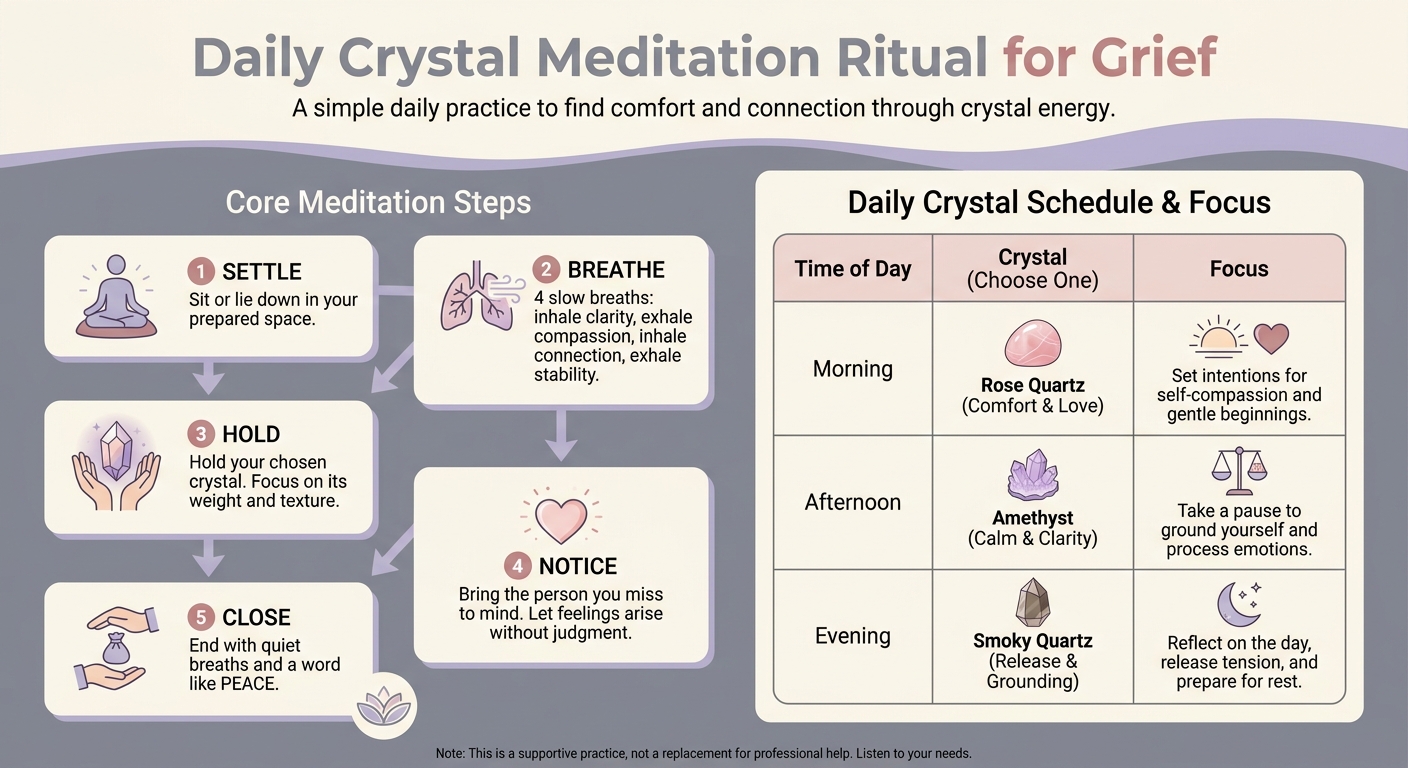
Daily Crystal Meditation Ritual for Grief: Step-by-Step Guide
Once your space and stone are ready, use the same short sequence each day. That repetition can make the practice feel easier to return to. And if a day feels off, trim any step down and keep it simple.
Core meditation steps: settle, breathe, hold, notice, close
- Settle
Sit or lie down in the space you prepared.
- Breathe
Take four slow breaths: inhale for clarity, exhale for compassion, inhale for connection, exhale for stability.
- Hold
Pick up your chosen crystal and hold it in your hands. Let the stone’s weight and texture pull your attention back to your hands.
- Notice
Bring the person you miss to mind. Let whatever comes up be there without judgment.
- Close
End with a few quiet breaths and a word like "Rest" or "Release." Close gently, then return to your day with less pressure. If you feel steady, use the next minute for a brief memory reflection.
Morning and evening routine planning table
Use this schedule as a default, not a rule.
| Time of Day | Suggested Duration | Crystal Placement | Main Focus |
|---|---|---|---|
| Morning | 2–5 minutes | Held in hand or placed in pocket | Grounding and setting a single-word intention for the day, such as "steady" or "open" |
| Evening | 7–10 minutes | Held or placed on your bedside table | Emotional release, a body scan, and easing toward rest |
| Hard Days | 30 seconds | Held over the heart | Simple presence and self-compassion, with no expectations |
How to keep the practice going on hard days
The table above gives shorter versions of the same five steps, so you can use the length that fits the day. A good way to make the ritual stick is to tie it to something you already do, like brewing your morning coffee or getting into bed. That way, it feels easy to come back to.
Keep your stone nearby as a small reminder to pause and begin again. If a session feels heavy, scale it back. Healing doesn’t move in a straight line, and patience matters more than perfection.
Add memory reflection and close with care
How to use memory reflection without feeling overwhelmed
After your breathing step, add this part only if you feel steady enough to do it.
Hold your crystal and look at a photo or keepsake. Let one memory come up and sit with it for a moment. Don’t try to sort through everything at once. Stay with that memory for 1–2 minutes, then stop before the feeling starts to spread.
If emotions rise, shift your attention back to the stone’s weight and texture.
When you’re ready to end, place the stone in a small cloth bag. That small action helps mark the session as complete.
Short variations for heart support, grounding, and grief surges
If the full ritual feels like too much, use a shorter version instead.
- Heart support: Place a Rose Quartz crystal set over your heart and take one slow breath.
- Grounding for overwhelm: Stand with both feet flat, hold Black Tourmaline or Obsidian, and notice its weight.
- Grief surge reset: Hold an Apache Tear, name the feeling once, then put the stone in its pouch.
Conclusion: The key parts of a safe daily grief ritual
Whatever version you use, end with a clear closing gesture so the practice has a clear finish.
A grief ritual tends to work best when it stays short, steady, and simple: one stone, one quiet breath, and one safe place to return to. Memory reflection is optional. Use it only when it feels right, and keep it brief when you do.
Keep the practice gentle. Some days, it may be a full ritual. Other days, it may be one breath with a hand over your heart. Both count.
FAQs
How do I choose the right crystal for my grief?
Choosing a crystal for grief is personal. There’s no wrong pick. The best crystal is the one you feel drawn to.
A simple way to start is to think about the feeling you want support with, such as comfort, grounding, or release.
For example:
- Apache Tear is often linked with comfort
- Moldavite is tied to transformation
- Rose Quartz is often used for self-compassion
- Clear Quartz can help with focus
- Black Tourmaline is often used for grounding
At the end of the day, trust your response to the stone. If one feels right in your hand or seems to pull your attention, that’s a good place to begin.
What if meditation feels too heavy on some days?
When meditation feels too heavy, go gentle instead of getting strict. If a ritual starts to feel like one more weight to carry, make it smaller: hold a crystal, take one slow breath with your hand over your heart, or say your intention while washing your hands.
What matters most is showing up with patience and self-compassion, not trying to force a certain state of mind. And if your grief feels unmanageable, reach out to a healthcare professional for support.
How can I end the ritual without feeling overwhelmed?
To end your ritual without feeling overwhelmed, keep it simple: ground yourself and ease back into daily life. A clear line can help, like saying your intention to return to ordinary awareness.
Then put out any candles or incense to mark the close of the ritual. If you still feel scattered, plant your feet firmly on the floor or hold a soothing stone like amethyst.
