


If chakra work brings up old pain, the goal is simple: go slow, stay grounded, and link each chakra to one core childhood theme. This article maps 7 chakras to common inner child patterns, shows how to set up a 10–15 minute practice, and explains when to stop if you feel flooded, numb, or disconnected.
Here’s the short version:
- Root points to safety, fear, and instability
- Sacral points to feelings, shame, and blocked joy
- Solar plexus points to self-worth, criticism, and control
- Heart points to love, betrayal, and closeness
- Throat points to voice, truth, and being shut down
- Third eye points to seeing the past with more clarity
- Crown points to closure and release
The article also covers:
- how I can set up a calm space before I begin
- grounding steps to use if emotions get too strong
- a simple root-to-crown sequence with short phrases
- crystal matches by chakra color and focus
- how to turn one session into a weekly habit with journaling
One point matters most: this is spiritual self-reflection, not mental health care. If I’m dealing with trauma or a current crisis, the article says to work with a licensed therapist and keep support close by.
So if I want a simple way to connect childhood wounds, body signals, chakra themes, and daily practice, this article gives me that full map in one place.
Understanding Your Inner Child Through the Chakra System
What the Inner Child Means in Spiritual Self-Work
Your inner child is the part of you that still holds childhood emotions, needs, and survival patterns. Inner child work asks you to notice those parts, validate them, and meet them with compassion.
The point isn't to force a release or fix everything in one sitting. It's to listen closely and respond with care to what those parts are still carrying.
Once you can name the part that feels hurt, the chakra map can help you see where that wound shows up in the body.
How the Main Chakras Connect to Emotional Themes
Use the chakra map to spot which pattern shows up most strongly in your body. As Dr. Richard A. Jelusich, author of Integrative Chakra Therapy, describes it:
"The seven main chakras are not merely abstract energy centers, but distinct, active centers of emotional and spiritual awareness."
Inner child work often starts with the lower chakras, where safety, feelings, and self-worth are most often felt. Begin with the chakra that matches the feeling you notice most often.
| Chakra | Emotional Theme | Common Inner Child Wound | Adult Reaction |
|---|---|---|---|
| Root | Safety & Survival | Fear, instability, neglect | Persistent anxiety, fight-or-flight |
| Sacral | Feelings & Pleasure | Shame, emotional invalidation | Numbness, creative blocks, poor boundaries |
| Solar Plexus | Self-Worth & Power | Criticism, lack of agency | Low self-esteem, controlling behavior |
| Heart | Love & Compassion | Betrayal, conditional love | Difficulty with intimacy, lack of self-love |
| Throat | Expression & Truth | Being silenced or dismissed | Difficulty speaking honestly, feeling shut down |
Childhood Wounds Linked to Key Chakras
Each chakra tends to reflect a certain type of childhood wound. Root insecurity can show up as anxiety or fight-or-flight. Sacral invalidation may lead to numbness or creative blocks. Solar plexus criticism can wear down self-worth. Heart wounds can make intimacy feel unsafe. Throat wounds can make self-expression feel blocked.
Paying attention to tension, tightness, or a sense of shutdown in your body can offer a quiet clue about which chakra - and which wound - may need your attention.
Use this map as a starting point. Next comes creating a space that feels safe enough to work with what came up.
sbb-itb-cb05739
Inner Child Healing with the Chakras | Emotional Empowerment (Ep. 13)
How to Prepare a Safe Space for Chakra-Based Inner Child Work
Before you begin, set up a clear container for the work. Jumping into inner child work too fast can leave you feeling exposed or all over the place. A steady setting makes it easier to stay present when chakra work stirs up old feelings.
Choose a Quiet Setting and Set Clear Boundaries
Pick a time when no one is likely to interrupt you. Put your phone on silent and choose a private spot that feels calm and safe. Sit in a chair with solid back support, or settle on the floor with cushions or props so your body can relax without strain. Keep a few comfort items close by, like water, a journal, a blanket, or something soothing to hold. Many practitioners also find that crystals for empaths help maintain a sense of energetic protection during deep emotional work.
Short sessions of 10–15 minutes are a good place to start and can help you stay within your capacity. As this starts to feel more familiar, you can slowly give yourself more time.
You may also want a simple ritual to open and close the practice. Light a candle and take three slow, conscious breaths at the start. Then, when you're done, blow out the candle, wash your hands, or move to another room to signal that the session is over.
Use Grounding Breath and a Safe-Place Visualization
Before you turn inward, anchor yourself in the present moment. Feel the weight of your body against the chair or floor. Notice where your feet, back, and hands make contact.
Then breathe in slowly through your nose and exhale through your mouth. Let the breath drop into your lower abdomen instead of keeping it high in your chest.
Once your breathing evens out, picture a place where you feel fully safe. It might be a lake, a thick forest, or any setting that gives you a sense of peace. Add details so it feels real: the warmth of the sun, the sound of water, the texture of the ground under you. If emotions start to spike, this mental place can give you somewhere steady to return to.
Signs to Pause and Return to the Present
"If you notice overwhelm or dissociation, pause and implement grounding techniques. Consider working with smaller 'doses' of material." - Maria Hinton, Founder, The Wounded Healer
This kind of emotional work can speed up fast. If you suddenly feel flooded, numb, or like the room doesn't feel quite real, that's your cue to stop. Don't try to power through it.
Open your eyes. Look around the room and name five things you can see. Stretch, take a sip of water, or shift to another spot. If the feeling keeps building, try moving your attention back and forth between the activated area and a part of your body that feels neutral or pleasant. Think of it like turning the dial down, not shutting the whole system off.
| Grounded, ready to practice | Not a good time to practice |
|---|---|
| Feeling calm, curious, and clear | Feeling numb, disconnected, or "unreal" |
| Breath is slow, deep, and steady | Breath is shallow, rapid, or held |
| Feet feel firmly planted on the floor | Racing thoughts, anxiety, or physical tension |
| Able to name objects in the room | Feeling overwhelmed or flooded by emotion |
| Basic life needs and stability are in place | Experiencing a current life crisis |
Keep a therapist's contact information or a crisis line nearby before you begin.
With that container in place, you're ready to move into the chakra sequence from root to crown.
Step-by-Step Chakra Balancing for Inner Child Healing
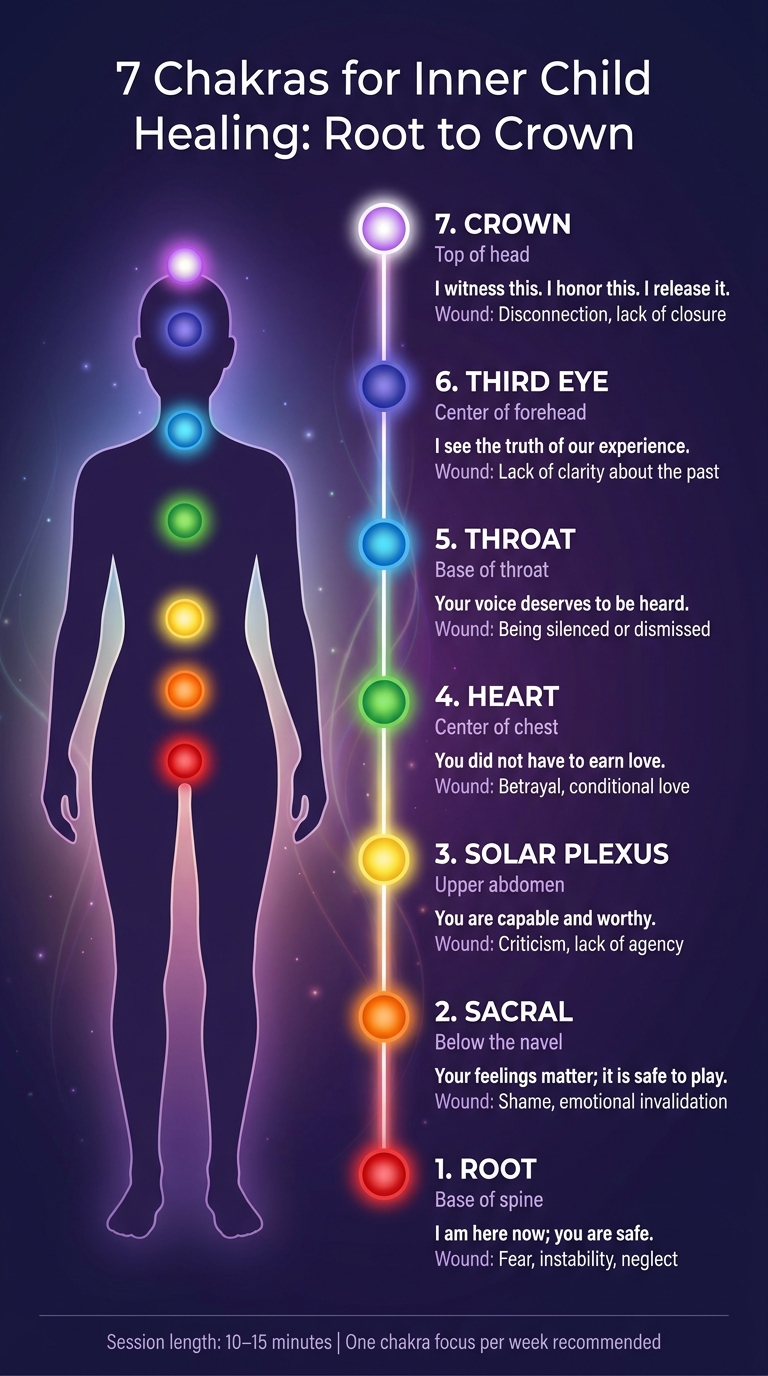
7 Chakras for Inner Child Healing: A Root-to-Crown Guide
Use the safe container you just built to move slowly from root to crown. Take your time. There’s no need to rush this.
Set an Intention and Meet Your Younger Self
Start with a simple breathing pattern: inhale for 4 counts, hold for 4, exhale for 4, hold for 4. This can help you settle before you begin. Then choose one short, present-tense intention, such as I am here to listen or I offer you compassion.
Next, picture your younger self in your safe place. Let the image come gently. Then ask, What do you need right now?
Root to Heart: Safety, Feelings, Self-Worth, and Love
At each center, place a hand on the part of the body linked with it. As you breathe in, imagine the chakra color growing brighter.
| Chakra | Body Area | Color | Supportive Phrase |
|---|---|---|---|
| Root | Base of spine | Red | I am here now; you are safe. |
| Sacral | Below the navel | Orange | Your feelings matter; it is safe to play. |
| Solar Plexus | Upper abdomen | Yellow | You are capable and worthy. |
| Heart | Center of chest | Green | You did not have to earn love. |
Move from root to heart at a gentle pace. Pause at each center for a moment and notice what comes up in your body and your feelings.
When the lower chakras feel more steady, move upward to voice, insight, and closure.
Throat to Crown: Expression, Inner Truth, and Closing the Session
- Throat chakra (blue, base of throat) Place a hand lightly at your throat. Ask your younger self if there was something they needed to say that no one heard. You don’t have to say it out loud. Just notice it and let it be known inside. Offer the phrase: Your voice deserves to be heard. If your throat feels tight, breathe gently into it.
- Third eye (indigo, center of forehead) Rest your attention between your eyebrows. This center can help you see your childhood from a broader view. Ask: What do I understand now that my younger self couldn't? Offer: I see the truth of our experience.
- Crown chakra (violet or white, top of head) Bring your attention to the top of your head to begin closing the session. Thank your younger self for trusting you today. Then say, aloud or silently: I witness this. I honor this. And I choose to release it now.
Open your eyes. Feel your feet on the floor. Look around the room. Take a sip of water. Then pause and choose one simple intention to carry with you.
How to Choose Crystals That Match Your Chakra Focus
Use crystals as optional anchors for the chakra you’re already working with. A simple way to start is to match the crystal’s color to the chakra you want to focus on. You can use one stone for each chakra, or just one stone that fits the center you’re opening during a session. This is a great way to begin a Chakra-Meditation für Einsteiger.
| Chakra | Color | Recommended Crystals | Focus |
|---|---|---|---|
| Root | Red / Black | Red Jasper, Garnet, Black Tourmaline | Safety, stability, grounding |
| Sacral | Orange | Carnelian, Orange Calcite, Sunstone | Emotional flow, joy, creativity |
| Solar Plexus | Yellow | Citrine, Tiger's Eye, Yellow Calcite | Confidence, personal power |
| Heart | Green / Pink | Rose Quartz, Aventurine | Compassion, forgiveness, love |
| Throat | Blue | Amazonite, Turquoise | Expression, speaking your truth |
| Third Eye | Indigo | Amethyst, Labradorite | Intuition, broader perspective |
| Crown | Violet / Clear | Amethyst, Clear Quartz | Clarity, spiritual connection |
A few pairings tend to be pretty intuitive. Red and black stones are often used for root work, while orange stones fit sacral practices. Yellow stones are commonly linked with the solar plexus, green and pink with the heart, blue with the throat, indigo with the third eye, and violet or clear stones with the crown.
Carnelian is a good example of how one crystal can sit between two centers. It can support both root and sacral work: redder pieces lean more root, while brighter orange tones lean more sacral. If you’re torn between a few stones, go with the one that feels most in sync with what you need that day.
Next, place those crystals in jewelry, sets, or around your space.
Ways to Use Crystal Jewelry, Sets, and Home Tools in Your Practice
Once you know which chakra you want to work with, pick the format that helps you stay present. You can wear the stone, hold it, or keep it close by. The best choice is the one that fits your session and feels easy to use.
Wearing crystal jewelry is one of the simplest options. A bracelet or ring keeps the stone with you during the session and after it ends. For root and sacral work, bracelets and rings are easy to wear the whole time. If you don't want that much direct contact, you can hold the stone instead.
Holding a stone during meditation gives you a physical point of focus. If your mind starts to wander, the feel of the stone in your hand can bring you back. That can help a lot during emotional inner child sessions, where staying present is the whole game.
As Conscious Items puts it:
"The presence of Carnelian stone can help you trust yourself, your perceptions, and your decisions."
For your home setup, a Selenite lamp can help define the space. It can also support a calm mood around nearby crystals. Add soft lighting, and the room can feel more grounded and supportive.
Whatever format you choose, put ethically sourced pieces first as you build your routine. Conscious Items offers ethically sourced crystal jewelry, healing lamps, crystal sets, and home accessories you can use in this practice.
Why Ethical Sourcing Matters in Spiritual Practice
Ethical sourcing matters because inner child work is built on safety, trust, and care. If your tools come from exploitative or harmful supply chains, that clashes with the values behind the practice. So once you know which stones match your chakra focus, it makes sense to source them with the same level of intention.
Choose genuine gemstones with natural variation. Small inclusions and shifts in color are normal. In fact, those details often help separate a real stone from an imitation.
Conscious Items offers ethically sourced, genuine gemstone jewelry and tools, including bracelets, necklaces, rings, crystal sets, healing lamps, and home accessories. Each purchase supports tree planting. From there, pick the piece that best fits how you want to use it during your session.
Bringing the Practice into Everyday Life
After each session, use small daily practices to keep the work part of your life. With inner child chakra work, consistency matters more than intensity. A five- to 10-minute session is usually much easier to keep up than the occasional long one. Those short, regular check-ins also help you spot how root, sacral, heart, or throat themes show up in everyday moments.
Journal What Came Up After Each Session
Right after a session, write a few plain, honest notes. Skip the analysis for now. Just record what happened.
Pay attention to:
- which chakra felt most active
- what emotions came up
- where you felt tension or heaviness in your body
- what messages or needs surfaced from your inner child
Useful prompts include: "What emotions did I see in my younger self today?" and "What did this child need that wasn't available at the time?"
Over time, these notes can show patterns you may not notice in the moment. They can also make next week’s chakra focus much easier to choose.
Build a Simple Weekly Ritual You Can Keep Up
A 10-minute check-in can be enough to stay on track. Pick one chakra focus per week instead of trying to handle everything at once, such as Root for safety or Sacral for play.
Keep the ritual simple. Use a small opening and closing cue, like lighting a candle at the start and blowing it out at the end. That small act tells your mind and body: this time matters.
It also helps to connect the practice to something you already do. For example, take three deep breaths before checking your phone, or say a short affirmation while making your morning coffee. You can set up a weekly "inner child date" too - drawing, eating a nostalgic food, or spending time in nature - to care for the playful side of the work.
That way, the practice doesn’t stay stuck in one session. It starts to live alongside the rest of your day.
Conclusion
Healing deepens through small daily actions that reinforce safety, expression, and self-trust. The goal is integration: daily actions that show your inner child you are a steady inner support.
FAQs
How do I know which chakra to start with?
Start with the root chakra and move upward to the crown to support balanced energy flow.
You can also pick based on how you feel. Anxiety, restlessness, or feeling ungrounded can point to the root. Grief or isolation may connect more with the heart. Trouble with self-expression often shows up around the throat.
Because childhood trauma often affects the lower chakras, starting there can help build a stronger base for healing.
What should I do if emotions feel too intense?
If emotions feel too intense, see them as natural protective responses, not obstacles. Pause the practice and ground yourself with three slow, deep breaths while focusing on the soles of your feet.
You can also shift your attention back and forth between the activated area and a neutral or pleasant part of your body, keep a comforting object nearby, or do the practice in smaller doses. If things start to feel overwhelming, put safety first and keep a crisis line or your therapist’s contact information close at hand.
Can I do inner child chakra work without crystals?
Yes. Crystals can help with energy alignment, but you don’t need them for inner child chakra work.
You can use:
- Vocal toning, humming, or chanting
- Visualization with chakra colors and hand placement
- Meditative journaling, painting, dancing, time in nature, or affirmations
