


If I want a crystal altar that works, I don’t start with more stones. I start with the right layout.
This guide boils the article down to 5 clear altar patterns, each tied to a specific meditation goal: clarity, chakra balance, elemental balance, unity, and compassion.
Here’s the short version:
- I use Centered Clarity when I want one clear focal point.
- I use Chakra-Aligned Vertical when I want a root-to-crown setup with 7 stones.
- I use Directional Elemental when I want 4 directions plus 1 center stone.
- I use Circular Mandala when I want a ring-based pattern with 8, 12, or 16 segments.
- I use Heart-Centered Compassion when I want a softer setup for self-love and forgiveness.
A few setup rules matter more than anything else:
- Leave about 4 in. of open space around the layout.
- Use one main anchor stone.
- Build with 3 height levels: 1–2 in., 3–5 in., and 8–12 in.
- Keep stones out of direct sunlight so pieces like amethyst and rose quartz don’t fade.
- For short sits of 15–20 minutes, I can scale any layout down to just 1 stone or 5–7 stones total.
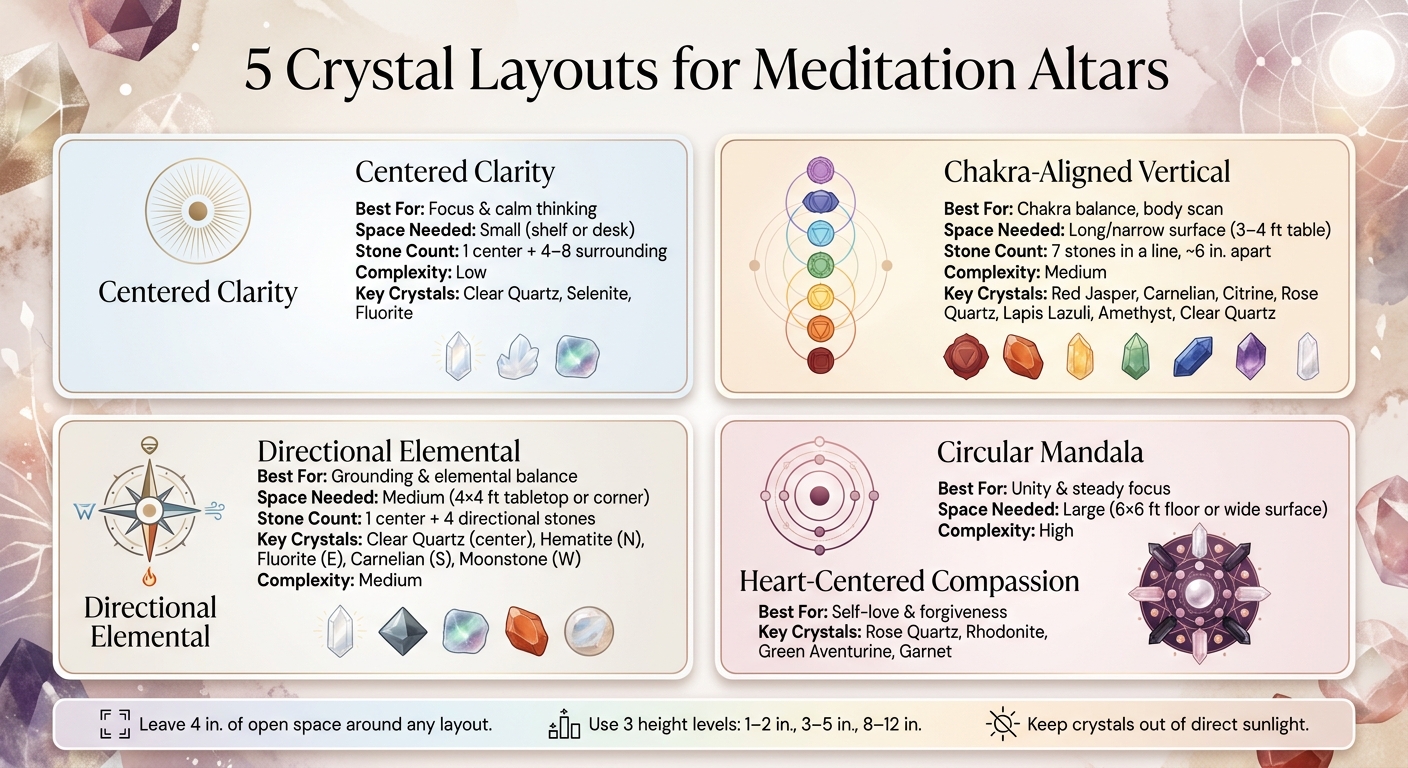
5 Crystal Layouts for Meditation Altars: Quick Comparison Guide
Quick Comparison
| Layout | Best For | Space Need | Stone Count / Shape | Best Fit |
|---|---|---|---|---|
| Centered Clarity | Focus, calm thinking | Small | 1 center + 4–8 around | Shelf, desk, small altar |
| Chakra-Aligned Vertical | Chakra work, body scan | Long surface | 7 in a line | Table or floor |
| Directional Elemental | Grounding, balance | Medium | 1 center + 4 directions | Corner or tabletop |
| Circular Mandala | Unity, steady focus | Large | Center + rings | Floor or wide surface |
| Heart-Centered Compassion | Self-love, forgiveness | Small to medium | Center + curved support stones | Vanity, shelf, tabletop |
What stands out most is this: space and intention decide the layout. If I have a small surface, I keep it simple. If I have more room, I can build a ring or floor pattern without crowding the altar.
sbb-itb-cb05739
How to Prepare Your Meditation Altar for Crystal Layouts
Pick a surface that feels calm, stays easy to see, and gives you enough room to reach your crystals during meditation.
Choose a Quiet, Stable Surface
A nightstand, side table, or shelf can all work well. Go with a spot away from high-traffic areas, and make sure the surface is flat and level so crystals don’t roll or tip over.
Skip direct sunlight too. Stones like amethyst and rose quartz can fade over time. It also helps to keep the altar away from routers and other electronics, since many people feel those devices disrupt the calm of the space.
Clear Visual Clutter Before Placing Crystals
Before you place any crystals, remove unrelated items from the area. Give the arrangement about 4 in. of open space on each side so it stays easy to read and doesn’t feel cramped.
Set the Space with a Simple Ritual
A small ritual can help signal that the space is ready. That might be smoke cleansing, a few slow breaths, a spoken intention, or the sound of a bell.
Once the area feels clear, you can move on to the layout itself.
Follow Basic Layout Rules for Balance
Use the same setup across all five layouts: one focal stone, balanced groupings, and a mix of heights. Odd-number groupings, such as 3 or 5 stones, tend to look more natural.
For height, aim for three levels:
- Tall: 8–12 in.
- Medium: 3–5 in.
- Low: 1–2 in.
This gives the altar more depth and keeps the layout from looking flat. If your crystals are close in size, small blocks or risers can help create that shape. Once the structure is in place, match the stones to the purpose of the meditation.
Choose Crystals Based on Your Meditation Goal
Pick stones that fit the intention behind the layout. For example, use clear quartz for clarity, amethyst for calm, rose quartz for compassion, black tourmaline for grounding, and citrine for motivation.
With the altar set, the first layout starts by placing clarity at the center.
1. Centered Clarity Layout
This layout puts one stone at the center of the altar to help steady your thoughts and narrow your focus. It works well when you're trying to get clear on a choice, sort through mental clutter, or calm a mind that keeps looping through stress. Start with a single focal stone from a healing crystal starter kit, then build around it with a simple shape.
Primary Intention
Use this layout when you want one clear focal point during meditation.
Crystal Placement Pattern
Place the center stone first. Then set the surrounding stones at even distances so your eye stays drawn to the middle. A ring or square of 4 to 8 smaller stones works well around the center stone.
After placing them, trace the connections with a clear quartz wand to reinforce your intention.
Best Altar Size
An 8- to 12-inch base gives the center stone and the surrounding stones enough space without making the layout feel cramped.
Suggested Crystal Types
| Role | Crystal | Why It Works |
|---|---|---|
| Center (Anchor) | Clear Quartz point | Amplifies intention and supports clarity |
| Center (Anchor) | Selenite tower | Supports cleansing and mental clarity |
| Surrounding stones | Fluorite | Helps with focus and decision-making |
| Surrounding stones | Sodalite | Encourages rational thinking |
| Surrounding stones | Blue Lace Agate | Brings a sense of peace |
Choose the center stone first. Then pick surrounding stones that support focus and a calm state of mind.
2. Chakra-Aligned Vertical Layout
If you want a layout with more structure, use a chakra-aligned vertical line. In this setup, you place seven crystals in one straight row, with one stone for each chakra. It works well when you feel off-center, want more harmony during yoga, or plan to move through a body-scan meditation.
Primary Intention
To support chakra balance from root to crown.
Crystal Placement Pattern
Place the root stone at the bottom, then build upward. Leave about 6 in. between each crystal. Once the line is set, touch each stone from crown to root, or trace the full row with a clear quartz point. Then sit or lie down so your spine lines up with the crystals.
Best Altar Size
A 3- to 4-foot tabletop works well. If you're setting this up on the floor, use about a 6-by-6-foot space.
Best Crystals
| Chakra | Best Stones | Focus |
|---|---|---|
| Root | Red Jasper, Hematite, Black Tourmaline | Grounding and stability |
| Sacral | Carnelian, Orange Calcite, Sunstone | Creativity and emotional flow |
| Solar Plexus | Citrine, Tiger's Eye, Yellow Aventurine | Confidence and personal power |
| Heart | Rose Quartz, Green Aventurine, Rhodonite | Compassion and emotional balance |
| Throat | Blue Lace Agate, Aquamarine, Sodalite | Communication and expression |
| Third Eye | Lapis Lazuli, Amethyst, Labradorite | Intuition and insight |
| Crown | Clear Quartz, Selenite, Lepidolite | Spiritual connection |
If you want something softer and less linear, the next layout moves energy outward instead of straight up.
3. Directional Elemental Layout
Unlike a vertical chakra layout, this pattern sends energy outward in four directions. You place one stone in the center and one at each cardinal point so Earth, Air, Fire, and Water surround the altar. The idea is simple: build a balanced energy field around your meditation space.
Primary Intention
To bring Earth, Air, Fire, and Water into balance and create a contained energy field for meditation or new moon rituals.
Crystal Placement Pattern
You can use a compass if you want the layout lined up with magnetic North, East, South, and West. To link the stones, trace a line from each outer stone back to the center with a clear quartz point or crystal wand. You can also gently touch each stone as you set your intention.
Best Altar Size
A 4×4-foot corner works well for a smaller setup. If you want a full floor layout, use at least 6×6 feet.
Suggested Crystal Types
| Direction | Element | Suggested Crystals |
|---|---|---|
| Center | Ether / Spirit | Clear Quartz, Selenite, Moldavite |
| North | Earth | Hematite, Black Tourmaline, Red Jasper |
| East | Air | Fluorite, Sodalite, Blue Lace Agate |
| South | Fire | Carnelian, Sunstone, Citrine |
| West | Water | Moonstone, Aquamarine, Rose Quartz |
If you want something more fluid and visually striking, the next layout takes a completely different shape.
4. Circular Mandala Layout
If you want a layout that feels more complete and self-contained than a directional grid, a circle is a strong pick. The circular mandala layout forms a closed, symmetrical field that helps with focus, unity, and a sense of completion.
Primary Intention
This layout is meant to support wholeness, balance, and steady focus. Its geometric symmetry slows the eye down and encourages more deliberate attention, which can help bring awareness back to the breath and the center of the altar.
Crystal Placement Pattern
Begin with an anchor stone at the exact center. A sphere, pyramid, or large generator works well. Then place supporting crystals in concentric rings that move outward. To keep the layout even, divide the circle into 8, 12, or 16 equal segments.
To activate the layout, use a Clear Quartz or Selenite wand to trace each ring from the center outward. That motion helps reinforce the concentric structure.
Best Altar Size
A 4×4-foot corner works for a small circle. If you want larger rings, plan for a 6×6-foot surface or room.
Suggested Crystal Types
| Ring Position | Role | Suggested Crystals |
|---|---|---|
| Center | Anchor Stone | Clear Quartz sphere or pyramid, Amethyst cluster, Selenite tower |
| Inner Ring | Supporting Stones | Rose Quartz, Amethyst, Fluorite (matched for symmetry) |
| Outer Ring | Perimeter Stones | Black Tourmaline, Citrine, small tumbled pieces |
To keep the layout from feeling crowded, limit the full arrangement to 5–7 pieces and stick to 2–3 colors max.
If you want something less centered on symmetry and more centered on care, the next layout shifts toward compassion.
5. Heart-Centered Compassion Layout
Unlike the mandala layout, this one leans into warmth more than perfect symmetry. The heart-centered compassion layout is built around self-love, forgiveness, and emotional warmth. It works well when you want to practice self-compassion, nurture forgiveness, or bring harmony back into a relationship that feels a little off.
Primary Intention
If you want a softer, more personal pattern, shift the focus from symmetry to the heart. This layout supports heart-centered meditation, self-compassion, forgiveness, and emotional warmth.
Crystal Placement Pattern
Place a large rose quartz sphere or generator at the center. Then curve the supporting stones around it in a gentle heart shape. Put rhodonite on the left, green aventurine on the right, and garnet near the base to help keep the layout grounded.
Best Altar Size
This layout fits nicely on a tabletop, vanity, or shelf.
Suggested Crystal Types
| Crystal | Role in Layout |
|---|---|
| Rose Quartz | Central anchor for unconditional love and emotional healing |
| Rhodonite | Supports forgiveness and emotional balance |
| Green Aventurine | Promotes heart chakra harmony and emotional growth |
| Garnet | Grounds and stabilizes the layout |
You can also add a pink candle or a few rose petals near the arrangement.
This layout works best when emotional tone matters more than strict symmetry.
Quick Comparison of All 5 Layouts
Use this quick comparison to pick the layout that fits your altar space and meditation aim. The table below lets you scan the purpose, space needs, and crystal style fast.
| Layout | Primary Intention | Space Required | Complexity | Typical Crystals | Best Formats |
|---|---|---|---|---|---|
| Centered Clarity | Mental focus & clarity | Small (shelf or desk) | Low | Clear Quartz, Selenite | Central points, towers, spheres |
| Chakra-Aligned | Energetic balance | Narrow/vertical | Medium | Red Jasper, Lapis Lazuli | Tumbled stones, chakra sets, small points |
| Directional Elemental | Grounding & protection | Medium (tabletop) | Medium | Black Tourmaline, Carnelian | Raw chunks, points, four directional stones |
| Circular Mandala | Unity & wholeness | Large (floor mat or wide surface) | High | Clear Quartz, Amethyst | Grids, clusters, master sphere or pyramid |
| Heart-Centered Compassion | Emotional healing & self-love | Small to medium (vanity or shelf) | Low | Rose Quartz, Rhodonite | Heart-shaped stones, palm stones, clusters |
In many cases, space is the main deciding factor. Smaller surfaces tend to work best for Centered Clarity and Heart-Centered Compassion, while a broader setup is a better match for Circular Mandala.
A few format notes can make the choice easier:
- Tumbled stones fit all five layouts.
- Points or generators work well when you want a stronger sense of focus.
- Heart-shaped stones and palm stones are a natural fit for Heart-Centered Compassion.
If you like a layout but need to scale it up or down, the next section shows how to adjust it without starting over.
How to Adjust a Layout Without Starting Over
You don’t need to rebuild a layout from scratch to change how it works. A few small edits can shift the whole feel.
Swap the anchor stone if you want to change the layout’s focus. For example, switching amethyst to citrine changes the focus from calm to abundance.
If the layout starts to feel crowded, take away the outer stones until only 5–7 stones are left. That keeps the setup easy to read while still holding onto the original structure.
For 15–20 minute sessions, keep things simple. Any of the five layouts can be cut down to just the central anchor stone or even a single palm stone.
You can also change the mood of a layout through height and spacing alone. Set the anchor stone on a small block or pedestal, or move the stones a bit farther apart to make the layout feel more open.
Conclusion
Each layout works best when it fits your space and your intention. The right crystal layout depends on what you want to do, how much room you have, and how you like to practice.
Start simple. Use one main crystal first, then add more only if they support the purpose of the layout. In most cases, a small, focused arrangement of carefully chosen stones works better than a crowded setup.
The best altar is the one you can return to consistently.
FAQs
Which layout is best for beginners?
For beginners, the simple circle grid is the easiest place to start. It uses one central focus stone, with six to eight stones around it at about the same distance.
Two other good starter picks are the four directions layout and the triangle of manifestation. They work well because they’re easy to set up and don’t call for exact measurements or tricky geometry.
Can I mix crystal shapes in one layout?
Yes. Mixing shapes like points, clusters, and freeforms can make your altar layout feel more dynamic and more interesting to look at.
You can also mix textures and sizes, like small tumbled stones with larger raw pieces. There are no strict rules here. The best layout is the one that matches your intentions and feels right to you.
How often should I change my altar layout?
Update your altar layout when your goals, focus, or personal needs shift. Some people refresh their crystal setup each month to match their current intentions, but there’s no fixed schedule.
You can also change or deactivate the layout when your intentions shift. Checking in with your altar on a regular basis helps keep it clear, purposeful, and supportive of your meditation practice.
