


If you want the short answer: moon-phase crystal work is mostly symbolic, while research only shows limited support for lunar effects on people.
What I see in this article is a simple split:
- Science: some sleep studies found people slept about 20 minutes less near the full moon, but large population reviews do not show a steady pattern for things like crime, ER visits, or birth rates.
- Spiritual use: people often match crystals to the moon cycle for intention, action, clarity, and release.
- Best way to use it: treat crystals as focus tools, not medical care.
Here’s the cycle in plain language:
- New moon: set goals with crystals for your new moon rituals like Moonstone, Labradorite, or Black Obsidian
- Waxing moon: work on growth with Citrine, Green Aventurine, Carnelian, or Sunstone
- Full moon: reflect and clear with Selenite, Amethyst, Moonstone, or Clear Quartz
- Waning moon: let go and rest with Black Tourmaline, Smoky Quartz, Blue Lace Agate, or Obsidian
A few facts stand out. One lab study reported 5 minutes longer to fall asleep, 20 minutes less total sleep, and 30% less deep-sleep activity around the full moon. At the same time, a survey found 63% of people said they noticed mood or sleep shifts during full moons. That does not prove moon energy claims. It just shows that belief, ritual, and personal experience still play a big part.
If I had to sum it up in one line, it would be this: use moon-phase crystal practice as a personal ritual for structure and reflection, not as proof that the moon controls behavior.
NEW MOON Crystal Grid Ritual 🌙 (Set New Moon Intentions)
sbb-itb-cb05739
What Research Says About Moon Phases, Sleep, Mood, and Behavior
The evidence is mixed. Big population studies don’t show a steady moon-related pattern, even when researchers check things like ER visits and crime. Smaller lab studies point more often to sleep as the area where lunar effects show up. That gap between broad public data and what people feel in their own lives helps explain why lunar beliefs still hold a place in spiritual practice.
Large Reviews vs. Smaller Studies: What the Data Shows
In 2013, Christian Cajochen's team reported that people in a controlled lab setting took 5 minutes longer to fall asleep, slept 20 minutes less, and showed 30% less deep-sleep activity during a full moon. In 2021, Leandro Casiraghi and colleagues tracked sleep in urban and rural communities, finding that sleep shortened by roughly 20 minutes in the days leading up to a full moon regardless of artificial light exposure. A 2023 global survey by the Sleep Cycle app added another layer: 63% of respondents said they noticed changes in mood or sleep during full moons.
| Study Type | Typical Findings | Strengths | Limitations |
|---|---|---|---|
| Large Reviews and Population Data | Little to no steady support for links to crime, ER visits, or birth rates | Massive sample sizes; shows broad societal trends | Looking back at old data limits person-by-person conclusions |
| Controlled Sleep Studies | Shorter sleep and less deep sleep | High precision; cuts out outside variables like artificial light and temperature | Small sample sizes; lab settings may not match day-to-day stress |
| User Surveys | High self-reported correlation (63%) between moon phases and mood/sleep | Reflects lived experience and day-to-day perception | Subjective; prone to confirmation bias and volunteer bias |
Key Takeaway: Cautious Evidence, Not Clear Proof
What the data points to is a subtle effect, if there is one at all, and it doesn’t seem to hit everyone the same way. The sleep results from controlled studies stand out, but they come from small groups in lab settings, so it’s hard to say they apply to the public at large. Some researchers have proposed an internal "circalunar" rhythm, but it remains unproven. Since the research is still inconclusive, many traditions lean on symbolic lunar meanings instead - and those meanings shape how crystals are used in each moon phase.
How Spiritual Traditions View Moon Energy and Crystal Use
Because the research is still inconclusive, many practitioners lean on symbolic lunar meanings instead. So, with science set aside for a moment, this part looks at the meanings people often connect to each moon phase.
Common Meanings Assigned to Each Moon Phase
Practitioners tend to map meaning onto the moon based on what they can see in the sky.
The new moon is often seen as a blank slate. It's the phase people link with setting intentions and turning inward. As the moon shifts into the waxing moon, the focus moves toward action and building momentum. The full moon is treated as the high point of the cycle - a time for clarity, gratitude, and emotional release. During the waning moon, people often focus on letting go and clearing space. The last stretch before the cycle begins again, sometimes called the dark moon, is tied to deep rest and reflection.
Why Crystals Are Paired With Lunar Rituals
Crystals often act as physical anchors in lunar practice. Put a stone on your desk, and it can become a simple daily reminder of what you meant to focus on when you picked it.
In practice, some people set an intention with a crystal during the new moon. They might hold a stone such as Moonstone or Labradorite and speak a clear intention into it. Then, under the full moon, they may clear or recharge that crystal by leaving it on a windowsill overnight. Crystals also show up in meditation, where they're placed on the Heart or Third Eye Chakra to help with focus and reflection. As author and philosophy researcher Jeff O'Connor puts it:
"The integration of astrology and crystals represents a rich synthesis of ancient divinatory traditions adapted for modern spiritual seekers."
A ritual can give structure to a practice. It can make intentions easier to repeat, track, and reflect on. That symbolic framework also shapes which crystals people choose for each lunar phase.
Which Crystals to Use for Each Moon Phase
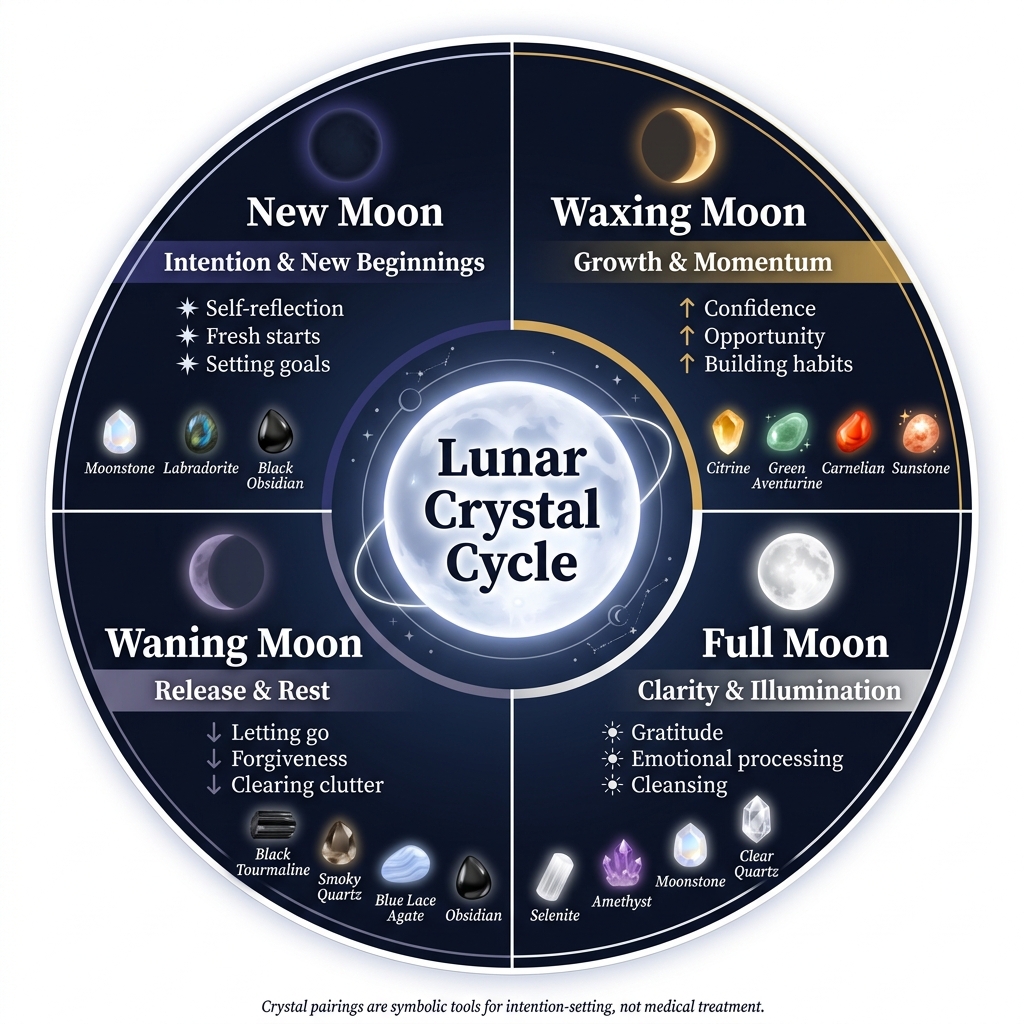
Moon Phases & Crystal Pairings: A Complete Cycle Guide
These crystal pairings line up with the lunar cycle. The idea is simple: set intentions, build momentum, seek clarity, then let go.
New and Waxing Moon: Crystals for Intention and Growth
During the new moon, people often turn inward. It’s a good time for fresh starts and quiet goal-setting. Moonstone fits this phase well for beginnings, Labradorite is often used for inner sight, and Black Obsidian is a go-to for protection.
The waxing moon is about movement. You’ve planted the seed, and now you’re feeding it. Citrine is often linked with manifestation, Green Aventurine with abundance, Carnelian with creativity, and Sunstone with momentum.
Full and Waning Moon: Crystals for Clarity, Release, and Rest
The full moon tends to be tied to clarity and emotional light being shined on whatever’s been building. Selenite is often used for clearing, Amethyst for intuition, Moonstone for fulfillment, and Clear Quartz for cleansing.
A practical note here: bring crystals inside before direct morning sun. Some stones, including Amethyst, can fade.
The waning moon shifts the focus toward release, rest, and tying up loose ends. Black Tourmaline and Smoky Quartz are often used for release and protection, Blue Lace Agate for communication, and Amethyst or Obsidian for closure.
Moon Phase Comparison Table
The table below condenses the phase, purpose, and most common crystal pairings.
| Moon Phase | Spiritual Themes | Common Intentions | Frequently Used Crystals |
|---|---|---|---|
| New Moon | Emergence, potential, initiation | Self-reflection, fresh starts, setting goals | Moonstone, Labradorite, Black Obsidian |
| Waxing Moon | Growth, momentum, expansion | Confidence, opportunity, building habits | Citrine, Green Aventurine, Carnelian, Sunstone |
| Full Moon | Illumination, fulfillment, peak energy | Gratitude, emotional processing, cleansing | Selenite, Amethyst, Moonstone, Clear Quartz |
| Waning Moon | Release, grounding, integration | Letting go, forgiveness, clearing clutter | Black Tourmaline, Smoky Quartz, Blue Lace Agate, Obsidian |
How to Choose Crystals and Build a Moon Practice
Using Zodiac Signs, Birthstones, and Personal Symbolism
Zodiac-based crystal pairings - like Aries with Carnelian or Cancer with Moonstone - are symbolic matches, not scientific rules. It helps to treat zodiac signs and birthstones by month as a second layer, after you choose based on the moon phase.
From there, go with the stone that feels most in sync with your sign, your story, or the meaning you want to work with. There’s no need to force a fixed formula. What matters most is sticking with the practice.
A Simple Lunar Ritual Framework With Conscious Items
Once you have a stone, keep the ritual simple. Set an intention at the new moon, take action during the waxing phase, reflect and release at the full moon, and rest during the waning phase.
Physical objects can make the routine easier to return to. A crystal bracelet or necklace from Conscious Items can act as a daily cue for your intention, while its lamps or home accessories can help shape a small ritual space that feels calm and personal.
What to Take Away From This Article
Science offers limited and cautious support for broad lunar effects on human biology. Sleep studies have found changes around the full moon, but that does not confirm every claim tied to moon energy. At the same time, spiritual traditions offer a clear way to work with intentions across a cycle that humans have tracked for at least 30,000 years.
The most useful approach makes room for both evidence and symbolism. In that setup, crystals work best as symbolic tools. Use them to focus your intention, keep the ritual easy to follow, and stay flexible.
FAQs
Do moon phases affect crystal energy?
In many spiritual practices, moon phases are said to shape crystal energy by setting a natural rhythm for cleansing, charging, and intention-setting.
The New Moon is often linked to new intentions. The waxing moon is tied to growth. And the Full Moon is commonly used for deep cleansing and letting go of negative energy. When people match crystals to each lunar phase, the idea is to bring their intentions into step with these natural cycles.
How do I choose the right crystal for my moon phase?
Match your crystal to the moon phase you’re working with. It’s a simple way to line up the stone’s vibe with the kind of energy that phase is known for.
- New Moon: labradorite, moonstone, or black obsidian for fresh intentions
- Waxing Moon: citrine, green aventurine, or carnelian for growth and abundance
- Full Moon: clear quartz, selenite, or amethyst for cleansing and charging
- Waning Moon: smoky quartz, black tourmaline, or apache tear for release
Can I use moon rituals without believing in moon energy?
Yes. Moon rituals can still be useful even if you don't believe in moon energy.
They can act as psychological anchors. In plain English, they give you a set moment to pause, sort through your intentions, and check in with your emotions and goals.
Using the lunar cycle as a simple framework can also help with:
- self-reflection
- mindful routines
- personal growth
Think of it like using a calendar, a journal prompt, or New Year's goals. The moon doesn't have to hold any special power for the ritual to matter. What counts is the space it creates for attention, meaning, and habit.
