


Most crystal listings tell you how a stone looks. Very few tell you where it came from, who handled it, or what was done to it.
When I shop for crystals with more care, I keep it simple: I ask where the stone came from, whether it was treated, and who handled it before it reached the seller. If those answers are vague, missing, or change from one message to the next, I move on.
Here’s the short version:
- Ethical shopping is about the supply chain, not polish, color, or grade.
- A crystal may pass through five hands before sale: miner, lapidary, exporter, importer, and retailer.
- Main risks include unsafe labor, child labor, low pay, land damage, water pollution, and weak traceability.
- Country of origin is the bare minimum. Region, mine, or locality is better.
- Sellers should also disclose if a stone was dyed, heated, coated, stabilized, or irradiated.
- Low prices can be a warning sign when stones look too uniform.
- Stock photos and spiritual language are not proof of sourcing.
- Since there is no universal crystal label, I rely on plain seller answers, listing details, and consistency across products.
What I look for is simple: clear origin, clear treatment disclosure, and plain answers. If I can’t get those, I don’t buy.
This guide boils the topic down to the risks, the seller checks that matter, and the buying habits that help me shop with less harm.
Social, Labor, and Transparency Issues in the Crystal Trade
Labor and Community Risks in Crystal Mining
In parts of Asia and South America, crystal mining has been tied to unsafe working conditions, unfair pay, child labor, and ethnic conflict. That’s the human side of the trade, and it often gets buried under polished marketing.
One big problem is traceability. A crystal can pass through five different hands before it reaches a seller:
- miner
- lapidary
- exporter
- importer
- retailer
At each step, the paper trail can get weaker. Many vendors also avoid sharing supplier names or exact mine locations, which makes labor conditions tough to check. So when a seller makes big sourcing claims, trust alone isn’t enough. Those claims need proof.
Land, Water, and Transport Costs of Crystal Extraction
Crystal extraction can damage land and water, especially in places with limited oversight. Reported harms include soil erosion, water contamination, and deforestation.
The method matters just as much as the place. Large-scale industrial mining tends to leave a bigger ecological footprint than artisanal and small-scale mining (ASM). Surface collecting has the lowest impact because it causes very little habitat disturbance.
There’s another layer here too. Some community cooperatives put mining profits back into local schools and healthcare. So “where did this crystal come from?” is only part of the story. How it was extracted matters too.
Why Crystal Supply Chains Are Hard to Trace
Once crystals move through several middlemen, origin claims often get fuzzy before the buyer ever sees the product. There’s no universal ethical label for crystals, so traceability usually depends on what a seller is willing and able to disclose.
In many cases, the trade leans on vague, hard-to-check language instead of clear sourcing standards. That’s why buyers should look for sellers who can plainly explain:
- what they know
- what they can’t verify
- how they checked the information they do have
That kind of plain-spoken disclosure is a lot more useful than polished claims with no detail behind them.
sbb-itb-cb05739
4 Sustainable, Eco-Friendly & Ethically Sourced Gemstones You Should Know About!
How to Judge Ethical Sourcing Claims
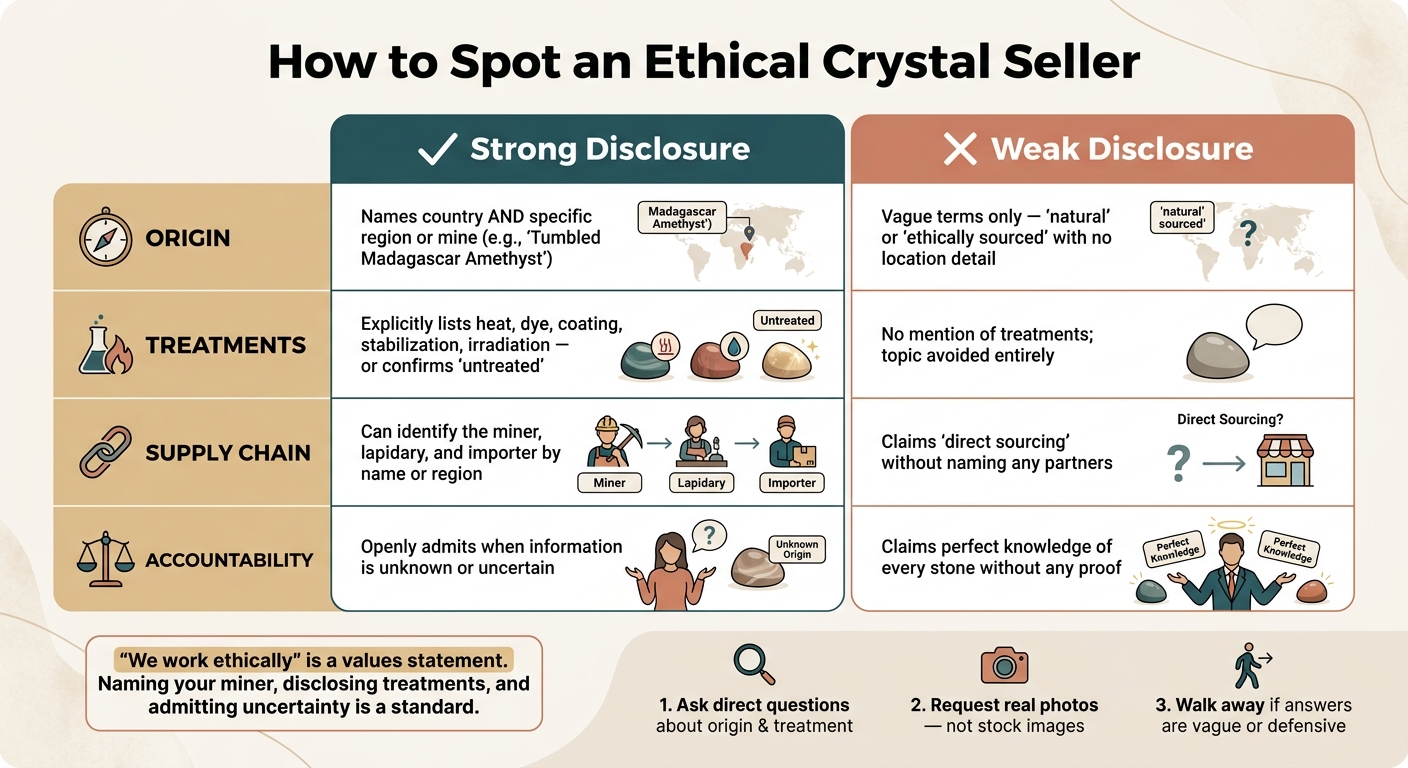
Ethical Crystal Seller: Strong vs. Weak Disclosure Signs
Crystal supply chains are often hard to see clearly. So when a seller makes ethical sourcing claims, the best thing to do is look at the details they can actually name.
Origin Details That Actually Matter
A seller should tell you the country of origin. Better sellers go further and name the region, mine, or locality too. For example, a listing like "tumbled Madagascar amethyst" gives you something specific to check. A listing that only says "natural crystal" or "ethically sourced" doesn't give you much to work with.
Treatment disclosure matters just as much. A seller should say if a stone has been dyed, heated, coated, stabilized, or irradiated. If that information is missing, that's a gap worth noticing.
Signs a Seller Has Real Sourcing Standards
A values statement tells you what a business says it cares about. A sourcing standard shows what it actually does.
"'We work ethically' is a values statement. 'We prioritize small-scale producers, disclose all treatments, and ask about working conditions' is a standard." - Beyond Bohemian
Product photos can tell you a lot too. Real photos of the actual stones help. Stock images make it harder to know what you're buying. And when a seller doesn't know something, the better move is to say that plainly instead of pretending to have all the answers.
| Feature | Strong Disclosure | Weak Disclosure |
|---|---|---|
| Origin | Names country and specific region or mine | Vague terms like "natural" or "ethically sourced" only |
| Treatments | Explicitly lists heat, dye, coating, etc., or confirms "untreated" | No mention of treatments; topic avoided entirely |
| Supply Chain | Can identify the miner, lapidary, and importer | Claims "direct sourcing" without naming any partners |
| Accountability | Admits when information is unknown or uncertain | Claims perfect knowledge of every stone without proof |
Price and Marketing Signals That Deserve Caution
Ethical sourcing can cost more because of fair wages and careful extraction. So if you see very low prices on stones that look unusually uniform, that can point to dyeing, mass production, or mislabeling.
Marketing language is worth watching too. Spiritual framing is fine. But it shouldn't stand in for basic sourcing facts. As Beyond Bohemian puts it:
"A seller who only posts about energy and vibration is teaching you spirituality, not sourcing." - Beyond Bohemian
These signals can help you figure out which sellers are worth a closer look and which ones deserve follow-up questions.
How to Check a Crystal Seller Before You Buy
Once you spot weak disclosure signals, the next step is simple: verify the seller directly.
Questions to Ask About Origin, Labor, and Treatment
Start with the listing. Then follow up with direct questions if anything feels fuzzy.
A solid listing should tell you the country of origin, disclose any treatments, and show photos of the exact piece instead of generic stock images. If you see a vague line like “beautiful high-energy amethyst” instead of something more concrete, like “tumbled Madagascar amethyst,” take note.
If the listing leaves gaps, ask the seller about:
- Origin: The country of origin and how they verify it
- Treatment: Whether the stone was dyed, heated, coated, stabilized, or irradiated
- Supply chain: Who handled the stone from miner to retailer
How to Evaluate the Answers You Get
The reply itself is the test.
What matters most is not whether the answer sounds good. It’s whether the answer is specific and consistent. Clear replies usually show that the seller knows where the stone came from and what happened to it along the way. Vague reassurance, on the other hand, doesn’t say much.
Oddly enough, “we don’t know” can be a better answer than a guess. At least it’s honest. But if a seller dodges the question or gets tense when you ask, that’s a bad sign.
"Defensive responses when you ask basic questions... [tell] you they don't have a good answer." - Beyond Bohemian
If the story changes from one message to the next, or the seller shifts into spiritual talk when you ask about labor or origin, it’s smart to move on.
What Documentation Can and Cannot Prove
If the seller’s answers still aren’t clear, look at what written proof they share.
Most crystals do not come with a widely recognized certification system. So you’ll need to lean on other signals instead: published sourcing standards, supplier disclosure, and treatment details that stay the same across listings and replies.
| Red Flag | Risk Level | What It May Indicate | Best Response |
|---|---|---|---|
| Perfectly uniform stones at unusually low prices | High | Mass-produced, dyed, or mislabeled material | Ask about treatments; compare market rates |
| Defensive or vague answers to direct questions | Critical | Lack of transparency or hidden poor practices | Walk away and prioritize sellers who answer clearly |
| Generic stock photos for unique pieces | Medium | Seller may not have physical possession of items | Request a photo or video of the actual piece |
Lower-Impact Buying Habits and Key Takeaways
Buy Less and Choose Traceable Products
Once you've checked a seller's sourcing claims, the next move is pretty simple: buy less and choose traceable pieces.
That means skipping impulse buys and being more selective about what you bring home. In many cases, smaller stones do the same job at a lower price and with less extraction impact.
And if a stone seems unusually cheap, don't brush it off. Ask why.
Look for Sustainability Beyond the Crystal Itself
Ethical sourcing doesn't stop at the mine. It should show up across the whole purchase, from packaging to clear action on waste and sourcing.
Look for specifics, not fuzzy promises. Good signs include:
- Reusable packaging
- Packaging buy-back programs
- Other clearly stated sustainability actions
Conscious Items offers ethically sourced crystal jewelry, healing lamps, crystal sets, and home accessories made with genuine gemstones; each purchase plants a tree.
Conclusion: The Simplest Way to Shop More Ethically
The simplest approach is also the most useful: buy fewer traceable pieces, ask direct questions, and walk away from vague sellers.
If answers feel slippery or prices look suspiciously low, take that as a warning sign. Crystal supply chains can be hard to trace, so honesty counts for a lot. Sellers who are upfront about what they know, what they don't, and the standards they use are easier to trust than sellers who hide behind spiritual language and stock photos. Choose sellers who disclose their sources and standards.
FAQs
How can I verify a crystal’s origin?
Look for clear, specific details instead of broad marketing claims. Start with the product listing and check the country of origin. Then go a step further and ask for the exact mine, mining region, or cooperative.
A seller you can trust should be able to explain their supply chain in plain language. They may also share chain-of-custody details, like batch IDs or digital passports, that show the crystal’s path from the mine to the shop.
What treatments should sellers disclose?
Sellers should say whether a stone has been treated and spell out exactly what was done.
Ask for written, product-level disclosure for treatments such as heating, dyeing, irradiation, oiling, or coating. That write-up should also state whether any part of the stone was dyed or chemically changed.
If a listing says nothing about treatments, treat that as a yellow flag and ask the seller directly. If the answers feel slippery, or the seller can’t provide records to back things up, that’s a red flag.
Are expensive crystals always more ethical?
Not necessarily. Ethical sourcing - such as fair wages, safety standards, and land restoration - can push a crystal’s price up by 10% to 30%. But a high price by itself does not prove that ethical practices were followed.
On the flip side, very low prices can be a red flag. The smartest way to check is to look at how open the seller is. That means sharing supply chain details, naming the exact mine origin, and clearly disclosing any stone treatments.
