


If I want better visualization, I don’t need 20 stones. I need the right one for the job. This list breaks it down fast: Clear Quartz for clarity, Amethyst for inner sight, Labradorite for dream work, Fluorite for focus, Carnelian for action, Rose Quartz for the heart, and Lapis Lazuli for truth.
Here’s the short version:
- I use Clear Quartz when I want to lock in one goal.
- I pick Amethyst or Labradorite when I want deeper inner images.
- I reach for Fluorite when my mind feels scattered.
- I choose Carnelian when I want momentum.
- I use Rose Quartz for self-love and relationship work.
- I pick Lapis Lazuli when I want honest self-reflection.
A simple pattern runs through all 7 stones: one helps me see, another helps me stay focused, and another helps me feel the intention. The article also covers how to use crystals for meditation, pairing ideas, placement, and one key care tip: do not soak Fluorite in water.
Quick Comparison
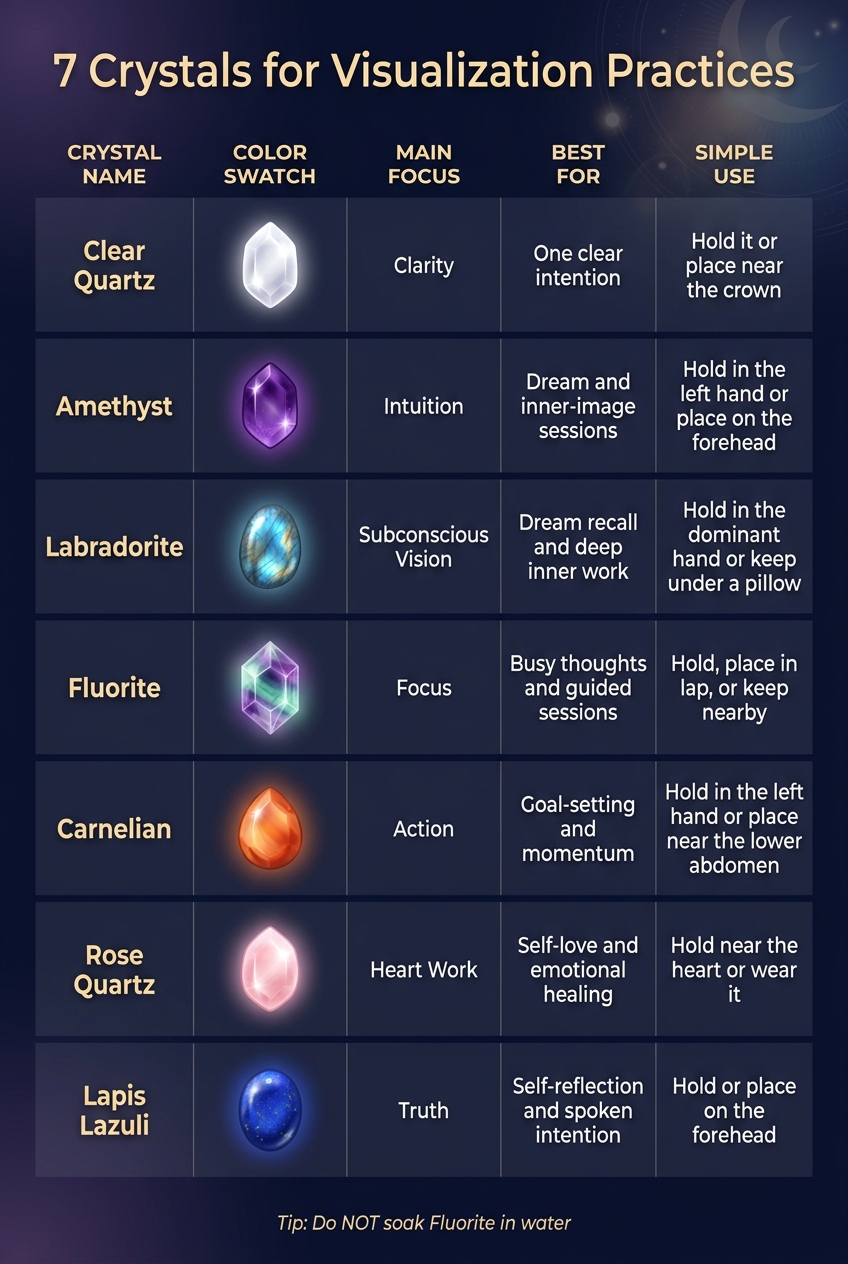
7 Best Crystals for Visualization: Quick Comparison Guide
| Crystal | Main focus | Best for | Simple use |
|---|---|---|---|
| Clear Quartz | Clarity | One clear intention | Hold it or place near the crown |
| Amethyst | Intuition | Dream and inner-image sessions | Hold in the left hand or place on the forehead |
| Labradorite | Subconscious vision | Dream recall and deep inner work | Hold in the dominant hand or keep under a pillow |
| Fluorite | Focus | Busy thoughts and guided sessions | Hold, place in lap, or keep nearby |
| Carnelian | Action | Goal-setting and momentum | Hold in the left hand or place near the lower abdomen |
| Rose Quartz | Heart work | Self-love and emotional healing | Hold near the heart or wear it |
| Lapis Lazuli | Truth | Self-reflection and spoken intention | Hold or place on the forehead |
Bottom line: I’d start with one crystal and learn its meaning, keep sessions short, and pair stones only when the combo helps me stay on track instead of pulling my attention apart.
sbb-itb-cb05739
How to Choose and Use Crystals for Visualization
Start by matching the stone to the state of mind you want to step into. Pick a crystal based on the quality you need most: clarity, intuition, creativity, emotional openness, or focus. Fluorite and Clear Quartz can help support a clear mental image. Labradorite and Amethyst are often linked with the third eye chakra and may help with intuition and inner vision.
Before you use a crystal, cleanse it to clear any leftover energy. You can use smoke, sound, or moonlight for this. One small but important note: do not soak Fluorite. Water can damage it. Once it's cleansed, hold the stone and say a short intention in the present tense, such as "I see my goal clearly" or "I am open to creative insight."
Placement during meditation can shape how the crystal supports your focus. You might hold an intuitive stone like Labradorite in your dominant hand and a clarity stone like Fluorite in your non-dominant hand. Another option is to place a crystal on your forehead at the third-eye position for intuitive visualization, or set one on your lap if you want a steadier, more grounding effect.
Between sessions, keep your crystals in a dedicated spot. A clean shelf or altar works well, and you can arrange them symmetrically. It also helps to refresh your intention on a regular basis. If you want to keep a crystal close during the day, a bracelet or pendant from Conscious Items can make that easy.
1. Clear Quartz
If you want one stone that works with almost any visualization style, start with Clear Quartz. People often reach for it because it can amplify intention, which makes it a strong fit for focused meditation work.
Visualization Support
Clear Quartz is also used for crystallomancy (crystal scrying), which means gazing into a crystal to receive images or insight. During scrying, gaze softly into the crystal and let images appear on their own. Because of that, it works well for sessions built around one clear intention.
Emotional or Energetic Tone
Clear Quartz is linked with mental clarity, heightened awareness, and harmony between the physical, emotional, and spiritual self. It also connects with the crown chakra, which can support expanded awareness.
Best Meditation Use Case
Use Clear Quartz when you want a single stone to hold one specific intention. Before you meditate, hold the stone and say your intention clearly so it can support that focus through the session. It also pairs well with Amethyst if you want a mix of intuition and clarity.
If your visualization leans more toward intuitive imagery than pure amplification, Amethyst is the next stone to look at.
Typical Placement or Form
| Form | Best Use |
|---|---|
| Crystal ball or sphere | Scrying |
| Point | Amplifying a set intention |
| Tumbled stone | Held in hand as a tactile anchor during meditation |
For chakra work, place Clear Quartz near the crown chakra at the top of the head to support expanded awareness.
2. Amethyst
If Clear Quartz works like a broad amplifier, Amethyst is the one to use when your visualization needs to lean into intuition, mental imagery, and spiritual awareness. Its purple color is tied to the Third Eye, which is why many people use it for inner vision and symbolic images. In practice, that makes it a strong pick when you want your session to feel more intuitive and more visually rich.
Emotional or Energetic Tone
Amethyst has a calm, clearing energy that can help quiet mental clutter and improve focus before it muddies your visualization.
Best Meditation Use Case
That clearing effect also makes Amethyst a good fit for dream-focused visualization. It tends to work well when your practice involves connecting with guides, or setting intentions around dream recall and dream interpretation. Before you begin, hold it in your left hand and give your mind a minute to settle. If you want incoming images to feel sharper, it also pairs well with Fluorite.
Typical Placement or Form
| Form | Best Use |
|---|---|
| Tumbled stone or sphere | Hold in your left hand during meditation |
| Raw cluster | Set on a meditation altar |
| Pendant or bracelet | Wear daily for steady support |
For chakra work, place Amethyst at the center of the forehead to support the Third Eye, or at the top of the head to engage the Crown Chakra.
3. Labradorite
If Amethyst helps with soft, intuitive imagery, Labradorite takes things deeper. It’s a good fit for visualization that moves past surface-level instinct and into subconscious images, dream work, and hidden insight. Its flash of color lines up with that long-held link to revealing what sits beneath the obvious.
That’s why it works best when your goal is insight, not just simple clarity.
Visualization Support
Labradorite is a strong choice for symbolic imagery, subconscious insight, and deeper inner vision. It’s also known for a protective feel, which can help you stay locked in during longer meditation sessions.
Emotional or Energetic Tone
Its energy can feel a bit intense. If that happens, pair it with Fluorite to bring in more structure.
Best Meditation Use Case
Labradorite works especially well for sessions centered on lucid dreaming or creative visioning. In plain English, it’s useful when you’re trying to reach beyond your usual thought patterns and see what else is there.
It can support subconscious imagery, dream recall, and new ideas that seem to come out of nowhere. It may also help you hold your intention with more focus. One small but important tip: write down any images or impressions right after meditation. They can disappear fast.
Typical Placement or Form
| Form | Best Use |
|---|---|
| Palm stone | Hold in your dominant hand during visualization |
| Raw or polished piece | Place directly on the Third Eye chakra (center of the forehead) |
| Under pillow | Supports dream recall and lucid dreaming |
4. Fluorite
After Labradorite’s big, dreamlike feel, Fluorite brings things back into place. It’s often called the "Genius Stone" because it helps sort scattered thoughts into mental images you can actually work with.
Visualization Support
Fluorite works best when you need structure. It helps take abstract, slippery intuitive impressions and turn them into clearer mental imagery. If your visualizations tend to feel fuzzy, busy, or hard to hold onto, this is the crystal that can help tighten the picture.
Emotional or Energetic Tone
Its energy feels calm and grounding. That steady tone can help settle racing thoughts during meditation and make it easier to stay with what you’re seeing.
Best Meditation Use Case
Fluorite is a good fit for guided visualizations and creative sessions that call for steady focus. It can also help when you want to journal what you saw before the details slip away. Record any images right after the session.
Typical Placement or Form
| Form | Best Use |
|---|---|
| Purple or rainbow tumbled stone | Place on the Third Eye to sharpen intuitive imagery |
| Palm stone | Hold in your non-dominant hand to anchor focus |
| Tower or sphere | Place in your meditation space to stabilize focus |
| Loose piece | Rest in your lap to stay grounded |
Fluorite is soft, so don’t soak it, and keep it out of long periods of direct sunlight.
5. Carnelian
After Fluorite’s structure, Carnelian brings motion. If your visualization practice needs a push, this stone helps shift an idea from “I want this” to “here’s what I’ll do next.” It works well when you’re picturing a goal and trying to map the next step.
Visualization Support
Carnelian is linked with the Sacral Chakra, the energy center tied to creativity, passion, and personal drive. That makes it a good fit for sessions centered on fresh ideas, forward movement, or starting over with new energy.
Emotional or Energetic Tone
Its energy feels active and expressive, which makes it a strong match for productivity, new projects, and creative momentum.
Best Meditation Use Case
Hold it in your left hand during meditation. You can also place it on a desk or altar to help set a focused space for brainstorming and visualization.
Typical Placement or Form
| Form | Best Use |
|---|---|
| Palm stone | Hold in the left hand during active visualization |
| Bracelet | Wear during meditation as a wearable option |
| Sphere | Place on a desk or altar to support creative energy |
| Lower abdomen | Rest on the lower abdomen during meditation to focus on the Sacral Chakra |
6. Rose Quartz
After Carnelian’s forward-moving energy, Rose Quartz shifts the focus back to the heart. It’s a strong fit for visualizations built around self-love, compassion, and emotional healing.
Visualization Support
Rose Quartz helps ground intentions tied to love, compassion, and emotional balance. That can make visualization feel more gentle, more caring, and a little easier to settle into with self-compassion.
Emotional or Energetic Tone
This stone brings a soft, heart-centered tone to a session. If you want meditation to feel calmer and more open, Rose Quartz is a natural pick.
Best Meditation Use Case
Rose Quartz works especially well in heart-focused sessions, like self-love work, emotional healing, and visualizing healthier relationships. You can hold it while journaling or reflecting to help keep your intention front and center.
For a deeper practice, pair it with Amethyst to deepen the spiritual experience, or with Clear Quartz to amplify heart-centered intentions.
If you want a more truth-centered focus, Lapis Lazuli shifts the emphasis upward.
Typical Placement or Form
| Form | Best Use |
|---|---|
| Tumbled stone | Hold in hand or place on or near the body during meditation |
| Pendant or bracelet | Wear daily as a reminder of your intention |
| Altar piece | Place on a meditation altar to invite love and emotional stability into the space |
| Carved heart or figurine | Use as a visual focal point during heart-centered visualization |
7. Lapis Lazuli
Where Rose Quartz softens intention, Lapis Lazuli brings things into focus with truth. It works well for visualization tied to self-reflection, honest intention, and seeing things as they are.
Visualization Support
Lapis Lazuli supports clear thinking and inner vision. That makes it a good fit when your practice is less about fantasy and more about self-knowledge. Instead of building intentions on wishful thinking, it helps root them in what you know, feel, and mean.
Emotional or Energetic Tone
Lapis Lazuli carries a clear, spiritual tone. It’s often linked to the third eye, crown, and throat chakras, which connect vision, awareness, and the ability to speak your truth.
Best Meditation Use Case
For third-eye or crown-focused meditation, lie down and place the stone on your forehead. Then breathe steadily while keeping your intention in mind. As you settle in, imagine the stone helping your inner vision come into sharper focus.
This tends to work best for sessions built around self-honesty, higher awareness, or intentions you want to say out loud.
Pair it with Amethyst for intuition or Rose Quartz for a softer emotional tone.
Typical Placement or Form
| Form | Best Use |
|---|---|
| Palm stone or pocket stone | Hold during meditation or place on the forehead (third eye) |
| Sphere | Use as a visual anchor in seated meditation |
| Necklace or earrings | Wear daily to keep it close to the upper chakras |
| Altar piece | Keep nearby as a focused reminder of truth-based intention |
The table below compares each crystal by focus and best use.
Crystal Comparison Table
Use this table to pick the stone that lines up best with your intention.
| Crystal | Main Visualization Role | Color | Chakra | Best for | Best Placement |
|---|---|---|---|---|---|
| Clear Quartz | Amplification & clarity | Clear / White | Crown | Amplifying any intention; boosting other crystals | Altar, in-hand, or worn as jewelry |
| Amethyst | Spiritual awareness | Purple / Violet | Crown & Third Eye | Spiritual growth; connecting with inner guidance | Third Eye placement or bedside |
| Labradorite | Intuitive awakening | Iridescent / Grey-Blue | Third Eye & Crown | Expanding imagination; seeing beyond the obvious | Dominant hand or on the Third Eye |
| Fluorite | Mental focus & order | Purple, Green, Rainbow | Third Eye, Crown, Heart | Organizing thoughts; grounding intuitive insights | Lap or desk |
| Carnelian | Creative momentum | Orange / Red | Sacral | Creativity, forward movement, and new beginnings | Left hand or lower abdomen |
| Rose Quartz | Emotional harmony | Pink | Heart | Heart-centered intentions; compassion and self-love | Near the heart or on an altar |
| Lapis Lazuli | Inner truth | Deep Blue | Crown | Self-reflection; inner truth and psychic insight | On the body or worn as jewelry |
Once you've picked the right crystal, the next move is pairing stones to deepen your visualization.
How to Pair Crystals for Deeper Visualization Sessions
Using one crystal is a solid place to start. But when you combine two or more stones, the session can feel more layered and more intentional. The main idea is simple: pair expansion with stability. In most cases, the best combo is one stone that opens the image and another that helps keep it steady.
Here are a few pairings to match the effect you want:
- Clear Quartz + Fluorite: clarity and structure
- Amethyst + Clear Quartz or Fluorite: intuitive awareness with focus
- Labradorite + Fluorite: imaginative vision, grounded
- Rose Quartz + Green Fluorite: emotional alignment
- Lapis Lazuli + Clear Quartz: truth and expanded awareness
A simple way to work with them: hold your opener in your dominant hand to support active focus, and your stabilizer in your non-dominant hand. One stone helps bring the image forward. The other helps keep it clean and steady. If you want to go deeper, place the stones on the third eye or rest them in your lap.
If you like to keep the pairing going after meditation, jewelry or matched stone sets can make the practice easier to repeat. Wear the pair, or keep the stones together between sessions.
Conclusion
There isn’t one “best” crystal for visualization work. The right choice depends on your intention.
Clear Quartz and Fluorite help with focus. Labradorite and Amethyst support inner vision. Rose Quartz leans toward compassion, while Lapis Lazuli is tied to truth.
Start with one stone. Add a second only if it helps your focus instead of pulling you in two directions. Short, steady sessions beat the occasional long session, and over time, they show you which stones still match your intention and which ones no longer do. Pick the stone that fits your focus, and let your practice change as you do.
FAQs
Which crystal should I start with?
Choosing a crystal is personal. There isn’t one “right” stone to start with. Go with the one that feels right to you and lines up with your intention.
Citrine is often a solid first pick because it’s easy to find, usually affordable, and known for its gentle, positive energy. Small curated sets with guided instructions can also make the process feel a lot less overwhelming, especially when you’re just getting started.
Can I use more than one crystal at once?
Yes. A lot of people use more than one crystal at a time to support a certain intention or to help create a balanced energy around them.
You might place them on an altar, hold them during meditation, or set them up in a crystal grid. If you’re working with several stones, trust your intuition and choose the mix that feels right for your needs and intentions.
How often should I cleanse my crystals?
There’s no one-size-fits-all rule here. How often you cleanse your crystals depends on how you use them, which stone you have, and what feels right to you.
As a general guide, crystals you use every day may need cleansing about once a week. Stones that mostly sit in your home may only need it once a month. If a crystal starts to feel stagnant or its energy seems dull, that’s usually a sign it’s time for a cleanse.
