


If crystal protection feels stronger after you set an intention, the change is most likely happening in your mind - not in the stone itself.
I’d sum up the article like this: when I set a clear intention, I give my attention a job, turn the crystal into a cue, and make the ritual feel safer and steadier. The main support in the article comes from psychology and neuroscience, including a 2025 CNS Spectrums study that found anxiety relief from crystal use only among believers. That points to expectation, attention, and ritual as the main factors.
Here’s the full point in plain English:
- Intention helps focus the mind
- Protection usually means emotional, mental, and spiritual steadiness
- Crystals act as symbols and reminders
- Rituals like cleansing, affirmations, and visualization can strengthen that effect
- Research does not show crystals emit measurable protective fields
If I were putting it in one line, it would be this: the ritual can help me feel more grounded, but the proof points to my response, not the crystal’s material properties.
A few crystals named in the article are Black Tourmaline, Obsidian, Smoky Quartz, Hematite, and Amethyst. In practice, people use them for things like grounding, boundaries, clearing, stability, and mental calm.
Quick take: if you want crystal protection to feel stronger, the article says to keep the process simple - hold the crystal, say a short present-tense intention, picture protection for a moment, and keep the stone where you’ll notice it often.
That’s the core idea the article builds on.
Understanding Intention in Crystal Protection
What Intention Means in Spiritual Practice
In crystal work, intention means giving your attention a clear job. You’re not just holding a stone and hoping for the best. You’re focusing your mind on a set aim.
From a research angle, this lines up with directed attention. Research in eNeuro found that sustained concentration on a specific object improves goal-directed attentional control over time. Put simply, the focus itself seems to matter more than the object. That’s why intention plays such a big part in protective practice.
What Protection Means for Crystal Users
In spiritual practice, protection usually means inner steadiness, not physical shielding. For many practitioners, it points to emotional steadiness, clearer boundaries, and feeling grounded under stress.
In day-to-day use, protection often comes down to a clearer internal stance. No clinical evidence shows crystals emit measurable shielding energy. So when people use crystals for protection, they’re usually working with symbolism, ritual, and personal meaning. That helps explain why certain stones became go-to tools in protective rituals.
Protective Crystals Commonly Used in Tradition
A handful of stones show up again and again in protection traditions. Their place comes from history and practitioner use, not scientific proof.
| Crystal | Traditional Association | Common Use |
|---|---|---|
| Black Tourmaline | Energy deflection | Shielding against negative energy |
| Obsidian | Absorption | Deep energetic clearing |
| Smoky Quartz | Grounding | Neutralizing absorbed negativity |
| Hematite | Stability | Staying present and grounded |
| Amethyst | Mental calm | Protection against mental distortion |
These meanings give intention a clear target. In practice, meaning comes first, and intention points that meaning somewhere. That shared framework leads into the next issue: how ritual and expectation shape perceived protection.
sbb-itb-cb05739
How To SET INTENTIONS With Crystals For Beginners (Program Crystals)
What Research Says About Intention, Ritual, and Perceived Safety
Once intention is clear, the next step is simpler: why does ritual feel protective in the first place?
Intention, Attention, and the Mind-Body Connection
What people expect can shape how they feel and respond. In crystal practice, a clear intention may help protection rituals feel more grounding and more effective. When someone visualizes protection, that can deepen the effect because the intention feels more present and immediate. Research on expectation shows that perceived meaning can influence bodily responses.
Meaning, Placebo, and Ritual Objects
Ritual objects, including crystals, can work like symbolic anchors. A crystal worn with a specific intention can become a physical reminder that reinforces that intention. Open-label placebo studies at Harvard have shown measurable symptom improvement even when participants are told the treatment contains nothing active. That points to the power of ritual, engagement, and meaning.
There’s also a simple human piece here. When people actively choose a ritual, they often feel a stronger sense of agency, and that can support the overall response.
That helps explain why the scientific question often shifts away from a crystal’s material properties and toward the meaning a person gives it.
Subtle Energy Research and Its Limits
Some traditions describe crystal protection in terms of subtle energy. Mainstream research, though, has not confirmed measurable protective emissions. Reported benefits are more likely linked to meaning, attention, and ritual.
From there, the practical question becomes clear: how can intention help crystal protection feel more focused and more consistent?
How Intention May Strengthen Protective Crystal Practices
How Intention Sharpens Focus and Adds Meaning
If meaning and expectation shape how protection is felt, intention is what turns that into a ritual you can actually use. When you hold a crystal and repeat a protection intention, expectation starts shaping attention and response. Over time, that can make the crystal a repeatable cue for the same protection routine. In that sense, the crystal works like a prompt for the protective mindset you want to keep in place.
Specific wording helps. Name the stone, state the purpose, and keep it in the present tense: "This black tourmaline supports my focus and boundaries." That kind of phrasing gives the intention a clear target and strengthens the mental pattern you want to practice.
Cleansing, Charging, and Visualization Through a Research Lens
Once the intention is set, cleansing and visualization can help mark the shift into a protective state. Rituals like moonlight or sound bowls can work as clean reset points - a deliberate act that tells the brain one mental state is ending and another, more focused one, is starting.
Visualization during charging stands out here. Research shows that mentally picturing an action can activate brain pathways similar to the ones used when actually doing it. So when you picture a crystal filling with protective light, you’re pairing the ritual with goal-directed focus.
Setting Protective Boundaries in Daily Life
Then comes daily placement, which matters because repetition helps turn intention into habit. A programmed crystal on your home office desk can become a visual cue - a small reminder to breathe, reset, and hold your boundaries during a tense call.
Here’s how a few common ritual steps can connect spiritual purpose with possible psychological effects:
How Common Ritual Steps Support Intention
| Ritual Element | Spiritual Purpose | Possible Psychological Effect |
|---|---|---|
| Spoken Affirmation | Setting the stone with a specific protective goal | Reinforces coping beliefs and primes attention shaped by expectation |
| Visualization | Charging the stone with protective light | Reinforces the intention through similar brain pathways |
| Intentional Placement | Aligning the stone with a specific space or purpose | Creates a habit anchor that triggers the intention on sight |
Practitioner Patterns and Research-Informed Ways to Set Intention
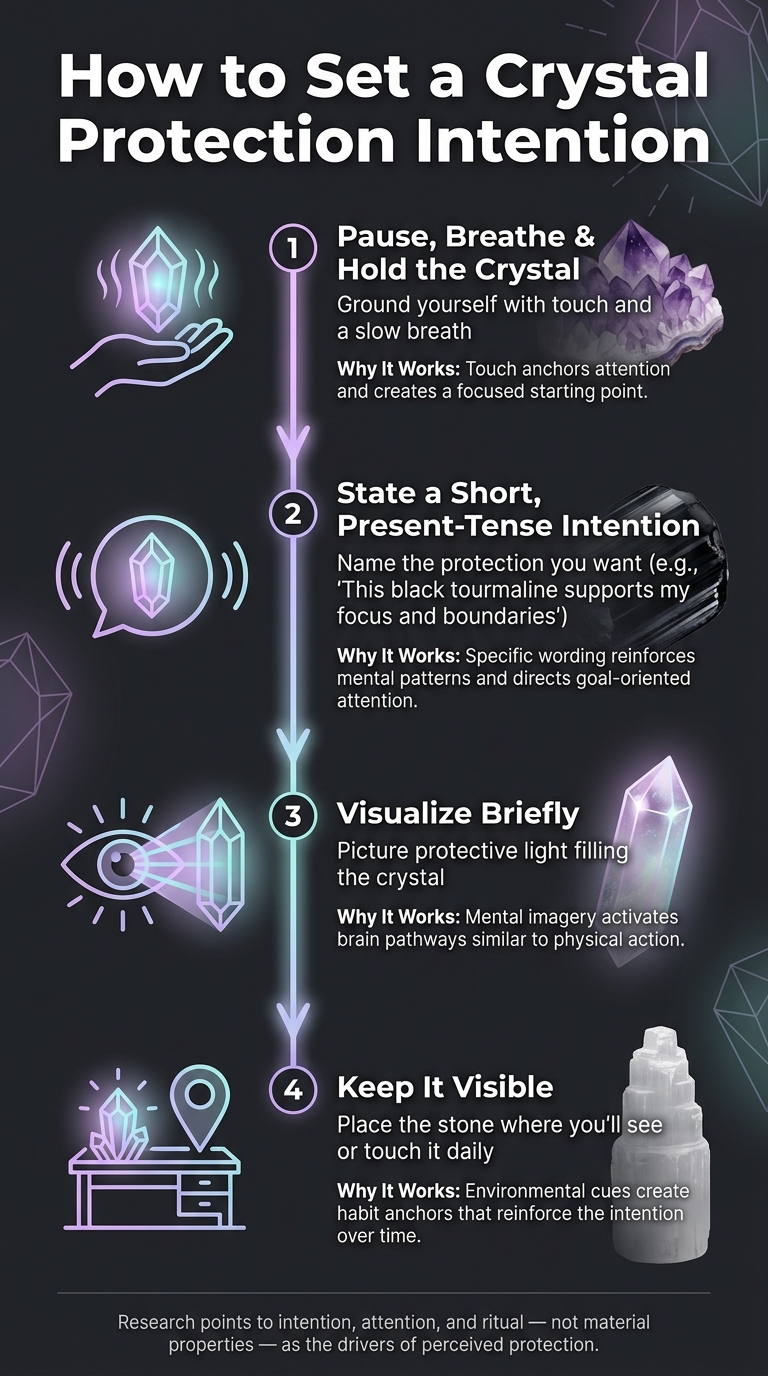
How to Set a Crystal Protection Intention: A Research-Informed Ritual
Common Patterns in Crystal Protection Practices
In day-to-day crystal protection practice, these research-linked effects tend to show up in familiar rituals. People often cleanse a crystal, hold it, say a present-tense intention, visualize protection, and then place the stone somewhere they’ll see or touch often.
You can see the same pattern in how certain stones are used. Black Tourmaline and Obsidian are often placed near entryways or in workspaces. Wearable pieces are used with a clear purpose too - pendants over the heart for emotional shielding, and bracelets on the right wrist for confidence in social settings.
A Simple, Research-Informed Way to Set Intention
This gets more practical when you shrink it down to a short routine. The parts linked to research are repetition, attention, and cues in your surroundings. Put simply, the routine works as a way to steady attention, meaning, and habit.
- Pause, breathe, and hold the crystal. This gives you a focused starting point, and touch can help anchor attention.
- State a short intention. Use a brief, present-tense phrase that names the kind of spiritual protection you want, such as safety, grounding, or boundaries.
- Visualize briefly. Picture protective light entering the crystal.
- Keep it visible. Put the stone somewhere you’ll see or touch it during the day so it can serve as a cue in your surroundings and a habit anchor.
When your focus slips, refresh the intention.
Conclusion: What the Evidence Supports
Taken together, the research points to intention, attention, and ritual as the main drivers behind perceived protection. It supports the psychological value of intention, ritual, focused attention, and meaningful objects in shaping how safe and grounded a person feels.
What the evidence does not support is the claim that crystals emit measurable protective fields or physically change through intention. That line matters. For many practitioners, though, the practice itself - the repeated act of setting intention with care - is what seems to make the difference.
FAQs
Can intention work without belief?
Yes. Intention can still work even without full belief because it may act through neuroplasticity and the mind-body connection.
It can help anchor mental states and shape emotional and physical responses, even if belief isn't complete.
How often should I reset my intention?
It’s usually a good idea to reset your intention every 40 days, or anytime your goals change.
You might also want to cleanse and reprogram your crystals more often when life feels emotionally intense, or during natural cycles like the full moon.
Which crystal is best for grounding and boundaries?
Black tourmaline is widely seen as the top crystal for grounding and boundaries. It’s closely linked to the root chakra and is known for protection, grounding, and turning heavy energy into something easier to handle.
