


Crystals are often used as tools for stress relief, but their effectiveness largely depends on belief and the placebo effect. Scientific studies, like the 2001 research by Dr. Christopher French, show that people report relaxation and other sensations when holding crystals, whether real or fake. Meditation and mindfulness practices seem to amplify these effects, suggesting that the act of meditating, rather than the crystals themselves, provides stress relief.
Key Points:
- Placebo Effect: Belief in crystals plays a significant role in perceived benefits.
- Meditation Benefits: Holding crystals during meditation helps focus attention, enhancing relaxation.
- Symbolic Use: Crystals are often used in rituals for emotional healing and mindfulness.
- Scientific Limitations: No evidence supports intrinsic healing properties of crystals; effects stem from psychological factors.
Popular crystals like amethyst, rose quartz, and citrine are associated with calming, emotional balance, and positivity. While crystals can be part of a wellness routine, they should not replace medical treatments for serious conditions.
Healing Crystals: Science or Just Sparkly Hype?
sbb-itb-cb05739
Research Studies on Crystals and Stress
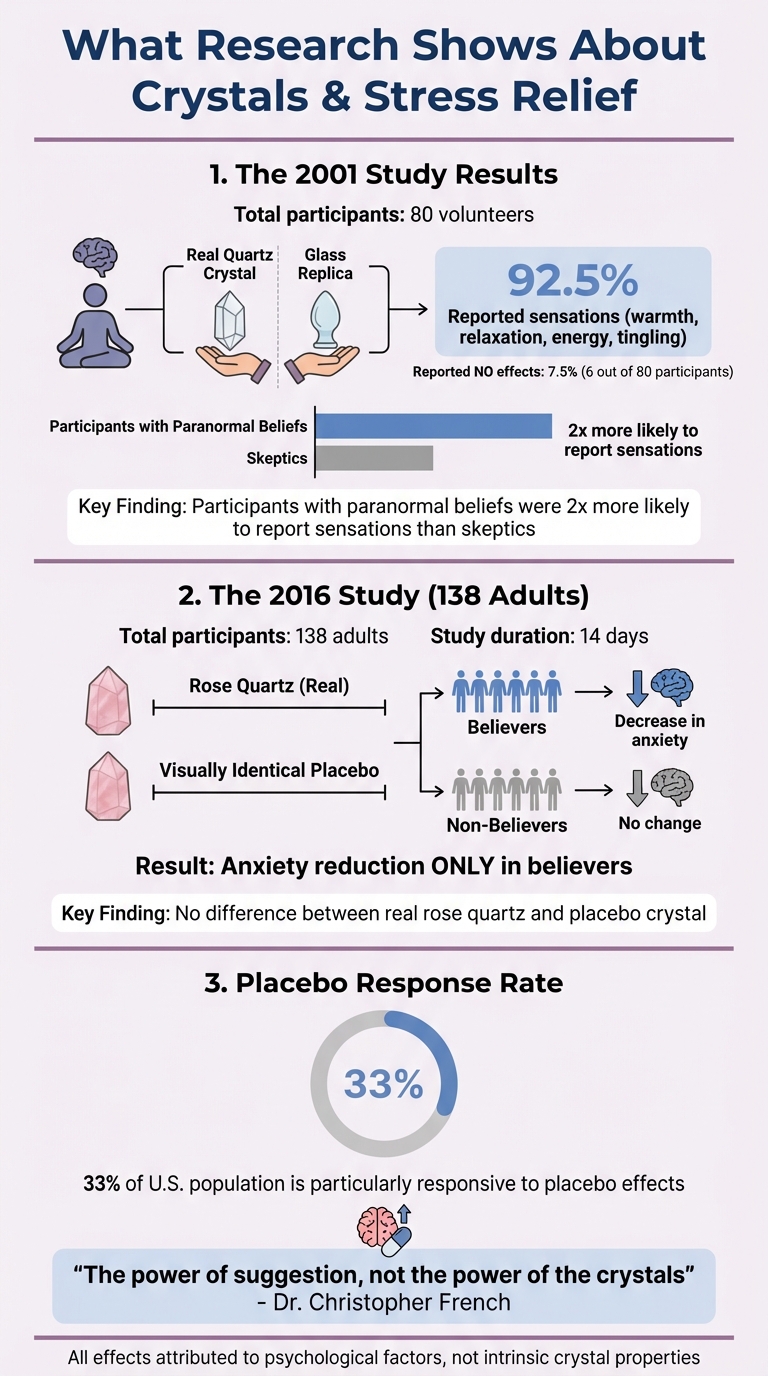
Crystal Stress Relief Research: Study Results and Placebo Effect Statistics
The 2001 European Congress of Psychology Study
In 2001, Dr. Christopher French from Goldsmiths College and Dr. Chris Wiseman from Hertfordshire University conducted an intriguing study on crystals and their potential to relieve stress. They asked 80 volunteers to meditate for five minutes while holding either a genuine quartz crystal or a glass replica. Interestingly, participants reported similar sensations - such as relaxation, warmth, energy, and tingling - regardless of whether they held the real crystal or the fake one. Only 6 out of the 80 participants (7.5%) reported feeling no effects at all. Notably, individuals with paranormal beliefs were twice as likely as skeptics to report these sensations.
Dr. French offered an insightful perspective on these findings:
"The power of suggestion, either explicit or implicit, seems to be the not so mysterious power that may convince many that crystals have the potential to work miracles."
– Dr. Christopher French, Professor of Psychology at Goldsmiths, University of London
The researchers attributed the observed effects to factors unrelated to the crystals themselves. For example, the warmth in participants' hands was likely due to gripping the object, while the relaxation and focus stemmed from the act of meditation. They also highlighted that belief played a critical role. A glass replica costing just a few dollars could produce effects comparable to a $375 quartz crystal - provided the individual believed in its power.
This study opened doors for more research into the symbolic and ritualistic use of crystals in emotional healing.
Crystals as Tools in Emotional Healing Rituals
A 2016 paper published in Complementary Therapies in Clinical Practice explored how crystals are used in emotional healing rituals. The analysis revealed that crystals are often chosen intuitively, with practitioners feeling drawn to a stone's "vibration" to promote relaxation, protection, and confidence. These rituals often incorporate symbolic actions, such as "cleansing" the stones in sunlight, mimicking biomedical practices to create a structured and comforting process for those dealing with emotional challenges.
In a randomized controlled study involving 138 adults, participants who believed in the effectiveness of crystals experienced reductions in anxiety, while those who were skeptical showed no such improvements. This suggests that belief plays a significant role in the perceived benefits of crystal therapy.
These findings highlight the psychological and symbolic dimensions of crystal use, particularly in rituals aimed at emotional well-being.
Crystals in Mindfulness and Meditation
Mindfulness meditation has become a trusted practice for managing stress, with many enthusiasts turning to crystals as tools to enhance their focus. The act of holding a crystal - feeling its weight, texture, and temperature - can help ground attention in the present moment, making it easier to stay mindful.
Certain crystals, like Clear Quartz and Amethyst, are often used during meditation to heighten focus. When paired with affirmations, these stones are believed to create a stronger connection between the mind and the emotional state you aim to achieve. Some meditators even place Green Aventurine over the heart or position Black Tourmaline near the feet to promote balance and stability during breathwork.
Mindfulness Meditation Research and Crystal Use
Research continues to highlight the benefits of mindfulness meditation. For instance, a 2021 review revealed that mindfulness meditation had a greater effect on reducing military-related PTSD symptoms compared to control conditions. Another 2021 study involving 53 adolescents in an inpatient psychiatric unit found that mindfulness meditation provided an immediate reduction in anxiety. While these studies didn’t specifically examine crystals, they reinforce meditation’s effectiveness - a practice that some believe crystals can complement.
Interestingly, a 2016 pilot study explored the potential role of crystals in meditation. Participants who held Rose Quartz during their sessions reported lower heart rates and felt more relaxed. However, many researchers suggest these effects are tied to the power of suggestion rather than any intrinsic properties of the crystals. Psychologist Richard Wiseman explained:
"It is suggestive that the power of crystals is in the mind instead of in the crystals"
– Richard Wiseman
Whether the benefits stem from a placebo effect or another mechanism, the outcome - reduced stress and increased calm - remains meaningful for those who incorporate crystals into their mindfulness practices. This blend of meditation techniques and the psychological influence of suggestion offers a practical way to deepen relaxation and focus.
Expert Views on Crystals and the Placebo Effect
Experts widely agree that the stress-relief people attribute to crystals is strongly tied to the placebo effect - but that doesn’t make the results any less real. Research shows that belief can spark measurable neurochemical changes in the brain and body. These changes, like the release of dopamine and natural painkillers, are triggered by expectations and align with findings from ritualistic and meditative practices.
James Giordano, Professor of Neurology and Biochemistry at Georgetown University Medical Center, highlights this connection:
"The magic isn't in the crystal; it's in your mind."
This theory is supported by recent studies. In September 2025, researcher Alex Escolá and colleagues conducted a randomized, controlled study with 138 adults to test whether rose quartz could reduce anxiety. Participants followed a 14-day protocol using either a real crystal or a visually identical placebo. The results? Anxiety levels only dropped for those who believed in the crystal's power, and there was no difference between the real rose quartz and the placebo.
The role of suggestion in these outcomes is undeniable. Christopher French, Professor of Psychology at Goldsmiths, University of London, noted after his 2001 study with 80 participants:
"The effects reported were a result of the power of suggestion, not the power of the crystals."
Interestingly, many experts argue that the placebo effect itself holds therapeutic value. Ted Kaptchuk, Professor of Medicine at Harvard Medical School, explains:
"A therapy's built-in placebo effect can be considered a distinct aspect of its efficacy... placebo-induced benefits should be promoted, not dismissed."
The physiological effects of the placebo response are real. The mind's reaction to placebo can regulate cortisol levels and impact the endocrine system, which affects stress, blood pressure, and immune function. About 33% of the U.S. population is particularly responsive to placebo effects. For these individuals, the ritual of using crystals can create a genuine sense of control and calm, much like carrying a lucky charm.
Common Crystals for Stress Relief
Amethyst, Rose Quartz, and Rhodonite
Amethyst is often associated with calming the mind and is linked to the crown chakra. Its name comes from the Ancient Greek word amethystos, meaning "not intoxicated", reflecting its historical connection to mental clarity . Many people use amethyst to help ease anxious thoughts, often placing a cluster near their bed or under their pillow to create a soothing atmosphere and combat insomnia caused by racing thoughts .
Rose Quartz, known as the "Stone of Unconditional Love", is tied to the heart chakra and has been used historically to promote emotional balance . For those struggling with stress related to self-criticism or emotional wounds, rose quartz encourages self-compassion and emotional healing . Some people wear it as a necklace or hold it while reciting affirmations to support self-acceptance and emotional release .
Rhodonite is cherished for its ability to help process past trauma. It’s believed to mend emotional wounds while fostering grounding and compassion. Often, people hold rhodonite over their heart or incorporate it into a crystal grid during moments of acute distress to aid in moving forward from painful experiences.
While these are popular choices, other crystals bring their own unique energies to stress relief.
Citrine and Moonstone
Citrine, connected to the solar plexus chakra, is sometimes referred to as the "Merchant's Stone" or "Joy Igniter" . It is said to transform stress into motivation and creativity. Many place citrine on their work desk to maintain a positive outlook and manage career-related stress . Citrine is also associated with abundance, success, and boosting personal power, making it a favorite for enhancing productivity and attracting positive energy.
Moonstone, named after the Greek goddess Selene, represents new beginnings and emotional stability . It is particularly helpful during life transitions like moving, career changes, or divorce, and is often used to balance hormonal mood swings . Author Raleigh Souther explains:
"Moonstone helps individuals when they're feeling anxious or stressed from daily life, so they can move forward more positively"
. Many people wear moonstone during meditation or on full-moon nights to support emotional release.
Together, these crystals highlight how their symbolic properties, paired with intentional use, can create a sense of calm and balance in stressful times, aligning with earlier research on their benefits.
Research Limitations and Conclusions
The current body of research on crystals and stress relief faces several notable challenges. Many studies rely on small sample sizes, often involving fewer than 100 participants. This limits the statistical power of the findings and makes it difficult to apply the results to larger populations. For example, a well-known 2001 study by Christopher French included just 80 participants. It was presented at a conference but never published in a peer-reviewed journal.
Another issue is sampling bias. Many studies recruit participants from settings like alternative therapy fairs or wellness communities, where individuals are already inclined to believe in crystal healing. This predisposition can skew results, as participants may report positive effects whether they are holding a genuine crystal or a placebo made of glass. A September 2025 study involving 138 adults highlighted this bias: reductions in anxiety were only observed among those who already believed in the efficacy of crystals. Furthermore, there was no measurable difference between participants given real rose quartz and those given visually identical placebo crystals.
A further limitation lies in the inability to measure energy fields, as there is no scientific evidence supporting the existence of chakras or a "human energy field" that crystals are said to interact with. One experiment tested 21 therapeutic touch practitioners, who were able to correctly identify a human energy field only 44% of the time - results no better than random chance. Jonathan Jarry from the McGill Office for Science & Society commented on this, stating:
"The healing energy that is claimed to come with certain crystals is instead some poorly defined concept, which lends itself well to the placebo effect".
Given these limitations, crystals should be viewed as supportive tools, not standalone solutions. The evidence suggests that any benefits likely stem from psychological and ritualistic factors rather than direct therapeutic properties. Crystals can still play a meaningful role in wellness practices by acting as a physical focal point for mindfulness exercises, such as meditation or deep breathing. However, they should never be used as a substitute for professional medical care, especially for conditions like anxiety or depression. The placebo effect itself can trigger real biochemical changes - like the release of endorphins - but this works best when expectations are realistic and crystals are paired with proven therapies. Ultimately, the value of crystals lies not in the stones themselves but in how they are integrated into a broader, evidence-based approach to stress management.
Ethically Sourced Crystal Products
When choosing crystals for stress relief or mindfulness, it's important to ensure they are ethically sourced. This not only aligns with personal values but also respects the origins and traditions tied to these natural resources. Conscious Items stands out as a brand committed to ethical practices, offering crystal jewelry and spiritual products that prioritize fair labor and environmental care. Since 2016, the company has served over 500,000 customers and planted 439,754 trees through its partnership program.
The brand collaborates with small, family-run mines to maintain transparency and ensure ethical oversight. Suppliers are thoroughly vetted to provide safe working conditions and fair wages. In addition, Conscious Items offsets its environmental footprint by planting a tree for every product sold and using sustainable packaging materials. Each item is cleansed before shipping and comes with a 30-day money-back guarantee.
Conscious Items guarantees 100% authentic, natural gemstones that are verified by experts, so customers can trust they’re receiving genuine crystals - not imitations made from dyed glass or plastic. Their offerings include bracelets, necklaces, rings, healing lamps, and crystal sets. Prices range from $19 for a Triple Protection Bracelet to $79 for a Cleanse-All Selenite Lamp. The brand has earned a 4.9/5 rating from 9,229 customer reviews.
Customer testimonials highlight the brand’s quality and impact. Teresa M. shared:
"Helps ground me through stress, anxiety, and life's turmoils. Every item I've purchased is top quality and a beautiful reminder of my goals."
Similarly, Sarah M. noted:
"After trying cheap 'crystal' jewelry from other sites, I finally found Conscious Items. The difference in quality and energy is incredible - you can actually feel it working!"
Whether you believe in the ritualistic or mindfulness benefits of crystals, choosing authentic, responsibly sourced stones adds meaning to your wellness journey. Conscious Items also offers a Crystal Quiz to help match individuals with stones that align with their energy and intentions. By supporting ethical practices, you contribute to a mindful and responsible approach to self-care.
FAQs
Do crystals actually reduce stress?
Crystals lack scientific proof of reducing stress beyond placebo effects. Yet, many individuals claim they feel calmer and more at ease when using them. This sense of relaxation might come from personal beliefs or the mindfulness rituals often tied to crystal use.
How can I use a crystal during meditation?
To incorporate a crystal into your meditation practice, begin by choosing one that resonates with your goal. For instance, Amethyst is often associated with calm and tranquility, while Citrine is linked to motivation and energy. Before starting, cleanse the crystal to refresh its energy - methods like smudging with sage or leaving it under moonlight work well.
Once cleansed, set a clear intention for your meditation. Hold the crystal in your hand, place it on a chakra point, or simply keep it nearby. This helps channel your focus, deepen your relaxation, and align your energy with your desired outcome.
How do I know if a crystal is ethically sourced and real?
To make sure a crystal is both ethically sourced and genuine, start by checking if the seller is transparent about its origin. This includes verified supply chains and proper documentation. Genuine crystals often have natural imperfections, so don’t expect them to look flawless. You can also confirm authenticity using techniques like visual inspection, hardness tests, or advanced methods like spectroscopic analysis. Trusted sellers usually share this information as part of their commitment to ethical sourcing.
