


You do not need dozens of stones to shape garden Feng Shui. In most cases, 3 to 4 well-placed crystals can help mark boundaries, slow harsh energy flow, and support calm or growth in the parts of your yard that matter most.
If I were setting this up, I’d keep it simple:
- Map the garden first with a basic Bagua grid
- Match each crystal to one job like protection, calm, love, or growth
- Use sun-safe stones outdoors and keep fade-prone ones in shade
- Start at the entrance, then move to beds, trees, and seating areas
- Check stones after storms and each season
A few placement rules matter more than anything else:
- Black Tourmaline works well near gates and edges
- Clear Quartz fits the center or near root zones
- Rose Quartz suits the back-right relationship area
- Citrine fits the back-left abundance area
- Amethyst is better in shaded, quiet corners
- Moss Agate and Green Aventurine pair well with planting beds
About 1 out of 3 common garden crystal choices in guides like this need extra care outdoors because sun, rain, or freezing weather can dull, crack, or shift them. So placement is not just about meaning. It is also about weather, drainage, and safety.
The short version: I’d use a small number of crystals, place them by zone and purpose, protect delicate stones from full sun and heavy rain, and review the layout every season so the garden stays calm, clear, and easy to maintain.
The Truth About Feng Shui Crystals and Wind Chimes
Garden Feng Shui Basics and the Best Crystals to Use
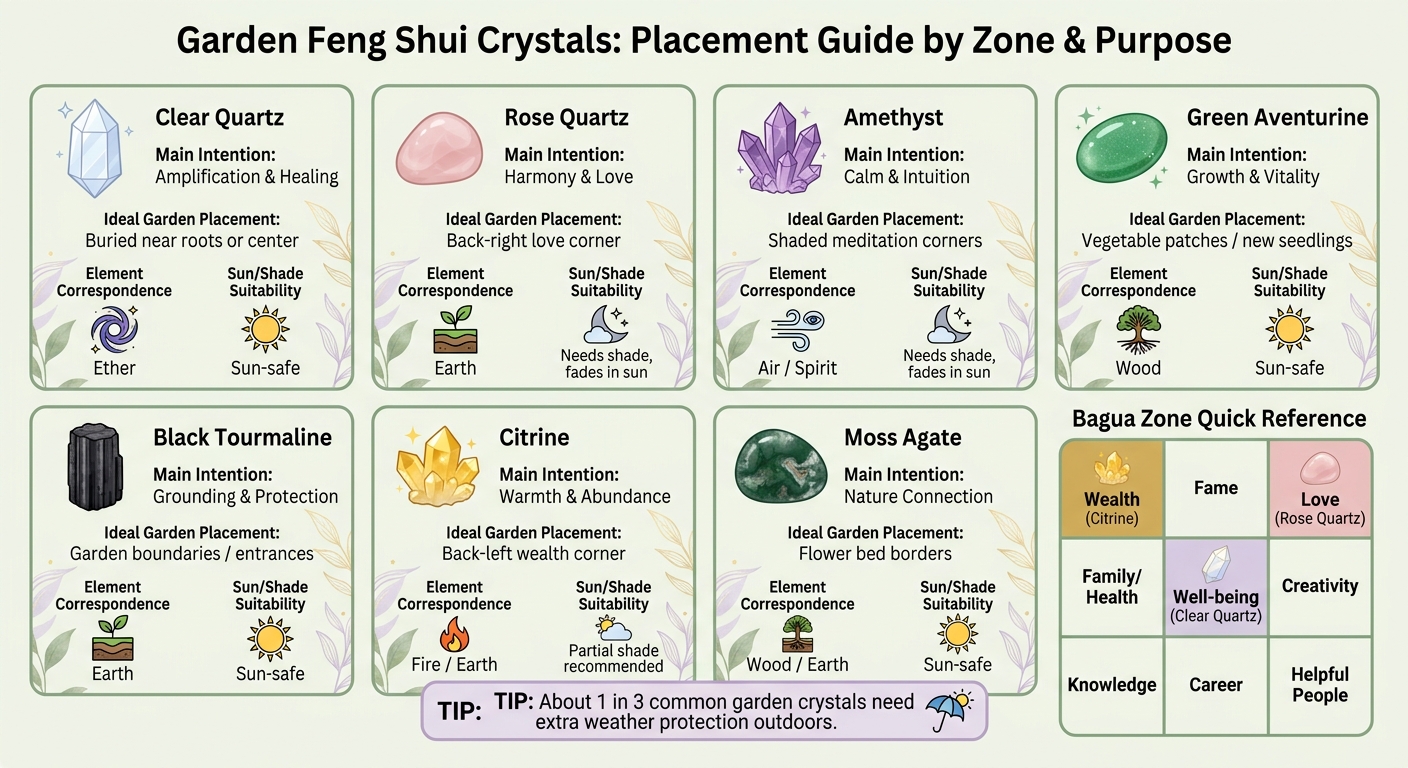
Garden Feng Shui Crystals: Placement Guide by Zone & Purpose
Chi is the life-force energy that moves through a garden. In Feng Shui, you want that energy to move in a gentle, steady way, not get stuck or rush past.
Gardens already have strong Wood and Earth energy. That’s why crystals often work well here. They can help steady edges, guide paths, and add focus to key spots.
How to Read Your Garden Through Bagua Zones
The Bagua is a nine-part energy map used in Feng Shui. To use it in your garden, stand at your front door and look outward. Then place a 3-by-3 grid over your yard.
Here’s how the main areas line up:
- The back-left corner connects to wealth and abundance
- The back-right corner relates to love and relationships
- The center-left area governs health and family
- The front center links to your career path
- The center ties to overall well-being
Once you know what each area stands for, you can match that zone with a crystal that fits your goal.
Which Crystals Fit Each Garden Intention
Each crystal has its own feel, and some pair more naturally with certain Bagua zones or elemental needs. Think of this table as your placement guide for the next step.
| Crystal | Main Intention | Ideal Garden Placement | Element Correspondence |
|---|---|---|---|
| Clear Quartz | Amplification & Healing | Buried near roots or in the center | All / Ether |
| Rose Quartz | Harmony & Love | Love/Marriage corner (back right) | Earth |
| Amethyst | Calm & Intuition | Meditation corners or shaded spots | Air / Spirit |
| Green Aventurine | Growth & Vitality | Vegetable patches or new seedlings | Wood |
| Black Tourmaline | Grounding & Protection | Garden boundaries or entrances | Earth |
| Citrine | Warmth & Abundance | Wealth corner (back left) | Fire / Earth |
| Moss Agate | Nature Connection | Flower bed borders | Wood / Earth |
How to Choose Durable Crystals for Outdoor Use
Not every crystal does well outside all day. Amethyst and rose quartz can fade in direct sun, so they’re better in shaded or covered areas. Delicate or porous crystals, like malachite or certain calcites, should also stay protected from rain and direct sun.
With your stones selected, the next step is preparing the garden and marking each placement.
Prepare Your Garden and Crystals Before Placement
Start by looking at the space, not changing it.
Assess Energy Flow and Sketch the Space
Walk through the garden slowly. Notice the main entrance, main paths, seating areas, messy corners, and spots that don’t get much use. Those areas often need the most attention.
After that, make a simple overhead sketch. It doesn’t have to be exact. A rough outline with estimated measurements in feet is enough. Mark patios, paths, trees, garden beds, fences, and any water features. Also note which areas get full sun, which stay shaded most of the day, and any places that are extra damp or windy. Those details matter because they affect where certain crystals should go.
Use the sketch to mark placement before you move a single stone. Then lay a rough Bagua grid over it, aligned with your main entrance. That takes an abstract energy map and turns it into something you can actually use.
Cleanse, Dry, and Set an Intention for Each Crystal
Before placing any crystal outdoors, cleanse it first. The easiest options are smoke cleansing with sage or Palo Santo, leaving the stone in moonlight overnight, or giving it a brief rinse under cool water if the stone is water-safe. Check first, though. Some crystals can crack or lose their finish after repeated water exposure.
Let each stone dry fully at room temperature. Don’t use heat, since that can damage some crystals.
Once the crystal is dry, hold it and give it a clear job in the garden. Maybe one is for protection near the boundary. Maybe another is meant to support growth near planting beds. Keep the intention simple and tied to where the stone will sit.
Match Crystals to Bagua and Element Zones
With your sketch ready and your crystals cleansed, use the table below to match each stone to its Bagua sector before placing anything. This gives you a clear guide and helps you avoid crowding one part of the garden.
| Bagua Sector | Element | Recommended Crystals |
|---|---|---|
| Southeast | Wood | Green Aventurine, Citrine, Jade |
| Southwest | Earth | Rose Quartz |
| Center | Earth | Clear Quartz |
| East | Wood | Jade, Green Aventurine |
| Northeast | Earth | Amethyst, Moss Agate |
| North | Water | Black Obsidian |
| Entry/Boundary | Various | Black Tourmaline, Onyx |
A small start usually works better. Three or four well-placed stones in key zones can do more than filling every corner all at once.
sbb-itb-cb05739
Step-by-Step Crystal Placement in Key Garden Areas
Place each crystal based on its zone, then pay attention to how the area feels over time.
Start at the point where energy enters. Then work inward toward growing areas and quiet corners.
Place Crystals at Entrances, Pathways, and Boundaries
Use your boundary or entry zone from the sketch.
- Identify the spot: Stand at your main gate or front garden entrance. Look for any long, straight line leading from the gate toward the door. In Feng Shui, that kind of direct channel can make chi move too fast and leave the space feeling less warm.
- Choose the crystal: Black Tourmaline and Black Obsidian fit well at entrances and gates. Moss Agate or Clear Quartz work well along pathway borders. Tree Agate or Jasper can line property edges for a grounded boundary.
- Place it safely: A shallow burial near gateposts helps keep a stone steady and out of the way. You can also place stones inside a heavy pot on each side of the gate, which makes seasonal changes easy. Along path edges, set tumbled stones at the border to mark the route.
- Check and adjust: Revisit the area after a few weeks. Only make changes if the space still feels unsettled.
Next, apply the same zone-based approach in beds and around trees, where the goal shifts from protection to support for growth.
Use Crystals in Beds, Around Trees, and Near Growing Spaces
Use the growth zones from your map.
- Identify the spot: Focus on vegetable beds, the herb garden, or the base of a young tree. These are active growing areas where crystal placement can help the space feel more connected.
- Choose the crystal: Moss Agate is a common pick for planting areas. Clear Quartz points can be placed near plants to encourage harmony and upward growth. Green Tourmaline is often used in plant-focused spaces.
- Place it safely: Bury Clear Quartz points facing upward beside the root zone, not through it, so they stay close to the plant without disturbing the root ball. Use tumbled Moss Agate stones to make a simple border around the bed’s edge. Around a tree, place the stones in a circle.
- Check and adjust: Come back after a few weeks and make changes only if the area still feels unsettled.
After the active growing areas, move to the quietest part of the garden and keep the setup spare.
Create Calm in Seating and Meditation Corners
In rest areas, slow the energy and keep the arrangement simple.
- Identify the spot: Use your Bagua sketch to find the calmest, most sheltered corner - ideally with a hedge, wall, fence, or tree behind it and open space in front.
- Choose the crystal: Amethyst is the clearest choice for calm and mental quiet. Rose Quartz works well near a shared bench or in a space meant for connection.
- Place it safely: In most gardens, surface placement is the easiest and most practical option. It keeps the stones visible, easy to cleanse, and simple to bring indoors before a storm.
- Check and adjust: Sensitive spaces can feel different as soon as the layout is simplified. Check the area after a few weeks and adjust only if the corner feels restless instead of calm.
Maintain Your Garden Crystal Feng Shui Through the Seasons
Once your crystals are set, the goal is simple: keep them clean, protect them from the weather, and make small changes as the garden shifts through the year.
Cleanse Outdoor Crystals and Check for Weather Wear
Regular care helps the layout stay balanced and cuts down on weather-related damage. Dust crystals weekly, cleanse them monthly, and check each stone for cracks, fading, or soil buildup around the base.
After storms, look at stones placed in soil first. Those tend to shift or collect mud more easily. If you have delicate pieces, move them under cover during heavy rain, extreme heat, or freezing weather.
Adjust Placements for Each Season
Once your base layout feels settled, make small seasonal updates instead of reworking the entire garden. Keep the same Bagua zones. Just switch stones when the season changes the feel of the space.
In spring, place Green Aventurine or Moss Agate near planting beds to support new growth. In summer, use Citrine near a seating or gathering area for a brighter, more social mood. Just keep it out of harsh direct sun to help reduce fading. In fall, Red Jasper fits well when the garden starts moving toward harvest and steadiness. In winter, move Black Obsidian or other protective stones closer to the home to support a quieter, more inward mood.
Conclusion: Keep the Layout Simple, Intentional, and Safe
Keep the layout simple: map the zones, place only a few stones with a clear purpose, and review the garden each season. A simple setup, steady care, and small seasonal shifts help the garden stay balanced and safe.
FAQs
Can I use just one crystal in my garden?
Yes. Even one crystal can work well in a garden.
For example, you might place Moss Agate near flowers to support growth. Or bury a small Clear Quartz by one plant to direct energy there.
Larger grids can strengthen the effect, but a single stone can still support your garden intention.
How do I know which Bagua zone my garden falls into?
Stand at your home’s back door and face the yard. Then picture a three-by-three grid laid across the whole garden.
The row closest to the house lines up with Knowledge, Career, and Helpful People. The middle row maps to Family, Health Center, and Children. The far row covers Wealth, Fame, and Relationships.
That simple layout lets you match each part of the garden to its Bagua zone.
Which crystals should I avoid leaving outside year-round?
Avoid leaving moisture-sensitive crystals like Selenite and Malachite outside all year. Rain and damp air can make them cloudy, brittle, or otherwise damaged.
It’s also smart to keep Amethyst, Fluorite, and Rose Quartz out of long stretches of direct sun, since their color can fade over time. And during hard freezes, crystals with trapped moisture or water inclusions may crack.
