


That crystal in a shop may come with dirty water, dust-filled air, and unsafe mine sites. I’d sum up the issue like this: crystal mining can harm nearby families through land damage, water pollution, air pollution, weak cleanup, and poor supply-chain tracking.
Here’s the short version:
- The crystal market hit $1.5 billion in 2023
- Demand is growing by 20% a year
- Mining can move up to 100 tons of earth for 1 ton of crystal
- Pollution can include lead, mercury, arsenic, acid drainage, and silica dust
- Harm can come from both small informal pits and large industrial sites
- Buyers often can’t track where a crystal came from
- In the U.S., “ethically sourced” has no legal definition
What stands out to me is simple: the damage often happens far from the store, but local people live with it every day. They may deal with dusty air, unsafe water, unstable ground, and abandoned pits long after mining stops.
If you want to buy with more care, I’d focus on a few checks right away:
- Ask for the country of origin
- Ask for the mine, region, or cooperative if available
- Look for a written supplier code
- Check whether treatments like heat, dye, irradiation, oiling, or coating are disclosed
- Be careful with steep discounts that may point to cut corners
Quick comparison
| Issue | What it can look like |
|---|---|
| Land damage | Erosion, cleared forest, sinkholes, unstable ground |
| Water pollution | Sediment runoff, heavy metals, acid leaks |
| Air pollution | Silica dust from digging, blasting, cutting, hauling |
| Community harm | Exposure near homes, schools, farms, and wells |
| Weak oversight | Little safety gear, little cleanup, poor monitoring |
| Buyer problem | Hard-to-trace supply chains and vague sourcing claims |
I see this article as a buyer’s guide to the hidden costs behind crystal mining, with a clear point: if you care about what a crystal means, it also makes sense to care about where it came from and what people near the mine may have paid for it.
sbb-itb-cb05739
How Crystal Mining Damages Local Areas
Even small crystal mines can leave damage that sticks around for years when oversight is weak and nobody restores the site. In places like that, the harm doesn’t stay inside the mine fence. It spreads into the land, the water, and the air that nearby communities rely on every day. As one researcher notes, unregulated small-scale mining can cause outsized harm. Once those shifts hit places where people live, farm, and get their water, they stop being just a mining issue and start becoming a health issue too.
Land Disruption, Dust, and Water Pollution
Crystal mining can move a shocking amount of earth. For every ton of crystal extracted, up to 100 tons of earth may need to be moved. That loose soil doesn’t just sit there. Rain can wash it into nearby streams, clog waterways, and leave the land bare. In Minas Gerais, Brazil, amethyst mining has cleared Atlantic Forest land, while jade and crystal excavation in Kachin State, Myanmar, has driven erosion and sinkholes.
Water pollution is another major problem. Mining can contaminate water through sediment runoff, acid leaks, and heavy metals such as lead, mercury, and arsenic. A clear example is the Tyrone Copper Mine in New Mexico - a source of blue chrysocolla. The site faced natural resource damage claims by the U.S. Department of Justice after an estimated 2 billion gallons of acid and heavy metals leaked into surrounding groundwater.
Air can take a hit too. Digging, blasting, and hauling send fine particles into the air, including silica dust. That dust can drift into nearby homes and fields, which means people may breathe it long after the digging stops for the day.
How Different Mining Models Create Different Risks
Different mining models expose communities in different ways, but weak oversight makes every version more dangerous.
| Mining Model | Typical Footprint | Primary Pollution Pathways | Common Community Exposure |
|---|---|---|---|
| Informal Small-Scale Mining | Small but scattered; numerous shallow pits | Sediment runoff, silica dust, and lack of waste management | Direct inhalation of dust, soil instability, and water turbidity |
| Industrial Mining | Massive; large open pits or deep shafts | Chemical leaching and heavy metal runoff | Contamination of regional groundwater and major river systems |
Artisanal operations - the kind seen in Madagascar's rose quartz and mica regions - often create the most direct exposure for the people living closest to them. Families sometimes live right next to unregulated pits, with no protective equipment and no cleanup once the site is abandoned. So while industrial sites can spread pollution across much larger areas, communities nearest to small, unregulated mines often face the fastest and most direct harm. That’s when damage to land, water, and air turns into a daily community health problem.
Health Effects on Nearby Communities
When a mine pollutes land, water, and air, nearby communities usually get hit first. People living close to active or abandoned mines often face the highest exposure, including families near homes, schools, farms, and job sites. The first path is the air.
Dust and Air Exposure Near Mining Sites
Digging, blasting, diesel machinery, and poorly ventilated cutting and polishing can send fine dust into the air, where it can drift past the mining site. That means exposure doesn’t stop at the fence line. Children can face more exposure because they spend time near homes, schools, and informal work areas.
But dust in the air is only part of it. Contamination can also move through water and soil, reaching places farther from the source.
Water, Soil, and Abandoned Pit Hazards
Runoff can carry lead, mercury, and arsenic into rivers, wells, farmland, and irrigation channels. So the risk isn’t limited to the mine itself. It can spread into the water people drink and the land they use every day.
Even after extraction stops, danger can stick around. Left unfilled, pits and unstable ground can stay hazardous long after work ends. That lasting risk helps explain a deeper issue: weak oversight and poor site cleanup.
Why These Problems Keep Going
These health harms don't stick around by accident. They keep going because much of crystal mining happens in informal systems that are hard to monitor, lightly regulated, and tough to trace from pit to store shelf.
Weak Oversight and Poor Site Cleanup
A large share of the crystal supply comes from informal pits where workers often have little safety gear, limited oversight, and almost no site reclamation. When cleanup isn't required, damaged land is often left as-is: open, unstable, and unsafe.
In places like Madagascar, mining may be the only way many families can earn money, which means dangerous work and polluted land can continue for years. And because most crystal mining lacks steady certification or third-party monitoring, there often isn't much pressure to fix what gets left behind.
When nobody is checking sourcing or cleanup, the same damage keeps moving down the chain to new buyers.
Low Traceability Keeps Buyers in the Dark
Crystals often move through several middlemen before they reach retail, and the paper trail gets thinner at each step. By the time a stone lands in a shop or online listing, a buyer may have no clear way to know where it came from.
That matters. Without traceability, people can't tell whether a crystal came from a site that was cleaned up or from one that is still harming nearby families. In the United States, "ethically sourced" has no legal definition and no agency that enforces it. So sellers can make sourcing claims that sound good, while buyers are left with little proof.
That's why sourcing transparency matters just as much as the stone itself.
Ethical Sourcing and Better Buying Choices
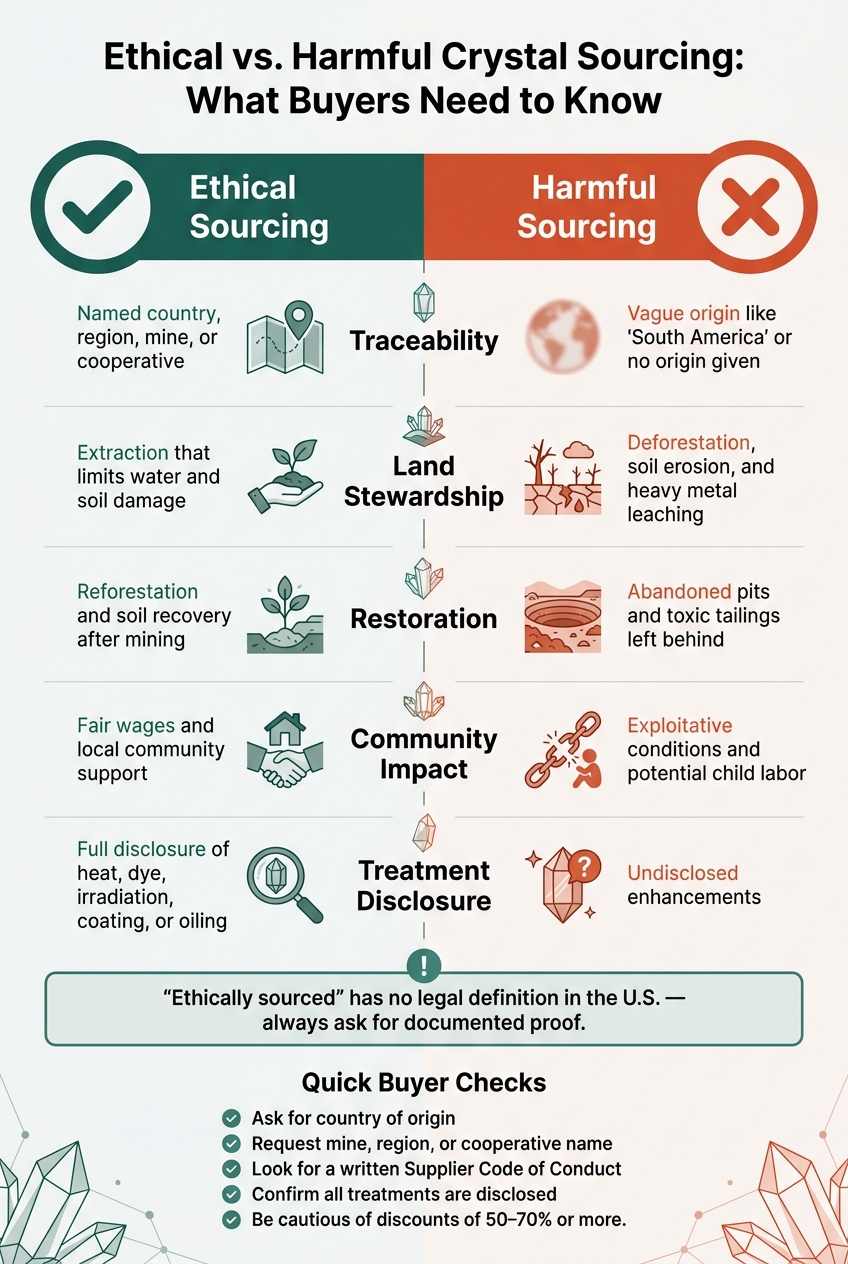
Ethical vs. Harmful Crystal Sourcing: What Buyers Need to Know
Knowing the problem is only half the job. The other half happens when you buy.
What Responsible Sourcing Looks Like
Sourcing can be hard to see from the outside. That means every purchase can do one of two things: support cleanup and accountability, or keep the damage going. Once you understand the risks, the next step is simple. Check whether the seller can back up their claims.
A seller you can rely on should clearly state the country of origin and, if possible, the region, mine, or cooperative. They should also disclose any treatments, including heat, irradiation, dyeing, oiling, or coating. That kind of detail points to basic supply-chain traceability.
A written sourcing standard also matters. Broad statements like "we care about the earth" sound nice, but they don't say much. A documented Supplier Code of Conduct with clear rules for labor, safety, and land management is much harder to fake.
Price can tell you a lot too. Ethical sourcing comes with real expenses: permits, taxes, lapidary work, freight, and fair pay. So when a seller offers 50% to 70% off across the board, it's often a sign that something else got squeezed.
Ethical Sourcing vs. Harmful Sourcing: A Side-by-Side Look
These are the fastest checks buyers can use.
| Criteria | Ethical Sourcing | Harmful Sourcing |
|---|---|---|
| Traceability | Named country, region, mine, or cooperative | Vague origin like "South America" or no origin given |
| Land Stewardship | Extraction that limits water and soil damage | Deforestation, soil erosion, and heavy metal leaching |
| Restoration | Reforestation and soil recovery | Abandoned pits and toxic tailings left behind |
| Community Impact | Fair wages and local community support | Exploitative conditions and child labor |
| Treatment Disclosure | Full disclosure of heat, dye, irradiation, coating, or oiling | Undisclosed enhancements |
Conclusion: Buy With Intention and Awareness
What connects these harms is simple: they're easy to miss once a stone reaches the market.
A crystal may look polished and harmless in a shop or online listing. But the damage often happened much earlier, at the mining site, and it doesn't just disappear when that site is left behind. When cleanup never happens, the harm stays. And as demand rises, that damage spreads with it.
Another big part of the problem is weak oversight and poor traceability. In plain terms, most buyers can't easily see where a stone came from, who moved it through the supply chain, or what conditions shaped that process. That's why buyer questions matter so much. Asking where a stone came from, who handled it, and whether the seller has a written sourcing standard does more than fill in a few blanks. It puts pressure on sellers to be clear about what they're offering. And if a seller can't answer those questions in a direct way, that tells you something.
If you want a simple next step, Conscious Items offers ethically sourced crystal jewelry and spiritual products, and each purchase supports tree planting.
Buy with intention. Ask better questions, and support sellers who answer them clearly.
FAQs
How do crystals affect nearby communities?
Crystal mining can hurt nearby communities in a few direct ways: pollution, shaky local economies, and health problems.
One of the biggest issues is water contamination. Mining can release heavy metals such as mercury, lead, and arsenic into local water sources. That puts both people and wildlife at risk.
The damage doesn't stop there. Mining can destroy habitats, wear away soil, and upset ecosystems that communities depend on for food and tourism. In some places, exploitative labor and unsafe working conditions make things even worse. And when mines shut down, the economic fallout can linger for years.
What makes crystal sourcing hard to trace?
Crystal sourcing is hard to track because the industry is fragmented, global, and doesn’t have one shared system for oversight or certification.
In many cases, a crystal moves through a long chain before it reaches a buyer. It may start with an artisanal miner, then pass to local buyers, traders, brokers, and wholesalers. By the time it gets to a store, details about where it came from can get blurry - or vanish altogether.
That’s part of what makes this space so tricky for shoppers. Labels like "ethically sourced" can sound reassuring, but they’re often vague and hard to check on your own.
How can I spot an ethically sourced crystal?
Look for clear sourcing, not fuzzy sales talk. Ask where the crystal came from: the country, the region, and the name of the mine or cooperative. A seller you can trust should also be able to walk you through the supply chain from the ground to the store.
You’ll also want written disclosure of any treatments, such as heating, dyeing, or irradiation. And if the price seems unusually low, take that as a warning sign. The same goes for sellers who can’t give straight answers about where their crystals come from.
