


If you want the lower-impact option, look for stones with a named mine, chain-of-custody records, and proof of land repair. Based on the article, conventional mining tends to do the most harm, while eco-friendly mining and ethical retailers can cut damage to land, water, wildlife, and nearby communities.
Here’s the short version:
- Conventional mining often leaves large pits, heavy waste, and weak cleanup.
- Eco-friendly mining aims to limit damage during extraction and repair land sooner.
- Ethical retailers add traceability, audits, and supplier rules that buyers can check.
- The article compares these three options using 4 tests:
- Land disturbance and restoration
- Water use and pollution risk
- Biodiversity loss
- Community accountability
A few numbers make the gap clear:
- Diamond mining can use about 127 gallons of water per carat
- Some artisanal emerald mining has used nearly 4,000 gallons per carat
- One closed-loop emerald mine cut water use from 15,000 liters to 300 liters per carat
- In Madagascar, unregulated mining has damaged 90% of riparian zones in some areas
What matters most? In my view, the clearest test is simple: does the land get repaired, or is it left behind?
The Environmental Impact of Crystals | How to Ethically Source Crystals
Quick Comparison
| Area | Conventional Mining | Eco-Friendly Mining | Ethical Retailers |
|---|---|---|---|
| Land | Large disturbance; cleanup may be weak | Smaller footprint; backfilling and replanting | Supplier repair rules and audit checks |
| Water | High use; runoff risk | Lower use at some sites; closed-loop systems | Better disclosure and oversight |
| Wildlife | Habitat loss and sediment spread | Less disturbance, less spillover damage | Sourcing limits tied to mine standards |
| Accountability | Hard to trace through many middlemen | Better mine-to-market tracking | Buyer-facing records, audits, and source checks |
If you’re shopping in the U.S., the article’s main point is straightforward: don’t trust vague sourcing claims. Ask for proof.
1. Conventional Gemstone Mining
Conventional gemstone mining covers a huge range of methods, from artisanal riverbed mining with hand tools to industrial open-pit extraction that relies on heavy machinery and explosives. That range matters because it sets the baseline for any comparison with eco-friendly mining, especially when the focus is land restoration.
Land Restoration
The biggest damage from conventional mining often shows up after the mine shuts down. Open-pit mines can leave craters several kilometers wide and more than 150 meters (490 feet) deep. And once operations stop, those pits, waste piles, and reworked landscapes often stay in place.
In many cases, cleanup is underfunded or not required at all, which leaves abandoned sites scarred for years. That’s a big part of the problem. Eco-friendly mining aims to deal with restoration during extraction instead of leaving the mess behind for later.
Water Use and Chemical Risk
Traditional diamond mining uses about 0.48 cubic meters, or roughly 127 gallons, of water per carat. Some colored-gemstone mining uses far more. In Colombia, artisanal emerald mining has used up to 15,000 liters, or nearly 4,000 gallons, per carat.
Chemical use adds another layer of risk. Mercury, cyanide, and oxalic acid may be used to extract and clean stones, and that can create runoff that reaches nearby groundwater and rivers. So the issue isn’t just how much water mining uses. It’s also what may end up in that water afterward.
Biodiversity Impact
Mining often starts with clearing vegetation and forests. That breaks up habitats and pushes wildlife out of the area. In Madagascar, unregulated mining has degraded 90% of the island's riparian zones, putting endemic species like the golden bamboo lemur at risk.
The damage doesn’t always stop at the edge of the mine. Dust and sediment can spread into nearby land and waterways, extending the impact well beyond the extraction site.
Community Accountability
The environmental side is only part of the story. Traceability matters too. Conventional gemstone supply chains often move through many middlemen, which makes it hard to track where a stone came from or what conditions surrounded its extraction.
That lack of visibility can hide serious harm. Labor abuses, hazardous working conditions, and child labor have been documented in producing regions such as Myanmar. When the supply chain is opaque, those problems are easier to miss - and easier to ignore.
Against this baseline, eco-friendly mining focuses on cutting disturbance and starting land recovery much earlier.
2. Eco-Friendly Gemstone Mining
Eco-friendly gemstone mining uses methods that cut harm during extraction. The aim is simple: disturb less land, use fewer resources, and repair the site while mining is still happening whenever possible.
Land Restoration
Smaller mines usually disturb less ground, so cleanup is easier. With a smaller excavation area, operators can backfill pits with the original soil and replant native vegetation during or after extraction.
At Tanzania's Merelani tanzanite mines, excavation stays shallow and native acacia trees are replanted to help stabilize the soil.
With less disturbed land, water control tends to be easier too.
Water Use and Chemical Risk
Some eco-friendly mining sites cut water use in a big way. The Muzo Emerald Company in Colombia uses a closed-loop water system that recycles 95% of its processing water. That drops consumption from 15,000 liters per carat to 300 liters per carat.
Chemical handling matters just as much. Instead of mercury or cyanide, these operations may use biodegradable solvents or options with lower chemical load. The Kagem emerald mine in Zambia has eliminated mercury use through solar-powered processing.
That means less polluted runoff and less strain on nearby habitats.
Biodiversity Impact
Smaller excavation zones help protect nearby habitat by limiting vegetation loss, soil disruption, and sediment runoff.
Put plainly, when the footprint stays small, the spillover damage often stays smaller too.
Community Accountability
Traceability sits at the center of eco-friendly sourcing. Digital tracking systems create records that follow a gemstone from a specific mine site to the retailer. That gives buyers and operators a clear line of accountability tied to environmental performance.
For retailers that talk about ethical sourcing, this kind of tracking sets a clear bar.
sbb-itb-cb05739
3. Ethically Sourced Gemstone Retailers
Retailers turn mining standards into something buyers can actually check. In plain terms, they bring supply-chain accountability closer to the customer through audits, traceability, and sourcing rules.
Community Accountability
Traceability tools can document a stone’s path from mine to market. Moyo Gems, for example, runs a direct-trade initiative in Tanzania that connects female artisanal miners directly to international buyers, helping ensure fair market value and traceability back to the source. That kind of setup cuts through a lot of the usual mystery around gemstone sourcing.
Some retailers also put money into community safety and living-condition programs for small-scale miners. That matters because sourcing claims mean more when they connect to people’s day-to-day lives, not just paperwork.
That accountability matters most when it leads to verified land repair.
Land Restoration
Ethical retailers often make rehabilitation a contract requirement, which means suppliers are expected to backfill pits and replant native species. Certifications such as SCS-007 and RJC Chain of Custody can help check those rehabilitation claims, so buyers should ask for product-level documentation.
Conscious Items also plants a tree with each purchase.
These retail practices make environmental claims easier to compare in the next section.
Side-by-Side Environmental Impact Analysis
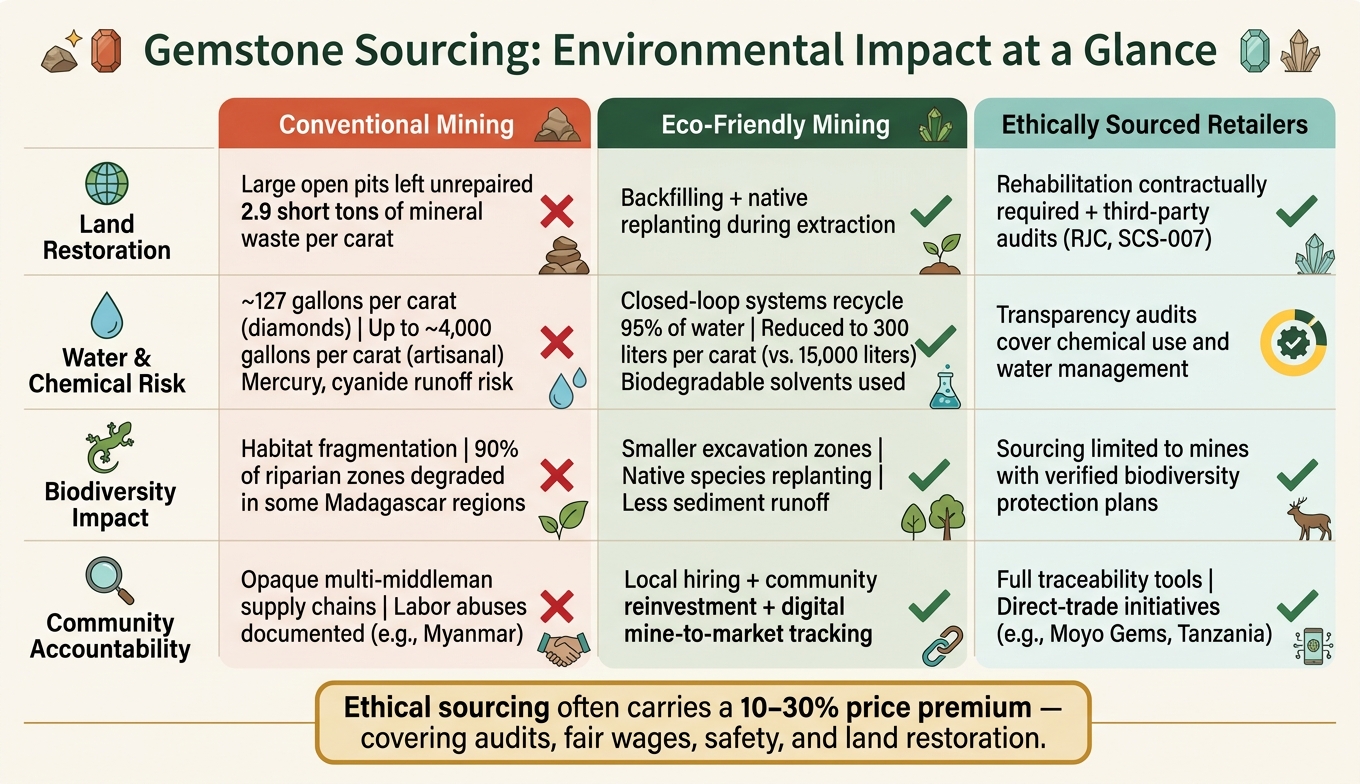
Eco-Friendly vs. Conventional Gemstone Mining: Environmental Impact Comparison
The comparison below zeroes in on the four outcomes that matter most: land restoration, water risk, biodiversity, and accountability. Based on the sourcing methods covered above, it shows which practices leave the smallest long-term footprint.
| Criteria | Conventional Mining | Eco-Friendly Mining | Ethically Sourced Retailers |
|---|---|---|---|
| Land Restoration | Often permanent; large open pits left without rehabilitation | Mandatory backfilling, native replanting, and slope stabilization | Third-party audits verify restoration is contractually required and funded |
| Water & Chemical Risk | High consumption; risk of heavy metal leaching and sediment runoff | Closed-loop systems recycle up to 95% of processing water | Transparency audits cover chemical use and water management |
| Biodiversity Impact | Habitat fragmentation; unregulated operations have degraded 90% of riparian zones in some regions | Native species replanting supports long-term ecosystem recovery | Sourcing limited to mines with verified biodiversity protection plans |
| Community Accountability | Opaque supply chains; oversight often limited to conflict financing | Local hiring, community reinvestment, and regulated small-scale operations | Full traceability tools tied to environmental and labor performance |
The biggest gaps show up in land repair, water control, habitat recovery, and traceability.
Land Restoration
Conventional open-pit operations produce about 2.9 short tons of mineral waste per carat and often leave behind long-term landscape damage instead of repaired land. Eco-friendly mines take a different path. They backfill pits, replant native species, and stabilize slopes during or after extraction. Ethically sourced retailers add another check by making rehabilitation a contract requirement. Certifications like RJC Chain of Custody give buyers a way to verify those claims.
Water management is the next clear test of whether a mine has a low-impact setup.
Water Use and Chemical Risk
Closed-loop systems cut freshwater use and reduce runoff risk. That matters because conventional operations can release heavy metals - including lead, mercury, and arsenic - into groundwater, along with sediment runoff into nearby rivers. Independent audits help confirm whether those risks are being controlled at both the mine and retailer level.
Those controls matter beyond the mine itself, because water damage rarely stays put.
Biodiversity Impact
Conventional mining clears vegetation, breaks up ecosystems, and often leaves soil too damaged for natural recovery. Eco-friendly operations limit excavation and restore native vegetation to reduce habitat loss. Retailers that require verified biodiversity protection plans add a layer of oversight that conventional supply chains often lack.
When that kind of damage happens, weak accountability makes it even harder to defend.
Community Accountability
Accountability gets stronger when mines and retailers use traceability, local hiring, and reinvestment programs. Conventional supply chains are often opaque, with oversight focused more on conflict financing than on labor conditions or environmental standards. Eco-friendly and ethically sourced models narrow that gap through blockchain traceability, which creates a tamper-resistant record of a stone's path from mine to market. Those controls carry more weight when third-party verification backs them up.
Pros and Cons of Each Sourcing Approach
Each sourcing model comes with a trade-off. You usually get some mix of lower cost, more supply, or tighter control over damage, but not all three at once. The table below separates the environmental results from the business trade-offs behind them.
| Sourcing Model | Benefits | Drawbacks | Likely Environmental Outcomes |
|---|---|---|---|
| Conventional Mining | High supply volume; lower consumer prices; local jobs | Habitat destruction; toxic waste; worker health risks from mercury and dust exposure | Long-term land degradation; potential permanent soil and water contamination |
| Eco-Friendly Mining | Lower chemical use; reduced carbon footprint; prioritized land rehabilitation | Higher operating costs; lower production volume; requires strict oversight | Backfilling, native replanting, and rehabilitating waterways |
| Ethically Sourced Retailers | High transparency; supports fair labor and community development | Higher retail prices; difficult to verify fragmented supply chains | Can reduce demand for higher-impact mining and support reforestation and conservation |
Conventional Gemstone Mining
Conventional mining is built for volume. Large operations can keep supply steady, hold prices down, and provide local jobs in places where work may be hard to find.
The problem is that a lot of the damage doesn't show up on the receipt. Habitat loss, soil damage, and abandoned land can remain long after extraction stops, which pushes cleanup and recovery into the future. In plain terms, the mine gets the output now, while the land carries the cost later.
Eco-Friendly Gemstone Mining
Eco-friendly mining aims to cut harm while the work is still happening. That usually means a smaller footprint, less chemical use, and land repair during extraction instead of after the site is exhausted. Rehabilitation is part of the operating model, so the cost is built into the stone rather than left for the next generation to deal with.
That said, this approach is harder to scale. It costs more to run, produces less material, and depends on close oversight to make sure standards are actually followed.
Ethically Sourced Gemstone Retailers
Retailers don't mine gemstones themselves, but they can still shape what happens upstream. When a seller asks for third-party audits and chain-of-custody records, that pressure moves back through the supply chain. It's one of the few ways buyers can influence practices without running a mine.
Conscious Items shows how this can look in practice. The brand highlights ethically sourced crystals and plants a tree with every purchase. Still, broad sourcing language isn't enough on its own. If a company makes claims without naming a third-party standard, treat those claims as unverified.
There's also a price angle. Ethical sourcing often adds a 10% to 30% premium because audits, fair wages, safety gear, and land restoration all cost more.
Conclusion
After looking at land, water, biodiversity, and accountability, one thing is clear: eco-friendly mining and ethical retail tend to leave a smaller long-term footprint than conventional mining. That doesn't mean either one is perfect. It does mean the difference is real.
Ethical sourcing only means something when a seller can verify origin, restoration, and supply-chain controls.
Main Takeaways
Conventional mining shifts the cost of damage onto land and nearby communities. Eco-friendly mining builds repair into the extraction process. Ethical retailers help push demand toward better practices when their claims are backed by records.
The big difference comes down to who pays for the harm. Conventional mining pushes those costs outward. Eco-friendly mining and ethical retail pay for them upfront. That's a big reason ethical sourcing often costs more.
What U.S. Buyers Can Look For
When you're shopping, use the same four tests from the comparison. Ask for:
- chain-of-custody records
- a named mine or region of origin
- third-party audit reports
- treatment disclosure for any stone treatments, such as heating or irradiation
Look for Fairmined or RJC Chain of Custody documentation. And be careful with company-level certificates: they do not prove the origin of the exact stone.
Conscious Items fits this model with ethically sourced crystal jewelry and a tree planted for every purchase. If a seller can't name the origin or back up the claim, treat the sourcing as incomplete.
FAQs
How can I verify a gemstone’s origin?
Don’t settle for just a country name. A seller you can trust should be able to tell you the country of origin, the exact mining region or cooperative, and how they work with that source.
For higher-value stones, ask for independent lab reports from GIA or AGL to confirm geological origin. Then go one step further and request chain-of-custody documentation, such as batch IDs or digital passports, because lab reports do not verify mining conditions.
Which certifications matter?
There isn’t one universal certification for the gemstone and crystal industry.
So instead of leaning on broad ethical labels, it’s smarter to look for third-party audited standards like the SCS-007 Standard for Sustainably Produced Gemstones.
Origin reports from reputable gem labs can verify where a stone came from. But they can’t tell you how that stone was mined.
That’s why a seller’s openness matters most. The clearest signal is whether they share documentation, explain who their suppliers are, and are upfront about the limits of their supply chain.
Are eco-friendly gemstones worth the higher price?
That comes down to what matters to you. Eco-friendly gemstones often cost more because the price can reflect ethical sourcing, fair wages, safer working conditions, and a lower impact on the planet.
If you want your purchase to support more responsible, transparent practices and the communities behind them, paying more may feel worth it.
