


If you want the short answer: fair trade-style crystal sourcing usually means better pay, safer work, clearer sourcing records, and less harm to land and water than conventional mining. In a market worth $1.5 billion in 2023 and growing by about 20% a year, that difference matters more as more people buy crystals in the U.S.
Here’s what I’d look at first before buying:
- Pay: direct trade and cooperatives can let miners keep up to 90% of a gemstone’s value
- Safety: better models use protective gear, training, and site rules
- Labor rights: child labor and forced labor are banned in ethical sourcing models
- Land and water: some lower-impact mines cut water use by up to 30%, and some recycle up to 85% of site water
- Traceability: a seller should name the mine, region, or cooperative, not just the country
- Treatment disclosure: I’d want to know if a crystal was dyed, heated, or irradiated
Most of the problem comes from weak oversight. In many conventional supply chains, miners get paid the least, work in riskier conditions, and the crystal’s paper trail can disappear once it moves through wholesalers. That makes it hard for you to know what you’re buying.
Quick takeaway: if a seller gives you specific origin details, public sourcing rules, and treatment disclosures, that’s a much stronger signal than vague claims like “ethically sourced.”
Ethical crystal mining and lapidary work
sbb-itb-cb05739
Quick Comparison
| Criteria | Fair Trade-Style Sourcing | Conventional Mining |
|---|---|---|
| Pay | Higher and more stable | Often low and uneven |
| Worker safety | Gear, training, site controls | More risk, less protection |
| Labor rights | No child or forced labor | Abuse risk is higher in weakly watched mines |
| Land and water impact | Lower-impact methods, site cleanup, water controls | More land damage, waste, and polluted runoff |
| Traceability | Clear chain of custody | Source often becomes unclear |
| Buyer transparency | Specific sourcing details | Broad or vague labels |
So if I were comparing the two, I’d sum it up like this: one model gives you facts you can check; the other often leaves you guessing.
What Fair Trade-Style Crystal Sourcing Looks Like
Fair trade-style crystal sourcing comes down to a few plain ideas: fair pay, safer job sites, lower impact on the land, and a clear paper trail. That’s the bar this model is trying to hit.
Fair pay, safer work, and basic labor protections
In a fair trade-style setup, miners are paid fairly and paid directly at the mine. Sellers often work through direct relationships or long-term partnerships, which can help create steadier income instead of sending money through a chain of middlemen. In some cases, ethical mining practices have been reported to increase community income by 50% compared with non-ethical methods.
Pay is only one part of it. Responsible sourcing also means safety training, proper protective gear, and mines that follow regulated safety standards. Forced labor and child labor are not allowed. Many ethical suppliers also use cooperative models, where local families own the land and part of the profit goes back into community needs. That setup can make a big difference. It gives people more say in what happens on their own ground, instead of leaving all the control in someone else’s hands.
It also nudges mining toward lower-impact methods.
Lower-impact mining and traceable sourcing
On the land-use side, fair trade-style sourcing focuses on low-impact extraction, land restoration, responsible water use, and avoiding harsh acids or petroleum-based chemicals during cleaning and polishing. Sustainable mining techniques can reduce water usage by up to 30% compared with conventional methods. Some regulated mines push this even further with closed-loop water systems that recycle up to 85% of the water used on-site.
Then there’s traceability, which is just as important. A transparent seller should be able to show where a crystal came from and how it moved from the mine or cooperative to the market. That can include mine records, permits, and transport logs. Country of origin alone doesn’t tell you much. Buyers need the specific mine, region, or cooperative.
That matters because “from Brazil” or “from Madagascar” is still pretty broad. If a seller can’t point to the exact source, it gets a lot harder to check pay practices, labor conditions, or how the material was handled along the way.
Conventional mining often looks very different.
How Conventional Crystal Mining Often Operates
Conventional crystal mining often runs through informal, loosely watched systems, and the same issues show up again and again from one site to the next.
Low pay and unstable income for miners
Most crystal mining is done by small-scale, artisanal, or family-run operations that often don't have formal contracts or much government oversight. That sounds simple enough on paper. In practice, it usually means the people doing the digging have the least power in the chain.
Middlemen often take repeated cuts before the stone ever reaches a retailer, which leaves miners with very little. By contrast, in direct-to-market models, mining cooperatives can keep up to 90% of a gemstone's value, while conventional supply chains depend on multiple markups that shrink the miner's share.
And once a stone passes through enough hands, the trail gets blurry. At that point, it's close to impossible for a retailer - or a buyer - to know what the person at the very start of that chain was paid.
Safety problems tend to work the same way: weak oversight at the source, then very little visibility later on.
Safety hazards, labor abuse, and land damage
Working conditions in poorly regulated mines are often dangerous. Many workers don't have proper protective equipment, face exposure to hazardous dust, and work in pits that can collapse without warning. In some regions, child or forced labor has been documented as a way to keep extraction costs low.
The damage to land can be just as stark. Extracting 1 ton of quartz can mean moving up to 100 tons of earth. That's not a small footprint. It can leave behind barren ground, abandoned pits, and heavy soil erosion. Chemical runoff can also pollute local waterways.
This kind of harm can spread fast. In Brazil's Minas Gerais region, amethyst mining has cleared large areas of the Atlantic Forest, one of the world's most biodiverse ecosystems. That gives you a plain picture of what conventional sourcing can look like on the ground - and why a crystal's origin matters far beyond the label on the shelf.
These differences become clearer in the side-by-side comparison below.
Fair Trade Crystals vs. Conventional Mining: Side-by-Side Comparison
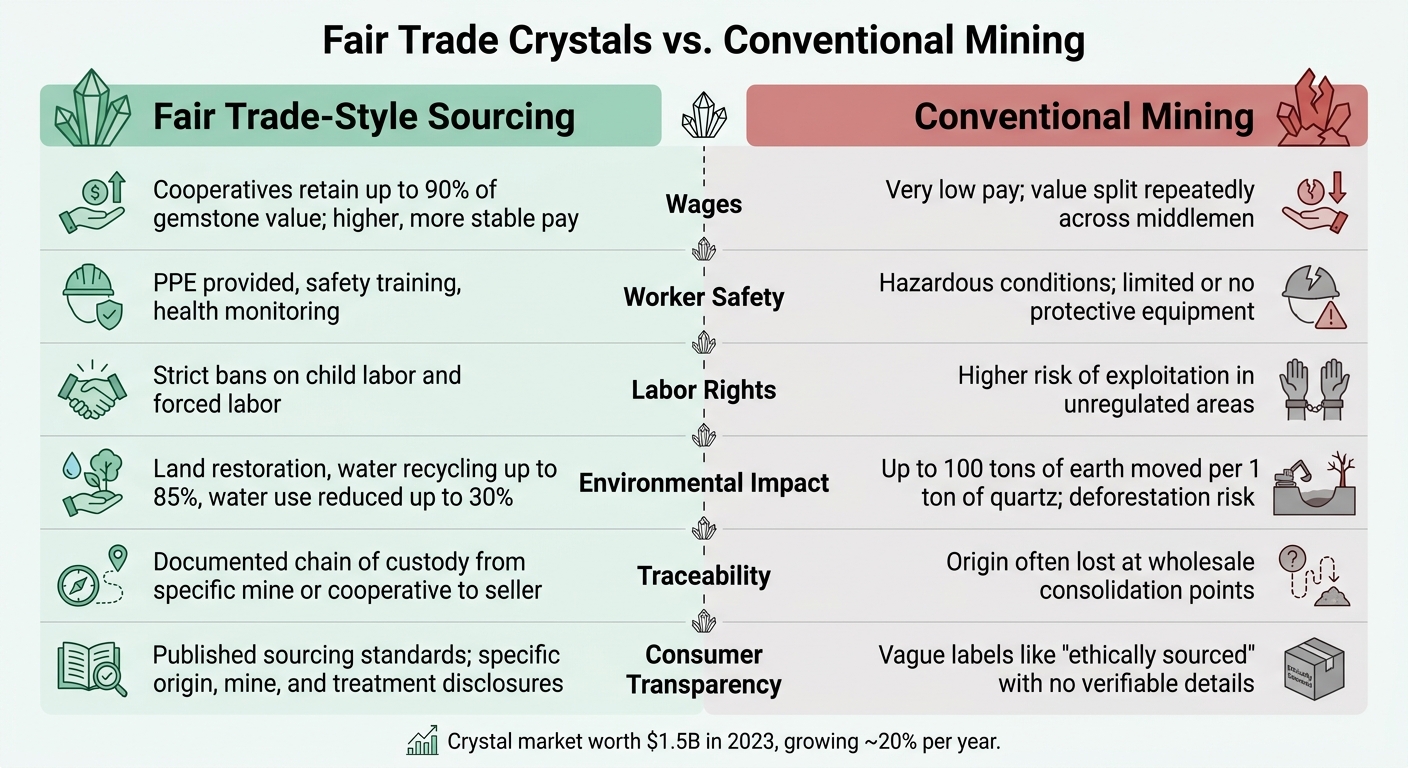
Fair Trade Crystals vs. Conventional Mining: Key Differences at a Glance
Here’s the direct comparison.
| Category | Fair Trade-Style Sourcing | Conventional Mining |
|---|---|---|
| Wages | Higher, more stable pay; cooperatives can retain up to 90% of a gemstone's value | Very low pay; value absorbed by multiple middlemen |
| Worker safety | PPE, training, monitoring | Hazardous conditions; limited or no safety equipment |
| Labor rights | Strict bans on child and forced labor | Higher risk of child labor and exploitation in unregulated areas |
| Environmental management | Restoration and lower-impact extraction | High risk of deforestation, unmanaged waste, and water contamination |
| Traceability | Documented chain of custody from mine to seller | Origin often lost at wholesale consolidation points |
| Consumer transparency | Published standards; specific origin details | Vague "ethically sourced" labels |
The biggest gaps come down to pay, safety, and transparency.
Wages, worker safety, and labor rights
The pay gap is hard to ignore. In fair trade-style setups, mining cooperatives can retain up to 90% of the gemstone's value. In a conventional supply chain, that money gets split again and again across middlemen before it reaches a retailer. By the time the miner gets paid, the share is often much smaller.
Safety shows a similar divide. Ethical sourcing models usually include PPE, training, and health monitoring as part of the job. Conventional operations often don’t. That leaves workers with less protection and more exposure to hazards like cave-ins.
Labor rights follow the same pattern. Fair trade standards put clear bans on child labor and forced labor. In conventional artisanal mining, especially in places with weak oversight, abuse is much easier to hide.
Land impact and supply chain transparency
Wages and safety matter most to many buyers, but land impact matters too. Fair trade-style operations focus on land restoration, controlled waste, and water protection after mining ends. Conventional mining can leave behind stripped land, unmanaged waste, and polluted waterways.
Transparency is another major split. Ethical suppliers document a crystal’s path from a specific mine or cooperative to the seller. In conventional supply chains, that trail often disappears once stones hit wholesale consolidation points.
That’s the core difference: one model shows you where the crystal came from and under what conditions it was mined, while the other often leaves you guessing.
What U.S. Consumers Can Do and Key Takeaways
What to check before you buy
Once you’ve compared the two models, the next move is simple: see if the seller can back up its sourcing claims.
Start with origin details. A real sourcing claim should name the mine, region, or cooperative and point to a published standard. You should also look for a sourcing standard or code of conduct that’s public, not just fuzzy marketing language like "ethically sourced." That phrase on its own is not a claim. A claim includes clear facts: source, standards, and treatments.
It also helps to check whether the brand says if the stone was heat-treated, dyed, or irradiated. If the price looks unusually low, that often means those costs are being pushed somewhere upstream.
Conscious Items is one example of a brand that highlights ethically sourced crystal products and plants one tree with every order.
Key points to remember
The shopper test is pretty simple: fair trade-style sourcing puts more weight on fair pay, worker safety, and lower impact. Conventional mining often doesn’t.
So when you’re shopping, look for:
- Specific origin details
- Published sourcing standards
- Treatment disclosures
- Real sustainability commitments, not just marketing language
A seller that can name the source and disclose treatment gives you a much stronger signal than a vague ethical label. And if a deal seems unusually cheap, there’s a good chance someone else is covering that cost.
FAQs
How can I verify a crystal’s source?
Checking where a crystal came from starts with asking direct questions. There’s no universal certification standard, and labels like "ethically sourced" can be vague.
Ask where the stone came from. If possible, get the specific region or cooperative. Then ask how it was mined and sourced. A seller you can trust should be able to walk you through the supply chain in plain English, even if they hold back a few details for safety or business reasons.
Generic claims aren’t enough. If a seller only says the crystal was sourced “responsibly” but can’t explain what that means, that’s a red flag.
Are fair trade crystals more expensive?
Yes, fair trade and ethically sourced crystals often cost more than conventional ones. That extra money helps pay for fair wages, safer working conditions, and mining methods that are more careful and lower impact.
On the flip side, very low prices can be a warning sign. They may suggest that worker pay, site safety, or mining practices were ignored.
Paying more can help support fair compensation and the long-term well-being of mining communities and nearby ecosystems.
What does treatment disclosure mean?
Treatment disclosure means being open about a crystal’s path from the mine to the store. That includes saying where the stone came from and under what conditions it was taken from the ground.
But honest disclosure is more than a simple statement on a label. It can also include records like mining permits, labor records, and transportation logs. Those details help show whether workers were paid fairly, whether job sites were safe, and whether the stone was sourced in an ethical way.
