


Natural and lab-grown crystals can look alike, but inside they form very differently. If I want to tell them apart fast, I look at how they formed, how long growth took, what flaws and inclusions they show, how even the lattice is, and how people read their origin.
Here’s the short version:
- Formation setting: Natural crystals grow in changing Earth conditions. Synthetic crystals grow in controlled lab systems.
- Time: Natural growth can take thousands to millions of years. Lab growth often takes weeks to a few months.
- Inside marks: Natural stones often show mineral bits, fluid pockets, healed cracks, and uneven zoning. Lab-grown stones often show method-linked signs like curved bands, gas bubbles, flux traces, or seed-related patterns.
- Atomic order and shape: Natural crystals often carry more strain and uneven growth. Synthetic crystals are often more even inside and more regular in shape.
- Meaning to buyers: Some people want a stone with a long geologic record. Others prefer a lab-grown crystal for its steady look and lower variation.
If you’re comparing the two, the main point is simple: the chemistry can match, but the growth record does not.
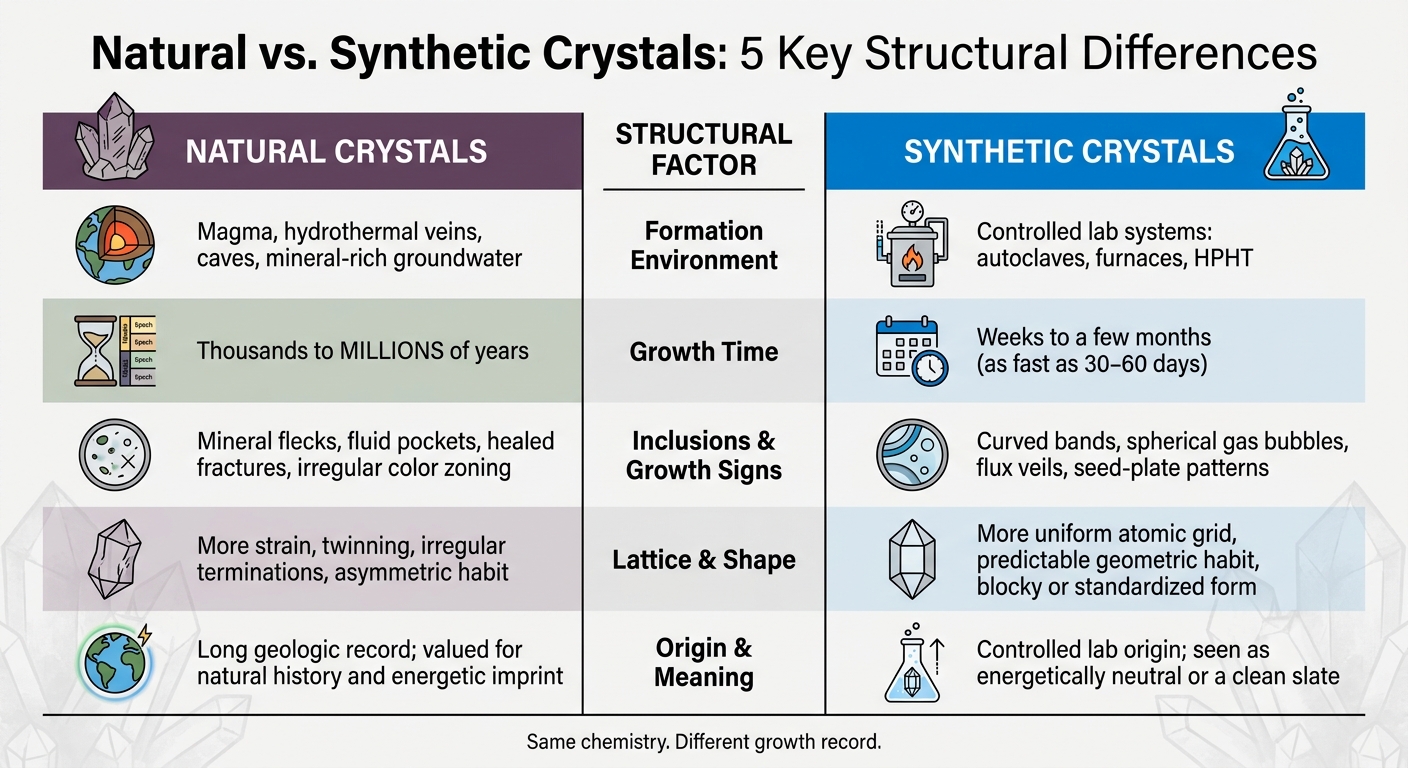
Natural vs. Synthetic Crystals: 5 Key Structural Differences
Natural Or Synthetic: The Science Of Gemstones
sbb-itb-cb05739
Quick Comparison
| What I compare | Natural crystals | Synthetic crystals |
|---|---|---|
| Growth setting | Earth: magma, veins, groundwater, caves | Lab: autoclaves, furnaces, HPHT systems |
| Growth time | Thousands to millions of years | Weeks to months |
| Common inner signs | Mineral inclusions, fluid pockets, healed fractures, uneven zoning | Curved bands, gas bubbles, flux veils, seed-plate signs |
| Lattice and shape | More strain and less even growth | More even growth and more regular form |
| Buyer view | Often tied to geologic age and origin | Often seen as more uniform and neutral |
That gives me the full picture up front, without having to inspect every detail first.
1. Natural Formation Environments vs. Controlled Lab Growth
Natural crystals form in places that don't sit still. They grow in magma, hydrothermal veins, caves, and mineral-rich groundwater, where heat, pressure, chemistry, and time keep shifting. Because of that, growth can take hundreds of years to millions of years. And that gap in conditions is the big dividing line between what nature does and what a lab can copy.
Synthetic crystals cut out most of that change. In labs, hydrothermal quartz grows inside sealed pressure vessels called autoclaves. There, temperature is kept around 662–752°F (350–400°C) and pressure stays near 10,000–24,000 psi. Under those steady conditions, crystals can form in weeks to a few months. That kind of control has a direct effect on what the crystal looks like inside.
Some lab methods move even faster. Melt-based growth, including the Czochralski process, pulls a crystal from a molten bath at about 2,000–3,600°F (1,100–2,000°C) and can bring it to usable size in as little as 30 to 60 days.
| Aspect | Natural Crystals | Synthetic Crystals |
|---|---|---|
| Typical environment | Magma, hydrothermal veins, and mineral-rich water systems | Sealed autoclaves (hydrothermal) or high-temperature furnaces (melt-based) |
| Timescale | Hundreds of years to millions of years | Weeks to a few months |
| Temperature range | ~300–1,650°F (150–900°C), changing over time | Hydrothermal: ~662–752°F (350–400°C); Melt-based: ~2,000–3,600°F (1,100–2,000°C), held nearly constant |
| Pressure conditions | Elevated but variable, depending on depth and tectonic activity | Tightly controlled; hydrothermal up to ~24,000 psi, melt-based near atmospheric |
How Growth Conditions Shape Internal Structure
In nature, the rules keep changing. Magma cools. Water picks up and drops off dissolved minerals. Pressure shifts as the crust moves. Those changes can get locked into the crystal as it grows, almost like stop-and-go traffic leaving marks on a road. One shift might leave a color band. Another might trap a tiny fluid pocket. A later stress event can create a small crack that heals over time. That's why natural crystals often have busy, uneven inner patterns.
Lab growth is built around the opposite idea. Temperature gradients, pressure, and solution chemistry are kept within narrow limits through the growth cycle. Atoms join the crystal lattice in a steady, repeatable pattern, so there are fewer random defects and a more even internal structure from one area to the next.
A lab-grown quartz crystal and a natural quartz point can have the same chemistry on paper. But inside, they tell different stories. Those growth conditions shape the inclusions, zoning, and defects covered next.
2. Defects, Inclusions, and Growth Patterns Inside the Crystal
The crystal’s growth history tends to show up best under magnification. Look closely, and natural crystals often reveal a messy inner record: mineral flecks, trapped fluid, healed fractures, and uneven color bands. Natural quartz often contains mineral flecks, fluid cavities, and irregular zoning.
Synthetic crystals leave different clues, and those clues often depend on how the stone was grown. Flame-fusion (Verneuil) synthetic corundum often shows curved color banding and spherical gas bubbles that follow those curves. Natural sapphire, by contrast, is more likely to show straight or irregular zoning and healed-fracture fingerprint inclusions instead of smooth, concentric curves. Point defects can appear in both natural and lab-grown stones, but lab-grown material usually shows more controlled patterns.
Natural Fingerprints vs. Lab-Made Patterns
Flux-grown rubies and emeralds may contain wispy flux veils or metallic platelets from the crucible. Hydrothermal synthetic quartz and emerald often show chevron or zigzag zoning linked to the seed crystal. Hydrothermal emeralds can also display nail-head spicules, which gemologists use as diagnostic clues under magnification.
| Feature | Natural Crystals | Synthetic Crystals |
|---|---|---|
| Inclusions | Mixed mineral inclusions, multi-phase fluid pockets, healed fractures | Method-specific flux veils, metallic platelets, gas bubbles |
| Gas bubbles | Generally absent in crystalline gems | Common in flame-fusion synthetics; spherical and often aligned |
| Color/growth zoning | Irregular, discontinuous, patchy | Curved bands in flame-fusion; chevron or regular bands in hydrothermal or Czochralski stones |
| Fingerprint inclusions | Common; healed fractures create feather-like trails | Rare; synthetic analogs are usually method-specific veils or flux patterns |
At 10× magnification, a few signs can tell you a lot. Round gas bubbles, curved bands, and metallic flecks lean toward synthetic growth. Irregular mineral inclusions and complex fluid pockets lean toward natural formation. Those inner markers set up the next piece of the puzzle: lattice regularity and crystal shape.
3. Lattice Regularity, Purity, and Crystal Shape
At the atomic level, the main difference comes down to lattice regularity. Natural crystals usually carry more strain, twinning, and zoning. Synthetic crystals, by contrast, are grown to keep the atomic grid more even. That affects both how pure the lattice appears and how evenly the crystal forms.
Natural crystals aren't defective. Their irregularities are part of the story, showing the conditions under which they formed. Synthetic crystals are made for predictability, and that tends to show up in both internal structure and final shape.
What Uniformity Looks Like in Natural and Synthetic Stones
Under a microscope, natural crystals may show dislocations, irregular twinning, and microscopic strain. That's normal for minerals formed under shifting geological conditions. Hydrothermal synthetic quartz, grown around a seed plate in a controlled autoclave, is made to reduce those features. High-purity synthetic quartz can be produced with tightly limited inclusions and low defect density.
You can often see the difference on the outside too. A natural quartz point may have asymmetrical terminations and small surface irregularities. Synthetic crystals grown around a seed crystal usually develop more predictable, geometric habits. Hydrothermal synthetic quartz often grows outward from both faces of a seed plate and may take on a squat, blocky form with scalloped facets. That looks quite different from the classic hexagonal prism with pyramidal terminations common in natural quartz.
Synthetic sapphires show a similar pattern. They often have more even color distribution and higher clarity than natural corundum. Natural corundum, on the other hand, often contains trace impurities such as iron, chromium, or titanium, which can lead to uneven coloration.
| Feature | Natural Crystals | Synthetic Crystals |
|---|---|---|
| Lattice regularity | Slight irregularities, strain, twinning from changing geological conditions | More uniform atomic arrangement; controlled growth reduces defects |
| Impurity distribution | Trace elements and fluid-derived inclusions can affect clarity and local structure | Made to limit unwanted contaminants; some intentional dopants may be added for color |
| Typical external form | Uneven faces, irregular terminations, and asymmetrical habits shaped by available space | More symmetrical and predictable shape grown around a seed crystal; blocky or standardized habit |
That more ordered or less ordered lattice is part of a crystal's structural record. And for some buyers, that's where ideas about origin and imprint start to matter.
4. Structural History and Perceived Energetic Imprint
Beyond composition, a crystal’s growth history also shapes how people read it. Natural crystals form over very long geologic periods, and that process can leave behind zoning and growth bands. Synthetic crystals are made for uniformity, so the difference in origin often changes how buyers interpret them.
Why Natural Origin Matters to Some Buyers
Many crystal users see a natural stone’s visible internal features as a kind of geologic record. In spiritual practice, that record is often described as a perceived energetic imprint - the idea that a stone formed under actual Earth conditions carries something a lab-grown crystal does not. This is a belief system, not a scientific claim. For that reason, many buyers place high value on a long natural formation history, while synthetic stones are often viewed as more neutral.
That structural record helps explain why some buyers read natural and synthetic stones in different ways. And those readings often shape which one they choose.
| Natural Crystals | Synthetic Crystals | |
|---|---|---|
| How buyers read the structure | Visible zoning and growth bands are interpreted as a geologic record of shifting Earth conditions. | Uniform structure is read as controlled and predictable, without a layered formation history. |
| Perceived energetic character | Often viewed as carrying an Earth-formed perceived energetic imprint; associated with grounding and connection to natural cycles. | Often seen as more neutral; valued for consistency and intention-setting. |
Conclusion: The 5 Structural Differences Side by Side
These five differences come back to one thing: how the crystal formed.
Natural crystals develop under shifting geologic conditions over long stretches of time. Synthetic crystals, by contrast, are grown much faster in controlled lab settings. That difference in origin shapes everything else, from defect patterns to color consistency.
For buyers, the tradeoff is pretty straightforward. Natural stones tend to vary more from one piece to the next. Synthetic stones are usually more consistent in color, clarity, and size. Neither is structurally “better.” They simply fit different goals.
Side by side, the five differences look like this:
| Aspect | Natural Crystals | Synthetic Crystals |
|---|---|---|
| Formation Environment | Form over thousands to millions of years under variable temperature, pressure, and chemistry inside the Earth | Grow in controlled lab conditions such as hydrothermal, flux, HPHT, or melt-based methods, usually in weeks to months |
| Defect History | Accumulate structural defects over time from stress, temperature shifts, and geological events | Tend to have fewer random defects and a more uniform defect profile because growth conditions are steady |
| Inclusions & Growth Signatures | Often contain mineral inclusions, fluid pockets, irregular zoning, and varied growth bands | Often show method-specific lab features such as curved growth lines, gas bubbles, flux platelets, or seed-plate remnants |
| Lattice Regularity & Purity | Contain trace elements and slight lattice distortions that create one-of-a-kind color and character | Can be engineered for higher purity or specific impurity profiles, with more uniform color and clarity |
| Origin & Perceived Meaning | Carry a long geological history that some spiritual practitioners interpret as a deep or ancient energetic imprint | Have a recent, controlled lab origin and are often viewed as energetically neutral or a “clean slate” by some practitioners |
Knowing these differences makes it easier to pick the crystal that matches what matters most to you. If you are just starting your journey, our healing crystals guide can help you build a foundational collection.
FAQs
Can a synthetic crystal be chemically identical to a natural one?
Yes. A synthetic crystal can be chemically identical to a natural one.
But there’s an important difference: lab-grown crystals are made through man-made processes. Because of that, they may not have the inclusions, internal variations, and energetic qualities often linked to crystals formed by Mother Earth.
They also tend to look unusually flawless, which can make them easier to tell apart from natural gemstones.
How can I tell if a crystal is natural or lab-grown?
Inspect it closely with a magnifying glass. Air bubbles often show up in glass or plastic imitations, but not in natural stones.
Natural crystals usually have sharp edges, uneven shapes, and small flaws like cracks or inclusions instead of perfect symmetry. You can also look at the color and texture, or try a scratch test, since genuine stones will often scratch glass.
Which is better for me: natural or synthetic crystals?
It depends on your goals.
If you want the healing properties and energy alignment often linked to crystals, natural crystals are the better pick because many people believe they carry the Earth’s own energy.
Synthetic or imitation stones can still look nice, but they don’t offer the same metaphysical value. If you’re mainly buying for decoration, synthetic crystals may be enough.
