


Visualization and affirmations can help you focus and follow through, but they do not make results happen on their own. The research points to a simple idea: if you picture the process, use believable self-statements, and take action, you are more likely to stay on track.
Here’s the short version:
- Visualization works best as mental practice for the next step, not just the end goal.
- Affirmations work best when they feel believable and connect to your values.
- Combined practice can help because it links words, images, emotion, and action.
- Action still matters most. Mental practice helps, but it does not replace effort.
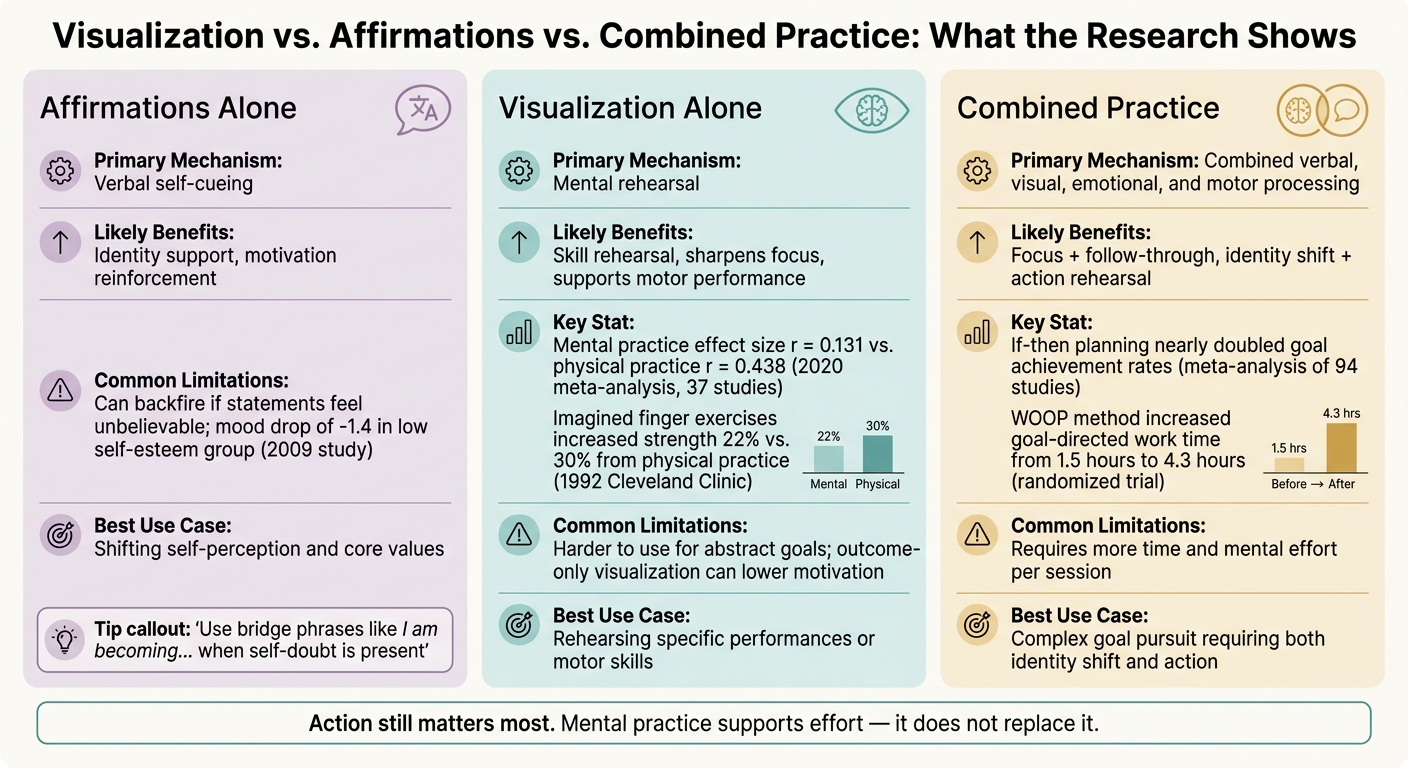
- There are limits. In one meta-analysis, mental practice had a small positive effect on performance (r = 0.131), while physical practice was much stronger (r = 0.438).
- Planning matters too. If-then planning in one meta-analysis of 94 studies almost doubled goal success compared with having a goal alone.
- Some affirmations can backfire. In a 2009 study, people with low self-esteem felt worse after repeating a statement that did not fit how they saw themselves.
If I boil the article down to one point, it’s this: “aligning energy” is best understood as getting your thoughts, feelings, and actions pointed the same way.
Here’s a quick snapshot:
| Practice | What it does | What to watch for |
|---|---|---|
| Affirmations | Support identity and motivation | Can feel false if too far from your current self-view |
| Visualization | Rehearses action and sharpens focus | End-goal fantasizing can lower drive |
| Both together | Connects self-talk with mental practice | Works best when tied to one clear action |
A simple daily routine can be as short as 5 to 10 minutes: breathe, say one value-based statement, picture today’s next step, and commit to one action. That’s the plain-English version of manifestation grounded in psychology, not magic.
What Research Says About Visualization and Affirmations Separately
What Visualization Research Shows About Performance, Mood, and Goal Focus
That matters because the same attention systems linked to inner alignment also shape performance and follow-through.
Visualization activates overlapping motor and visual networks, which means mental rehearsal can help support actual performance. Neuroscientist Marc Jeannerod put it this way:
"Motor imagery … should involve, in the subject's motor brain, neural mechanisms similar to those operating during the real action." - Marc Jeannerod
Put simply, visualization helps line up attention with action.
A 2020 meta-analysis of 37 studies found that mental practice had a small but meaningful positive effect on performance (r = 0.131), while physical practice had a much stronger effect (r = 0.438). So the point isn't that visualization replaces practice. It can help, but you still have to do the work.
A 1992 Cleveland Clinic study found that imagined finger exercises increased strength by 22% over four weeks, compared with 30% from physical practice.
There’s also an important catch. Visualization that stays fixed on the end result can lower motivation by giving people a false sense of progress. Process-focused visualization works better for follow-through, especially when paired with mental contrasting, because it includes both the goal and the obstacles that may show up on the way.
Self-talk affects behavior through a different route: it shifts how people read threat, effort, and setbacks.
What Affirmation Research Shows About Self-Concept, Stress, and Behavior
Self-affirmation theory says that affirming a core value can lower defensiveness and help people regain perspective when a goal feels under pressure .
Brain imaging studies point in the same direction. Affirming core values appears to activate the ventromedial prefrontal cortex (vmPFC) and the ventral striatum, which are tied to self-evaluation and reward processing. That helps explain why value-based affirmations often feel more grounded than generic positive statements.
That said, affirmations don't land the same way for everyone. In a 2009 study, participants with low self-esteem who repeated "I am a lovable person" showed a -1.4 drop in mood compared with a control group. If a statement feels too far from a person's current self-view, the brain may push back. Researchers refer to that response as mental resistance .
The pattern is pretty clear: affirmations help most when they support identity and lower resistance, not when they try to force positivity that doesn't feel believable.
| Affirmation Type | Research Takeaway |
|---|---|
| Value-based ("I show up for others") | Best aligned with core-value affirmations |
| Identity-based ("I am abundant") | Works better when it already fits a person's self-view |
| Growth-oriented ("I am becoming more...") | Often a better option when self-doubt is present |
| Overly positive ("I am amazing") | Can feel unconvincing and may backfire |
The next section explains why using both together can have a stronger effect than using either one on its own.
sbb-itb-cb05739
Neuroscientist Shares 6 Ways to Manifest Your Dreams Into a Reality | This Morning
How Visualization and Affirmations Work Together
Visualization vs. Affirmations vs. Combined Practice: What the Research Shows
Why Pairing Words and Mental Imagery Can Improve Focus
Affirmations and visualization work on different parts of the mind.
Affirmations give you verbal cues. Visualization gives you mental rehearsal. Put them together, and you get words to guide you and images to practice in your head. In spiritual wellness language, that mix can create a felt sense of alignment: clear intention, sharp mental pictures, and a plan to act.
One pairing that works well is an if-then plan: "If [obstacle], then I will [action]." This gives your affirmation a job to do. Instead of sitting there as a nice sentence, it becomes a response to the problems your visualization brings up.
A meta-analysis of 94 studies found that this kind of if-then planning nearly doubled goal achievement rates compared with simply holding a goal in mind. In manifestation terms, that’s what alignment looks like: the same goal held in words, images, and action, often supported by tools like a wealth manifestation bracelet set.
Visualization Alone, Affirmations Alone, and Combined Practice: A Comparison
| Feature | Affirmations Alone | Visualization Alone | Combined Practice |
|---|---|---|---|
| Primary Mechanism | Verbal self-cueing | Mental rehearsal | Combined verbal, visual, emotional, and motor processing |
| Likely Benefits | Identity support | Skill rehearsal | Focus + follow-through |
| Common Limitations | Can backfire if statements feel unbelievable | Harder to use for abstract goals like patience | Requires more time and mental effort per session |
| Best Use Case | Shifting self-perception and core values | Rehearsing specific performances or motor skills | Complex goal pursuit requiring both identity shift and action |
Multi-sensory imagery can work better than goal-only thinking. Why? Because it gives the mind more to work with. You’re not just naming the finish line. You’re seeing it, feeling it, and mentally walking through it.
Adding an affirmation after visualization can also help the words feel more believable, because the visualization has already built the emotional state behind them.
That comparison matters for a simple reason: the best results usually come from a practice that is realistic, specific, and repeatable.
What the Evidence Does Not Support
It helps to say this clearly: neither practice guarantees outcomes.
Visualization and affirmations can sharpen focus and improve follow-through, support identity shifts,, but only when they’re paired with real effort, skill-building, and honest planning. They can help you steer the car. They do not drive it for you.
There’s also a catch with outcome-only visualization. It can lower motivation, because the mind may feel as if the job is already done before action starts. That’s why bridge affirmations such as "I am becoming..." can help when a statement feels too far from what you believe right now.
There is no scientific evidence that thoughts emit frequencies the universe responds to. Their value is psychological: better focus, steadier motivation, and more consistent action. That makes the next step simple: turn the idea into a short daily routine.
Applying the Research in a Spiritual Wellness Routine
A Simple Daily Practice: Value-Based Affirmation Plus Process Visualization
You can turn the research into a short morning routine that connects intention, mental imagery, and one clear action.
A 5- to 10-minute session is enough. It keeps the practice easy to repeat and less likely to feel like a chore. Here’s a simple flow:
- Settle (1–2 minutes) Sit quietly and take five slow, deep breaths. This can help shift your attention before you begin.
- Affirm (1–2 minutes) Say one value-based statement out loud. Keep it believable. If your goal still feels far away, use a bridge phrase like "I am learning to..." or "I am becoming someone who..." Saying it aloud makes the moment more deliberate. Then move right from the statement into a clear mental scene.
- Visualize the next step (3–5 minutes) Focus on the next action, not the end result. Picture the exact thing you need to do today: the meeting you’ll lead, the talk you’ve been putting off, or the task you need to finish. Bring in a few senses, like sight, sound, and touch, so the scene feels more real.
- Commit to one action (1 minute) Name the one step you’ll take as soon as the session ends. That keeps the practice tied to behavior instead of leaving it at the level of intention.
Using Crystals and Ritual Objects as Intention Anchors
A crystal bracelet or ritual object can work as a daily reminder of your intention. When you pair the same object with the same practice over time, that repeated cue can help bring you back to the same mental state each day.
A Conscious Items crystal bracelet or set can serve as that physical cue. Wearing a bracelet during your morning practice, or keeping a ritual object nearby after the session, gives your intention something concrete to connect with.
Routine Components and the Psychological Processes They Support
| Routine Component | Likely Psychological Function | Research Basis |
|---|---|---|
| Goal Clarity | Attention control; primes the RAS to filter for relevant information | |
| Value-Based Affirmation | Values reinforcement; activates reward processing in the vmPFC | |
| Process Visualization | Mental rehearsal; strengthens activation through repeated practice | |
| Supportive Objects / Environment | Symbolic anchoring; cues the brain to return to the intended state |
Each part of the routine supports a different part of the process. One piece sets direction. Another strengthens motivation. Another helps turn repetition into habit over time.
The routine can be useful, but the evidence still has limits.
Research Limits, Open Questions, and Key Takeaways
What Current Studies Support and Where the Gaps Remain
The limits matter just as much as the upside.
Current research does support visualization and affirmations. But that support is narrow, not all-purpose. Most imagery research comes from athletics and motor rehearsal, which means those results don't automatically apply to broad life goals.
There's another catch: outcome-only fantasizing can lower motivation, while process-focused imagery helps people follow through. Put in plain English, the point is to manage attention well. You want to save your energy for actual effort, not burn it all on a mental movie of the finish line.
What the evidence does support is pretty clear: repetition, mental rehearsal, values-based affirmations, attention focus, and action. What it does not support is the idea that thought by itself produces results.
Affirmations also have a known downside. They can backfire when they feel false or forced. That's why bridge phrases such as "I am becoming…" can help reduce resistance.
Key Points to Carry Into Practice
Action, not thought alone, moves outcomes forward.
Visualization tends to work best when it's process-oriented. Affirmations tend to work best when they feel believable and connect to something you genuinely value. Put together, they can help strengthen focus and consistency. But that only happens when they're paired with real-world follow-through, honest self-reflection, and patience over time.
One research-backed way to keep this practice tied to action is WOOP. In a randomized trial, participants using WOOP - Wish, Outcome, Obstacle, Plan - increased the time they spent working toward their goals from 1.5 hours to 4.3 hours. Instead of stopping at a positive image, you also picture the most likely obstacle and decide ahead of time how you'll respond. That's the practical version of alignment: clearer intention, stronger follow-through, and less drift.
Used well, these practices support focus and follow-through. They are not guarantees. In that sense, alignment means thought, emotion, and action working together - not passive wishing.
FAQs
How is process visualization different from fantasizing about the end goal?
Process visualization focuses on the habits, actions, and day-to-day work needed to reach a goal, not just the final result.
Thinking about the finish line can feel good for a moment. But it can also create a false sense that you've already done something. Process visualization is different. It works more like mental rehearsal, helping link your intention to the effort required to turn the goal into something real.
What should I do if affirmations feel fake or make me feel worse?
If affirmations feel fake - or worse, make you more anxious - the problem may be the gap between how you see yourself now and what the statement says.
That’s where bridge affirmations can help. Instead of making a big leap, use language that feels believable. For example, say "I am becoming more comfortable with" rather than pushing an extreme claim that doesn’t feel true yet.
It also helps to check your goals. Are they based on what you want, or on what you think you should want? That distinction matters more than people think.
Start from an honest place. Then use gratitude first to shift your emotional state before you move into affirmations.
How can I combine affirmations and visualization into a simple daily routine?
Set aside 10 to 15 minutes each day for this practice. Begin with two minutes of slow, deep breathing so your mind and body can settle. Then get clear on your goal. After that, spend five to eight minutes picturing yourself as if you're already living it. Bring in the details: what you see, what you hear, and how it feels.
Next, say an affirmation, either quietly to yourself or out loud. The main thing is to do it every day. Consistency matters more than intensity. If it helps, use a physical anchor, like a crystal set from Conscious Items. Wrap up with gratitude and take one small step toward your goal.
