


Most crystal mining waste never becomes a finished product, and that waste can pollute water, spread dust, and leave toxic metals behind. If I want to judge whether crystal mining is ethical, I need to look at four things first: where the crystal came from, how waste is stored, how water is protected, and what happens after the mine closes.
Here’s the short version:
- In some quartz mines, only 21.43% of mined material becomes a sale item. The other 78.57% ends up as waste.
- Main waste types include overburden, tailings, sediment, dust, and process chemicals.
- Main risks include lead, arsenic, mercury, cadmium, acid drainage, silica dust, and dirty runoff.
- In some mining areas, more than 40% of headwaters are harmed by mining pollution.
- Quartz mining dust can cause silicosis, a serious lung disease.
- Better waste control includes backfilling, lined ponds, silt basins, dry-stacked tailings, water recycling, and water testing.
- Buyers should ask for the mine name, permits, water records, chemical-use details, and the closure plan.
The bottom line is simple: ethical crystal mining is not just about workers or origin claims. It also depends on whether the mine keeps toxic waste out of soil, streams, groundwater, and air - and whether it can prove that with records, not just words.
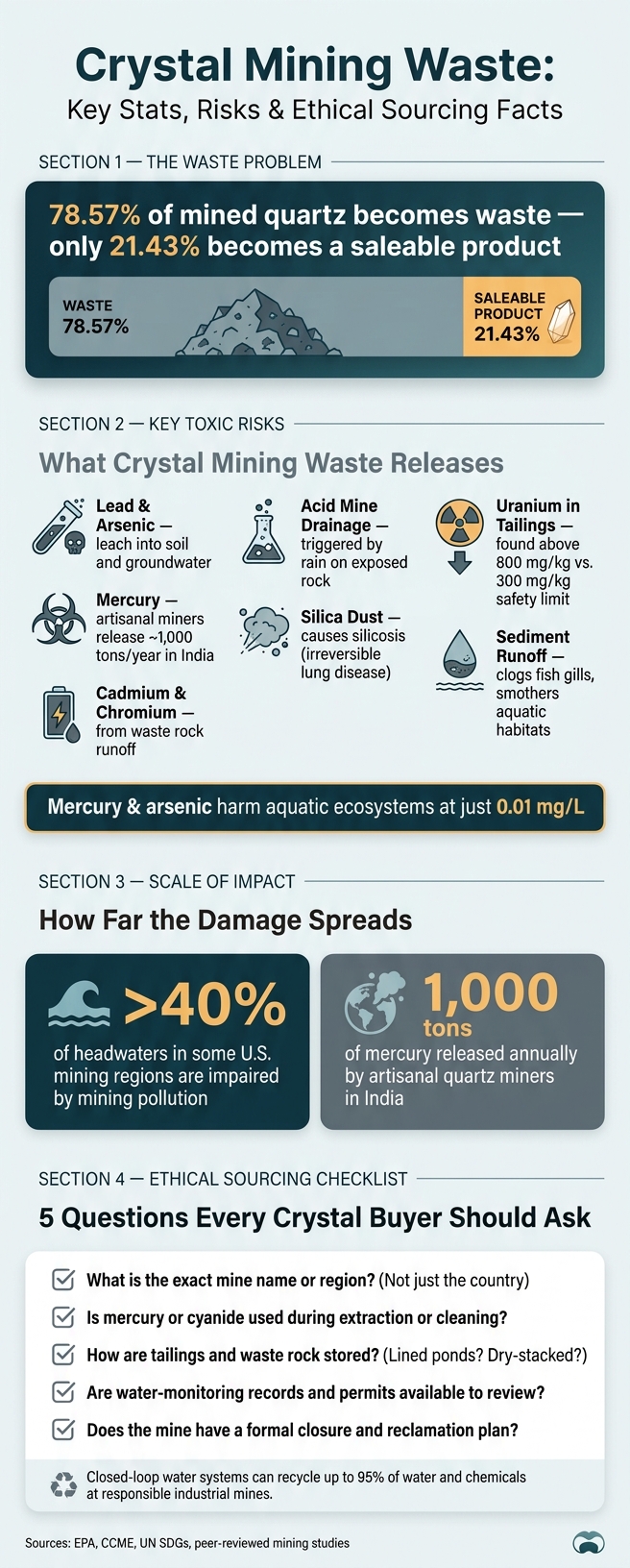
Crystal Mining Waste: Key Stats, Risks & Ethical Sourcing Facts
The Environmental Impact of Crystals | How to Ethically Source Crystals
sbb-itb-cb05739
Common toxic byproducts and risks to the environment
These waste streams turn dangerous when they leach, blow, or wash past the mine site. And crystal waste doesn’t all behave the same way. The risk depends on the mineral being mined, the host rock around it, and the processing method used.
Heavy metals, acid drainage, and chemical contamination
Waste rock and tailings left out in the open can release toxic elements into streams and groundwater. Rain can also set off acid mine drainage, which helps move pollutants through the surrounding area. Common contaminants include arsenic, lead, mercury, cadmium, and chromium. In some U.S. mining regions, more than 40% of headwaters are impaired by this pollution.
The danger can be even higher in artisanal mining, where unsafe chemical use is common. In India, artisanal miners are estimated to release 1,000 tons of mercury each year into water bodies while extracting quartz. Even tiny amounts matter here: mercury and arsenic can harm aquatic ecosystems at concentrations as low as 0.01 mg/L.
Heavy-mineral concentrates can bring radiation risk too. That’s because monazite and zircon may contain uranium and thorium. A 2022 study in Sri Lanka found uranium in tailings above the industrial safety limit.
Sediment, dust, and damage to water and habitat
Spoil piles and haul roads can send sediment into waterways during rain, which pushes up turbidity. That cloudy water can clog fish gills, smother aquatic habitats, and block sunlight from reaching underwater plants.
Dust is another big problem. Fine silica dust released during quartz excavation and crushing can travel beyond the mine site. Over time, breathing it in can cause silicosis, an irreversible lung disease. A simple fix helps: cover piles and mist dusty areas to cut down airborne dust.
The main risks change from one waste stream to another, but the key point is the contamination pathway. Some pollutants move through water. Others spread through air or sediment.
Comparison table: waste types and their main risks
| Waste Type | Main Toxic Risks | Affected Areas | Impact |
|---|---|---|---|
| Waste Rock | Heavy metal leaching (As, Cd, Pb) | Soil, Biodiversity | Long-term; High severity |
| Tailings | Contaminated runoff (Cyanide, Hg), Uranium concentration | Groundwater, Surface water | Permanent if unmanaged; Extreme |
| Sediment | Turbidity, siltation, gill clogging | Surface water, Aquatic life | Seasonal; High local impact |
| Dust | Silicosis, respiratory issues, air quality | Air, Human health | Chronic; High occupational risk |
| Process Chemicals | Oxalic acid, Sulfuric acid, Cyanide | Soil, Surface water | Short to Medium; Acute toxicity |
Best practices for reducing and managing toxic waste
Waste reduction, safer storage, and water protection
Once the risks are clear, the next step is getting waste under control at the mine. Ethical crystal mining starts on-site, before waste ever leaves the property. Selective extraction helps cut dust and broken material at the source. Backfilling mined-out areas with sterile rock and tailings can shrink surface waste piles and help keep the ground stable.
Water protection matters just as much. Lined retention ponds and silt basins help keep contaminated water and sediment from moving offsite.
You can see these steps in practice at working mines. Wegner Quartz Crystal Mines in Arkansas has reclaimed mine sites and built settlement ponds to trap sediment before it reaches streams.
Chemical controls, monitoring, and cleanup
Responsible mining also means limiting harsh process chemicals. For crystal cleaning, milder options such as oxalic acid can be used. At industrial mines, closed-loop systems can recycle up to 95% of water and chemicals.
Still, storage and containment by themselves aren't enough. Mining sites need regular monitoring during operations, especially for heavy metals and pH in water. That work should continue after closure through remediation efforts.
Comparison table: tailings and waste storage methods
| Storage Method | Toxic Leaching Risk | Structural Stability | Cost | Scale Fit | Best Use |
|---|---|---|---|---|---|
| Backfilling | Low (contained in original pit) | High | Moderate | Best for underground or deep pit mines | High - especially for trench-style operations |
| Lined Impoundments | Very Low (barrier prevents seepage) | Moderate (requires ongoing monitoring) | High | Industrial scale | Moderate - essential where process chemicals are used |
| Dry-Stacked Tailings | Low | Very High | High | Larger operations | Strong - reduces the risk of catastrophic dam failure |
| Unlined Tailings Piles | High (runoff enters groundwater directly) | Low (prone to erosion and dust) | Low | Common at legacy/artisanal sites | Poor - high acid drainage and leaching risk |
Dry-stacked tailings have gained traction because they lower the risk of a catastrophic impoundment failure. The downside is cost. Both lined impoundments and dry stacking need more upfront investment than dumping waste on unlined ground.
These controls only matter when standards and closure plans back them up.
Standards, regulation, and closure planning
Mining standards and responsible supply-chain expectations
Waste controls only matter when standards and permits give them teeth.
There’s no universal certification made just for crystals. So buyers usually have to lean on vendor policies, traceability, and published sourcing standards. Without a recognized label, ethical claims come down to each supplier’s own code of conduct. Broader mining rules tend to focus on pollution prevention, tailings safety, hazardous-waste controls, and supply-chain transparency. These frameworks line up with SDG 12 and SDG 15.
U.S. waste rules and why mine closure plans matter
In the U.S., EPA effluent rules and NPDES permits regulate mine drainage, process water, and stormwater runoff. The rules also include subparts for minerals such as jade and novaculite.
But discharge limits are only one piece of the puzzle. Closure plans deal with the long-term risk that can stick around long after mining stops. If reclamation is done poorly, abandoned pits can erode, increase sedimentation, and pollute groundwater. A solid closure plan should cover backfilling with waste rock and tailings to stabilize landforms, topsoil replacement, revegetation, and continued water-quality monitoring. This gets even more serious when monazite or zircon show up in tailings: uranium can reach 800 mg/kg, which is above the CCME industrial land-use limit of 300 mg/kg.
Reference table: frameworks and waste-management requirements
| Framework / Regulation | Core Waste-Related Requirements | Scope |
|---|---|---|
| EPA 40 CFR Part 436 | Controls on mine drainage, processing wastewater, and stormwater runoff; includes subparts for jade and novaculite | U.S. regulatory context |
| NPDES Permits | Site-specific discharge limits; mandatory monitoring and reporting | U.S. mining operations |
| CCME Soil Quality Guidelines | Permissible limits for toxic elements, including uranium at 300 mg/kg for industrial land use | Environmental benchmark |
| UN SDGs 12 & 15 | Responsible production, waste reduction, and protection of terrestrial ecosystems | Global supply chain |
| Responsible Sourcing Principles | Pollution prevention, tailings safety, hazardous waste controls, and transparency | Global supply chain |
| National Gem and Jewellery Authority | Oversight of mining activities and traditional waste disposal, including backfilling | Sri Lanka |
These frameworks help separate marketing claims from waste-management practices that can actually be checked.
Ethical sourcing decisions for crystal buyers and brands
Questions to ask about waste, water, and chemical use
Once standards exist on paper, buyers need to check whether they hold up on the ground. That means asking for site-specific proof, not broad sourcing claims.
Start with the mine itself and the chemicals used. Ask for the exact mine name or the specific region, not just the country of origin, so traceability can actually be checked. Then ask a direct question: is mercury or cyanide used during extraction or cleaning? If the crystal comes from a larger ore mine, the waste controls at that parent site matter just as much.
Next, ask how the site handles waste and water. Does the operation use silt basins, buffer strips, or closed-loop water systems? How are tailings and non-gem-bearing rock stored? Is iron pyrite present at the site? If it is, it can form sulfuric acid that leaches toxic metals such as cadmium and copper into the water table.
Then ask for documents you can review:
- Permits
- Water-monitoring records
- The closure plan
If a supplier can't answer with clear details, that tells you something too.
How Conscious Items fits into a responsible sourcing conversation

The same level of transparency buyers ask from mines should also appear in the brands they support. Conscious Items offers ethically sourced, authentic crystal jewelry and spiritual products, and each order supports sustainability by planting a tree.
Traceability and accountability are what turn a sourcing policy into something you can check. As Kristy Phillips, Founder, Blissful Things, noted:
"If you claim something is ethically sourced, and even one part of that chain proves otherwise, legally you are responsible."
When those answers aren't there, the sourcing claim is incomplete.
Conclusion: the clearest signs of responsible crystal mining
The clearest signs are traceable origin, controlled tailings, clean water management, and a real reclamation plan. Buyers only see those signs when sourcing choices favor suppliers that can back them up with facts.
FAQs
How can I verify a crystal mine’s waste practices?
It can be hard, but start by figuring out the mine or region the stone came from. Put sellers first if they share clear, documented sourcing details instead of vague location claims.
Also check for signs of better mining practices, like land reclamation work, lined retention ponds that help limit chemical runoff, and routine water-quality monitoring. Choosing stones with natural variation can help ease pressure on high-volume extraction that creates more waste.
Which mining wastes are most harmful?
The most harmful mining waste usually falls into three groups: fine dust, chemical runoff, and contaminated tailings.
Fine dust from crushed rock can lead to serious breathing problems. Chemical runoff is another major issue. Substances like cyanide, sulfuric acid, and heavy metals can pollute groundwater and nearby waterways, and that damage can spread fast once it gets into the water system.
Tailings can be just as dangerous. They may hold concentrated minerals, including uranium, which adds more safety risks. On top of that, large waste storage areas can harm soil, destroy vegetation, and disrupt wildlife habitat.
What should a mine closure plan include?
A mine closure plan should start early, not at the end of mining. It also needs regular updates over the life of the mine.
The plan should set out a clear vision for closure, along with specific objectives, stakeholder engagement, and baseline environmental data.
It should also include:
- risk assessment
- reclamation and closure measures
- measurable success criteria
- financial provisions
- monitoring
- social transition
- post-closure land use
- infrastructure decommissioning
