


Crystal mining can damage land for decades, even when the mine is small. I’d sum it up like this: mining strips topsoil, packs the ground hard, shifts soil chemistry, and can leave metals behind. With the crystal market at $1.5 billion in 2023 and demand growing by about 20% per year, the soil cost is not small.
If you want the short answer, here it is:
- Mining 1 ton of crystal can move up to 100 tons of earth
- Topsoil loss cuts soil life and crop potential
- Compaction blocks water from soaking in and limits root growth
- Erosion sends sediment into streams and rivers
- Acidic drainage can lower soil pH for years
- Lead, arsenic, cadmium, and mercury may stay in soil long after mining ends
- Small artisanal sites are often left without cleanup
- Recovery can take decades, or longer if soil biology is badly damaged
This matters beyond the pit. I see three big long-term costs: less fertile land, dirtier water, and fewer future land uses for nearby communities. Compared with metal, coal, and sand extraction, crystal mining is often smaller in area, but many sites face weak rules and no repair work after digging stops.
Here’s the bottom line: restoration and traceable sourcing are the main ways to cut soil damage. That includes topsoil salvage, backfilling, native replanting, and cleanup methods for polluted soil and water. If a seller can’t clearly say where a crystal came from or what happened to the land after mining, that should give you pause.
The Environmental Impact of Crystals | How to Ethically Source Crystals
sbb-itb-cb05739
How Crystal Mining Damages Soil Over Time
Crystal mining can leave soil damaged for decades, both physically and chemically.
Topsoil Loss, Compaction, and Erosion
Topsoil is often the first thing to go. When vegetation and the fertile surface layer are stripped away, the soil loses the organic matter and microbes that help it stay structured and productive.
Then heavy equipment makes things worse. It presses the soil down and collapses pore spaces. As a result, water soaks in less easily, roots can't grow as deep, and more rain turns into runoff instead of sinking into the ground.
What remains - bare soil and waste piles - is easy prey for wind and rain. Erosion can strip the site even further, leaving it unstable and much harder to repair. Once soil structure breaks down, chemical harm and microbial loss tend to follow fast.
Physical disruption is only one side of the problem. Exposed rock can also alter the soil's chemistry in ways that linger.
pH Shifts, Trace Metals, and Disrupted Soil Biology
Mining doesn't just wear soil down. It can also make it more acidic and chemically unstable. When exposed rock reacts with air and water, it can produce acidic drainage that lowers soil pH. In some places, pH can drop low enough that many native plants can't live there. Processing methods that use sulfuric acid can push that acidification even further.
Mining can also bring trace metals to the surface. Based on the deposit, soil may contain lead, arsenic, cadmium, or mercury. These metals don't break down over time. Instead, they build up in soil and can move through the food chain, creating long-term risks for wildlife and people.
The end result is soil that has lost much of its biological life. Microbes and fungi that handle nutrient cycling are damaged or wiped out, which slows recovery sharply. That makes reclaimed land less useful for farming, habitat, or future planting. Without microbes, fungi, and stable topsoil, recovery can take decades or even centuries.
How Crystal Mining Compares With Other Industries
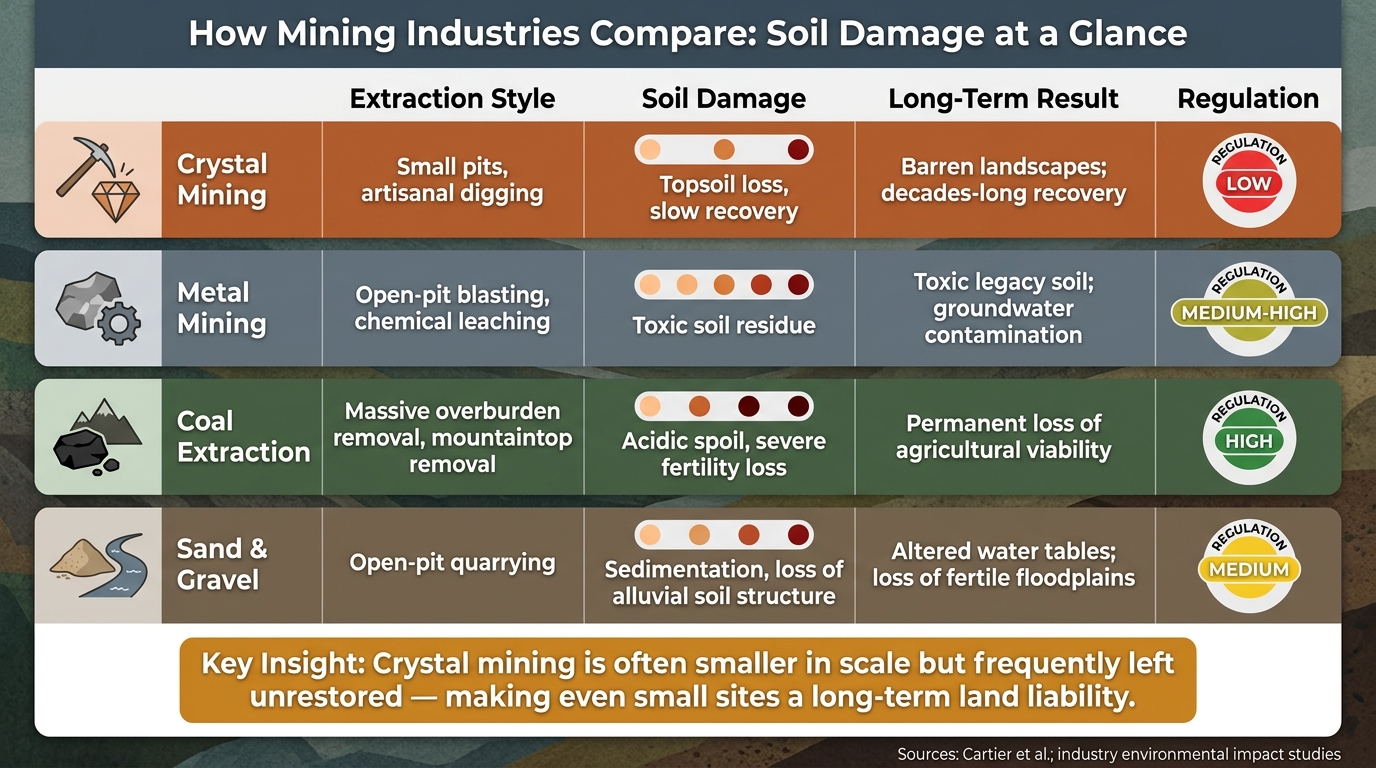
Crystal Mining vs. Other Industries: Soil Damage & Long-Term Land Costs
Those soil losses aren't limited to crystals. They show up across mining of all kinds. Crystal mining brings many of the same ground-level problems seen in other extractive work: topsoil loss, compaction, erosion, and a drop in soil fertility. The main differences usually come down to scale, the type of pollution left behind, and whether the site gets restored.
Soil Impacts Shared Across Mining Sectors
Across mining sectors, the first stage of damage looks much the same. Vegetation and topsoil are stripped away first. After that, soil structure starts to break down, and nutrient cycling begins to fail.
The table below shows how each industry affects the land it leaves behind.
| Industry | Extraction Style | Soil Damage | Long-Term Result |
|---|---|---|---|
| Crystal Mining | Small pits, artisanal digging | Topsoil loss and slow recovery | Barren landscapes; decades-long recovery |
| Metal Mining | Open-pit blasting, chemical leaching | Toxic soil residue | Toxic legacy soil; groundwater contamination |
| Coal Extraction | Massive overburden removal, mountaintop removal | Acidic spoil, severe fertility loss | Permanent loss of agricultural viability |
| Sand & Gravel | Open-pit quarrying | Sedimentation, loss of alluvial soil structure | Altered water tables; loss of fertile floodplains |
Metal and coal mining often leave behind a heavier chemical load, which can make the land unfit for farming. Sand extraction changes riverbeds and floodplains in ways that are hard to undo.
What Sets Crystal Mining Apart
Crystal mining is often smaller than coal or metal mining, but smaller doesn't mean safe. A lot of crystal mining is artisanal, small-scale, and lightly regulated. That means many sites are abandoned without any restoration work.
So the core damage pattern isn't what sets crystal mining apart. The bigger issue is how often crystal sites are left as-is, with no formal cleanup or repair. Large industrial mines in developed countries are more likely to face legal restoration rules. Artisanal crystal mines often face none. As Laurent E. Cartier has noted, better drilling, blasting, and pitting practices would reduce harm at small-scale sites.
Without restoration, even a small site can leave behind soil damage that lasts for decades.
Long-Term Costs for Land, Communities, and Future Land Use
Reduced Fertility and Slower Ecosystem Recovery
When a crystal mine shuts down, the land often doesn’t bounce back. The soil can stay compacted, acidic, and stripped of topsoil for decades, which makes it hard to grow crops, support native plants, or bring forests back. In Minas Gerais, amethyst mining has cleared large sections of the Atlantic Forest.
A lot of small-scale crystal mines are mobile operations. Miners dig, remove what they came for, and move on without stabilizing the ground or replanting the site. What’s left behind is degraded land that local communities have to live with, even when they don’t have the money, labor, or support to repair it. If no restoration work happens, the damage doesn’t just sit there. It turns into a long-term land-use problem.
Legacy Risks for Water and Nearby Communities
The damage doesn’t stop at the edge of the mine. Eroded sediment can wash into streams, clog irrigation systems, and harm aquatic habitat. Mining can also leave toxic heavy metals such as lead, mercury, and arsenic in the soil. Those pollutants can remain long after a mine closes and contaminate fish and crops that local communities rely on.
For farming communities near unregulated mine sites, this hits close to home. Dirty water and infertile land can cut food production and income at the same time. Most crystal buyers never see the degraded ground left behind by extraction. That’s why restoration needs to start as soon as mining ends.
These long-lasting costs leave little room for half-measures. Restoration and ethical sourcing are the only response that can hold up over time.
Solutions: Reducing Soil Costs Through Restoration and Ethical Sourcing
Mine Restoration Methods That Aid Soil Recovery
Once soil is damaged, fixing it takes two things: repair at the mine site and cleaner sourcing upstream. The recovery process starts where the damage began. Different restoration methods deal with different problems, from erosion and broken land contours to pollution in soil and water.
| Restoration Method | Main Soil Benefit | Expected Time Scale | Key Limitation |
|---|---|---|---|
| Topsoil Salvage | Preserves seed banks and organic matter for immediate reuse | Immediate (during mining) | Requires careful storage to prevent anaerobic conditions |
| Backfilling | Restores land contours and reduces deep-pit hazards | Months to years | Can cause compaction if heavy machinery is used |
| Native Revegetation | Prevents erosion and restores local biodiversity | 5–20 years | High failure rate if pH and nutrients aren't corrected first |
| Bioremediation | Removes heavy metals and toxins from soil and water | Years | Effectiveness varies by contaminant type and concentration |
No single method does the whole job. Topsoil salvage helps protect the living layer of soil before mining strips it away. Backfilling helps reshape the land so pits and unstable slopes don't keep causing harm. Native revegetation helps hold soil in place, but it usually won't work well if pH and nutrient levels are still off. And bioremediation can help clean up heavy metals and other toxins, though results depend on what the contaminants are and how concentrated they are.
That’s why these methods tend to work best as a package of solutions, not as one-off fixes. Backfilling can steady the terrain. Revegetation can then help slow erosion. Bioremediation can chip away at contamination over time. Closed-loop water systems also help by lowering the risk that polluted water spreads the damage further.
Why Ethical Sourcing Matters for Crystal Buyers
For buyers, prevention starts with a simple point: know where the stone came from. If sourcing is traceable, a buyer can check the mine or region of origin and see whether the site followed restoration rules. That matters because it ties responsibility to the land, not just to the sale.
A seller doesn’t need a polished pitch. What matters is whether they can answer basic questions clearly. For example:
- Do they have a written sourcing standard?
- Are workers paid living wages?
- Is the mine site subject to restoration rules?
If those answers are vague, that’s a red flag. A low sticker price can hide a much bigger land cost somewhere else.
Conclusion: From Extraction to Better Soil Stewardship
Crystal mining can leave soil damage that lasts for years. Restoration and traceable sourcing are the main ways to cut that cost. At a minimum, the price of a crystal should reflect the condition of the land left behind.
FAQs
Why is soil recovery so slow after crystal mining?
Soil recovery is slow because crystal mining often strips away topsoil, leaving the land barren, unstable, and easy to wash out. That damage can set off erosion, landslides, and flooding.
What’s left behind usually isn’t healthy soil in any normal sense. It can turn highly acidic and become polluted by heavy metals or chemicals used during processing. As a result, plants struggle to take root, and natural regrowth slows to a crawl.
Fixing that kind of damage usually takes intensive treatment over a long period, not a simple replanting job.
Can small crystal mines really cause long-term soil damage?
Yes. Small-scale crystal mines can cause long-term soil damage. Even without heavy machinery, unregulated or migratory artisanal mining can tear up fragile soil structure and speed up erosion.
The result? Land can be left barren and unstable. On top of that, unmanaged waste and chemical use may pollute the soil, slow native plant regrowth, and damage local ecosystems long after mining stops.
How can buyers tell if a crystal was ethically sourced?
Look past labels like “ethically sourced.” There’s no universal certification standard behind that phrase, so by itself, it doesn’t tell you much. The better signal is transparency from the seller.
Ask where the stone came from: the country, the region, and, if possible, the exact mine or cooperative. A seller you can trust should be able to walk you through their supply chain in plain language.
A few red flags are hard to ignore:
- Vague or evasive answers
- Prices that seem unusually low
- No paperwork or supporting records
- No clear disclosure about treatments, including dyes or chemicals
That last point matters more than many buyers think. If a stone has been treated, you should know before you buy.
