


Ethical sourcing is no longer just about where a product comes from. It is also about what gets damaged, and what gets repaired.
If I had to sum up the article in a few lines, it would be this:
- Crystal sourcing can damage land, forests, and water systems.
- The impact does not stop at mining; cutting, polishing, packaging, and shipping add more strain.
- Tree planting does not erase that harm, but it can help repair part of it.
- Tree planting only matters when brands cut harm first, show where materials come from, and track planting results over time.
- Buyers care about this: 88% say clear ethical sourcing matters, 83% say they will pay more for ethically produced goods, and 73% of crystal buyers have said they worry about where their stones come from.
Put simply: doing less damage is not enough. If a brand wants to talk about ethical sourcing, I think it should also show some form of repair.
Here’s the core idea at a glance:
| Topic | What matters |
|---|---|
| Sourcing | Clear origin, labor standards, lower-impact shipping, and repair work |
| Main harm | Deforestation, erosion, water disruption, and mine runoff |
| Supply chain impact | Mining, polishing, packaging, and shipping all add up |
| Why trees matter | They help store carbon, support soil, and help bring back habitat |
| What to watch for | Native species, survival tracking, local input, and outside verification |
| Red flag | Planting trees without supply chain transparency |
A few facts stand out. In Madagascar, mining has been linked to the loss of 90% of original forests and damage to 90% of riparian zones mentioned in the article. The article also notes that polishing 1 kg of crystal can use up to 50 kWh of electricity. Those numbers help show why repair work is part of the conversation now.
So the main takeaway is simple: ethical sourcing is stronger when it pairs lower harm with measured restoration. That is where tree planting fits in.
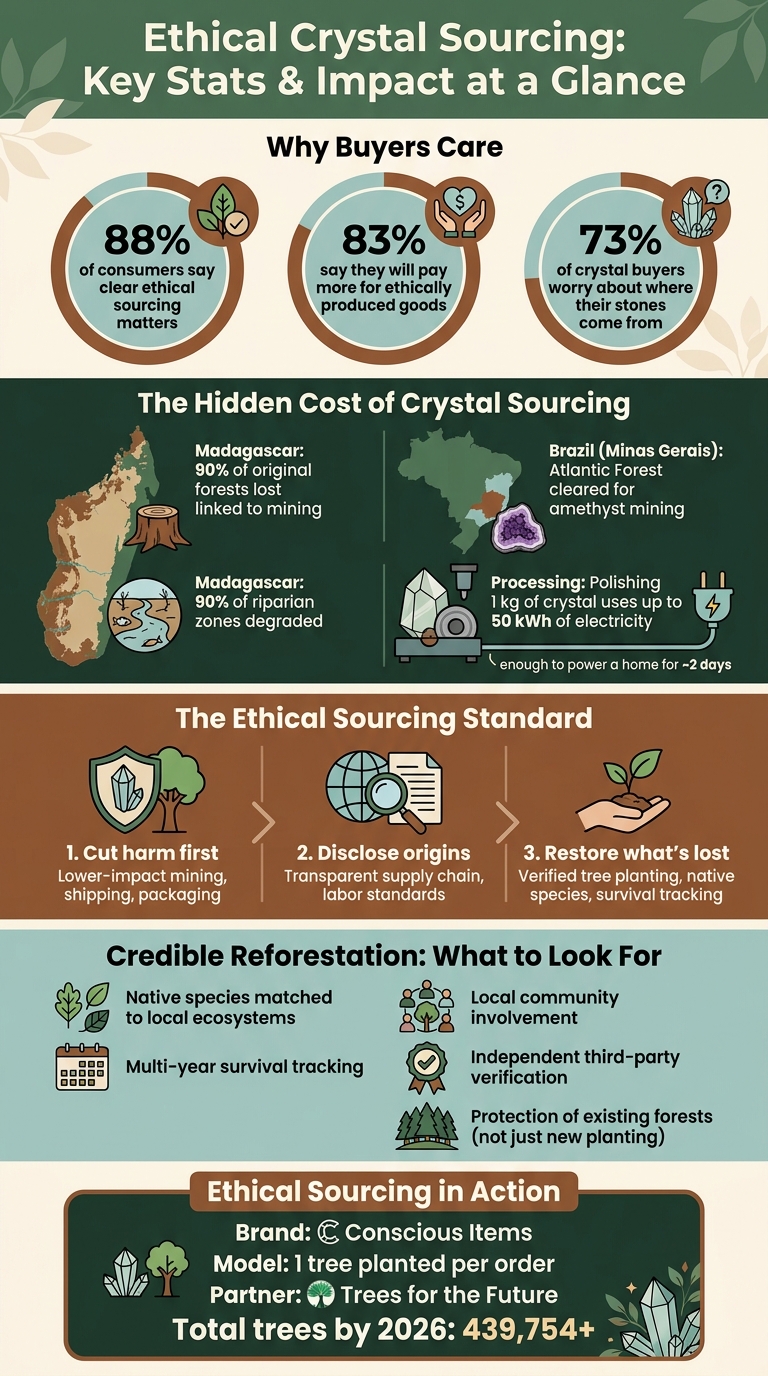
Ethical Crystal Sourcing: Key Stats & Impact at a Glance
The Environmental Impact of Crystals | How to Ethically Source Crystals
sbb-itb-cb05739
The problem: sourcing crystals and spiritual goods can damage ecosystems
Crystal mining can harm land, water, and wildlife habitat. You can often see that damage right around the mine itself.
How extraction can cause deforestation, erosion, and water disruption
Getting to crystal deposits usually means stripping away surface plants and digging deep into the ground. That wipes out habitat, loosens soil, and leaves the land open to erosion.
In Madagascar, a main source of rose quartz and labradorite, unregulated mining has played a part in the loss of 90% of the country's original forests and the degradation of 90% of the island's riparian zones. In Brazil's Minas Gerais region, mining for amethyst has cleared large parts of the Atlantic Forest, a major biodiversity hotspot.
That kind of damage isn't abstract. It changes landscapes, puts pressure on wildlife, and disrupts the water systems nearby. These are the kinds of losses ethical sourcing should help repair.
But digging the stones out of the ground is only part of the story. The footprint grows after extraction too.
Why transport and processing add to the overall footprint
Once crystals are mined, they still have to be cut, polished, packaged, and shipped. And that often happens across several continents before a stone reaches the buyer.
Polishing just 1 kg of crystal can use up to 50 kWh of electricity, which is roughly enough to power an average household for nearly two days. Mine runoff can also carry heavy metals into nearby rivers and groundwater. And when yields are low, more earth has to be moved just to produce a smaller number of stones that can actually be sold.
So the impact doesn't stop at the mine site. It adds up across the whole supply chain, step by step. That's why sourcing needs to be judged on more than extraction alone, and why tree planting has a place in the fix.
The solution: tree planting helps repair part of the impact
Tree planting doesn't undo mining damage by itself. But as part of a broader sourcing plan, it can help repair some of what extraction and shipping take away.
How trees support carbon capture, soil health, and biodiversity
Reforestation can cut part of the carbon footprint by storing carbon in trees and soil. It also helps in other ways. Trees can hold loose, eroded ground in place and rebuild the organic matter that extraction removes.
Trees can also help bring watersheds back into better shape and improve water retention. As forest cover returns, habitat comes back too. That supports insects, birds, and plant species pushed out during extraction.
But this only matters when planting is done as real restoration, not a numbers game.
What makes a tree-planting program credible
Not every tree-planting program leads to results that last. Many projects aren't monitored long enough to confirm survival, and fewer than half track tree survival rates.
A credible program does far more than count seedlings. It uses native species that fit the local ecosystem, tracks survival for several years, includes local communities in decisions, and protects existing forests instead of treating new planting like a swap for clearing old growth. Independent third-party verification adds an auditable layer that self-reported estimates simply can't match.
That's the line between real restoration and a marketing claim. When brands follow those rules from the start, tree planting becomes part of ethical sourcing instead of an extra.
How ethical brands connect sourcing with tree planting
What responsible integration looks like in practice
Once planting standards are in place, the next step is linking them to everyday sourcing. The order matters: cut harm first, disclose where materials come from and how they’re processed, then plant trees to address what’s left.
If a brand skips transparency and jumps straight to restoration, it opens the door to greenwashing. A clear trigger - like one tree for every order - makes the promise easy to track. Sourcing carries more weight when each purchase is tied to restoration.
How Conscious Items ties each purchase to sustainability

Here’s what that looks like on the ground. Conscious Items sells crystal jewelry and spiritual products, works with small-scale miners, and plants one tree for every order through Trees for the Future. By 2026, that total reached more than 439,754 trees.
Conclusion: ethical sourcing is stronger when it includes restoration
Ethical sourcing can cut harm, but it can't fix all of it. Mining still wears down soil. Shipping still adds emissions as goods move around the world. Tree planting helps fill that gap, without acting like it wipes the slate clean.
That move - from doing less damage to doing some repair - is why tree planting fits ethical sourcing so well.
Tree-planting programs carry more weight when they use verified methods and track results over time.
That matters because shoppers want proof they can see, not broad statements. The standard is pretty simple: visible action beats vague pledges. A tree linked to each purchase is easier to trust than a general sustainability claim.
Spiritual ecommerce should connect meaning with accountability. When Conscious Items links each purchase to tree planting, it makes sustainability a measurable part of the product. That is what makes ethical sourcing stronger: less harm, real restoration, and a result buyers can see.
FAQs
How does tree planting help after mining?
Tree planting plays a direct role in post-mining recovery. It helps bring damaged land back to life, supports biodiversity, and gives stripped-down sites a path toward becoming working ecosystems again.
Reforestation also helps hold soil in place and cut erosion. On top of that, some plant species can help lower soil contaminants, which makes recovery more effective over time.
There’s another piece people often miss: wildlife movement. As barren land starts to recover, planted areas can form wildlife corridors that help animals move more safely from one habitat to another. That movement matters because it supports genetic diversity and helps ecosystems rebuild step by step.
Conscious Items supports this work by planting a tree with every purchase.
What makes a tree-planting program credible?
A tree-planting program you can trust does more than put seedlings in the ground. It shows verified, measurable, long-term impact.
If you want to avoid greenwashing, look for a few clear signs:
- GPS-tagged planting locations
- Independent third-party audits
- Clear, public reporting
That’s the bare minimum. A solid program should also track survival rates at 6, 12, and 24 months. Why does that matter? Because planting is the easy part. What counts is whether those trees are still alive later.
It should also report on native species diversity and ecosystem health, not just the number of trees planted. And to avoid double counting while showing growth over time, it should use transparent tools like blockchain or satellite imagery.
How can I verify ethical crystal sourcing?
Verifying ethical crystal sourcing takes some legwork because there’s no single certification system everyone follows.
So it helps to ask direct questions about:
- where the stone came from
- who handled the mining and labor
- what standards the company uses when it sources crystals
A seller you can trust should at least tell you the country of origin. Even better, they can point to the region or mine.
It also helps to check for plain disclosure about gemstone treatments, like heat treatment or dyeing. Those details matter. If a seller leans on vague marketing claims instead of giving clear facts, that’s usually a red flag.
