


Crystals do not make things happen on their own. What may help is the habit built around them: clear goals, mental rehearsal, a set cue, and action.
Here’s the short version:
- Visualization can help you prepare by rehearsing a task in your mind
- Crystals can act as reminders to pause, focus, and return to your goal
- If-then plans work better than vague wishes because they link a cue to one next step
- Ritual and expectation can shape how the practice feels, which may help you stay with it
- There is no peer-reviewed clinical proof that crystals directly heal or change outside events
I’d put it this way: if you use a crystal like a desk note, ring, or other physical prompt, it may help you repeat a short focus routine more often. And repetition matters. A 30-second daily reset often does more than a long session you do once and forget.
A few key points stand out from the article:
- Mental imagery may use some of the same brain pathways involved in performance
- Positive emotion during imagery may support calm and follow-through
- Visible and touch-based cues can make a goal feel more concrete
- The strongest support is for attention, habit, and routine - not for crystal power
Bottom line: manifestation works best when intention is tied to action. In this setup, a crystal is not the cause of the result. It is the cue that helps you come back to the practice and take the next step.
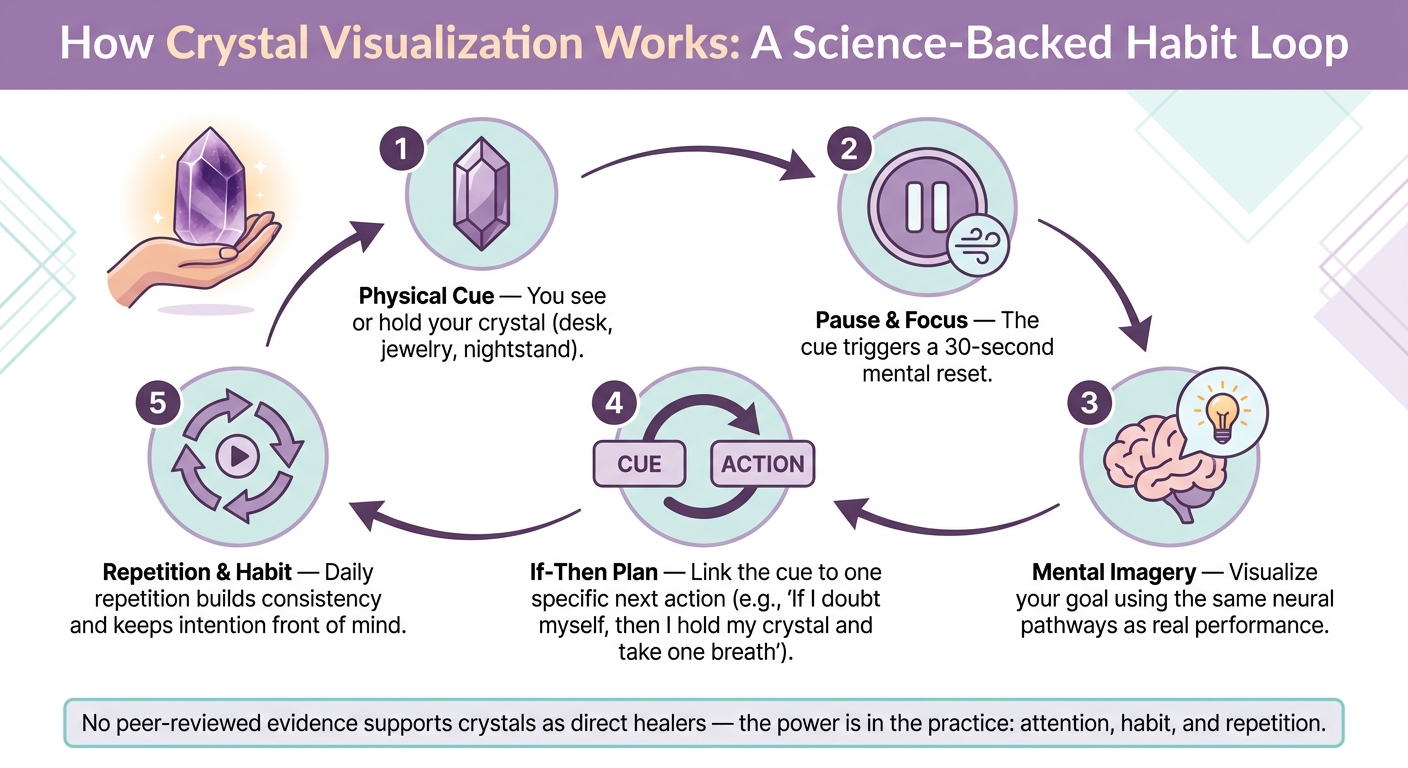
How Crystal Visualization Works: A Science-Backed Habit Loop
What Research Says About Visualization and Goal Pursuit
Mental Imagery Can Strengthen Motivation and Action Planning
Research suggests that mentally rehearsing a goal can switch on many of the same neural circuits the brain uses during actual performance. Put simply, the mind is not just daydreaming. It is, in part, practicing.
In crystal practice, the crystal acts as the cue that starts that rehearsal. You see it, hold it, or place it somewhere in view, and that becomes the signal to run the mental script again.
Studies also show that mental imagery tends to work better when it is paired with a clear if-then plan. That kind of plan makes follow-through more likely because it links a situation to a specific action. For example:
- If I start doubting myself before a meeting, then I will hold my crystal, take one breath, and picture myself speaking clearly.
- If I sit down to train, then I will spend 30 seconds visualizing the first few steps going well.
There’s an important limit here. Visualization helps most with internal factors like confidence, coordination, and familiarity. It can support preparation, but it does not control outside events. That’s where crystals fit in: not as a force that changes the world for you, but as a steady cue that helps you return to the practice.
Guided Imagery May Support Calm, Attention, and Consistency
Guided imagery may involve brain systems tied to emotion regulation and decision-making. That matters because goal pursuit is not just about effort. It is also about staying steady when stress, doubt, or distraction show up.
Research also suggests that positive emotions during imagery can broaden attention and support resilience over time. In plain English, when the exercise leaves you feeling calmer and more settled, it may be easier to stay with it instead of dropping it after a few days.
A more focused state can also make the practice easier to repeat and strengthen. And repetition is the whole game here. A crystal can help by turning guided imagery from something vague and occasional into a routine you actually return to. The object becomes a small anchor: a physical reminder to pause, focus, and run the exercise again.
Why Crystals May Make Visualization Feel More Effective
Belief and Expectation Shape the Experience
No peer-reviewed clinical trials support crystal healing as a direct medical treatment. Still, belief and context can shape mood, focus, and perceived progress. In plain English: the main value comes from how the ritual helps organize your attention, not from any proven effect of the crystal itself.
That helps explain why crystal rituals can feel calming, focused, and more grounded even when the effect is psychological rather than metaphysical. When someone uses the same object in the same intentional way over and over, expectation starts to do part of the work. The crystal becomes less about the object alone and more about what your mind has learned to connect with it.
Ritual Structure Can Increase Commitment and Emotional Focus
Repetition matters here. Over time, the crystal turns into a cue that signals it’s time to slow down and focus. That kind of routine can make a goal feel less vague because the intention is tied to something you can see and hold.
A physical object also makes it easier to come back to the same thought or aim. Instead of letting an intention drift around in your head, you place it somewhere concrete. That’s often why these routines feel steady: they combine an object, focused attention, and repetition.
Psychological Mechanisms Activated by Crystal Rituals
These effects are best understood through attention, expectation, and habit. Belief and context shape how the ritual feels and how often people return to it. If the practice also brings up positive emotions, that can widen attention and help support resilience over time.
The crystal, then, works through the meaning attached to it. Used with a clear intention and a steady routine, it can keep a goal front and center - and make that goal easier to act on.
The next step is how the crystal itself functions as a physical cue for attention and habit.
How Crystals Work as Physical Cues for Habit and Attention
Visual and Tactile Cues Help People Repeat Intention Practices
A crystal on your desk or nightstand can act as a simple prompt to pause and refocus. In plain terms, it works like any visible reminder: it keeps your intention concrete and easy to return to.
Habit research shows that objects can function as physical anchors for implementation intentions, or if-then plans that connect a cue to a response. The key is simple. The cue works best when it's linked to a specific action, not just a vague goal.
If I see the crystal on my desk, then I take one slow breath and bring my mind back to today's goal.
That kind of pairing gives the object a job. It stops being just decoration and starts serving as a prompt for attention.
Multisensory Focus May Deepen Engagement with Mental Imagery
Holding a crystal while visualizing adds touch to the exercise. Instead of keeping the whole process in your head, you have something physical to feel, which can make the imagery seem more concrete.
Wearing a crystal as jewelry carries that same effect into the rest of the day. A bracelet or ring can work as an ongoing physical reminder that keeps your goal top of mind during the day. Think of it like tying a string around your finger, but a bit more personal and easier to keep with you.
Short, daily interactions with a physical cue tend to work better for habit formation than occasional long sessions. That's why a small repeatable practice often beats a big once-in-a-while effort. When the same cue is built into a simple routine, it becomes easier to revisit the intention without much friction.
Role of Physical Cues in Goal-Directed Visualization
Whether a crystal is visible, held, worn, or kept in one set spot, its main role is to create a repeatable cue for attention and action. The practical use comes from staying consistent: use the crystal as the same cue each time, pair it with a clear visualization routine, and follow it with one concrete next step.
sbb-itb-cb05739
Applying the Evidence to a Responsible Crystal Practice
What the Evidence Supports Most Clearly
The clearest takeaway is simple: the best support is for the practice around crystals, not for crystals as a direct force on their own.
Visualization tends to help most when the main obstacle is confidence, coordination, or lack of familiarity. In that setup, a ritual can give your effort shape. And a physical object can help keep your intention in front of you instead of letting it drift into the background. So the crystal works more like a reminder for repetition than the thing causing the outcome.
Limits of the Evidence and Why Practical Action Still Matters
The research also draws a firm line. No peer-reviewed clinical trials show that crystals directly treat health or medical conditions. That matters.
A crystal may help you stay focused on a goal. It may prompt a habit. It may remind you to pause, picture the next step, or follow through. But it cannot do the work for you, and it should not stand in for medical care or direct action.
Evidence-Informed Components of Crystal Visualization
The parts with the strongest support are mental imagery, repeated ritual, physical cues, and if-then plans. Put together around a clear intention, those pieces create a practice tied to research on imagery, habit, and goal pursuit.
In plain English, the useful parts look like this:
- Mental imagery helps you rehearse what you want to do
- Repeated ritual gives the practice a steady pattern
- Physical cues remind you to return to that intention
- If-then plans turn a vague goal into a specific response
Used this way, crystal visualization is less about waiting for change to happen and more about giving yourself a steady prompt to act.
How To MEDITATE WITH CRYSTALS For Beginners 💎(In 15 Minutes) Crystal Healing Guided Meditation
FAQs
How do I use a crystal as a daily cue?
Use a crystal as a physical anchor for your intention during the day. A bracelet or necklace can act like a small tap on the shoulder, bringing your goal back into focus when life gets busy or your mind starts to wander.
You can also keep a crystal on your desk, next to your planner, or on an altar so it stays in sight. That simple visual cue can help you reconnect with your commitment without overthinking it. Conscious Items offers ethically sourced crystal jewelry and sets for this purpose.
What visualization works best with crystals?
Visualization works best when you focus on the process, not just the finish line. Picture the habits, actions, and small steps that move you toward your goal. That way, you’re not just daydreaming about the outcome - you’re mentally practicing what it takes to get there.
A crystal from Conscious Items can help with that by acting as a physical anchor. Hold it in your hand or keep it close by, and it gives your mind something concrete to return to. Sometimes that small cue is enough to bring your attention back, ground your intentions, and help you stay focused day after day.
How long does crystal visualization take to become a habit?
There’s no fixed timeline for crystal visualization to become a habit. It’s personal, and it depends more on consistency than on a set number of days.
Doing it often helps the practice feel more natural and routine. If it helps, a Conscious Items crystal bracelet or ritual object can act as a physical reminder to pause and begin. Even 5 to 10 minutes a day can help you stay consistent over time.
