


If you want to bury a crystal in soil, use hard, grounding stones and skip soft or water-sensitive ones. In this list, I’d keep Black Tourmaline, Smoky Quartz, Hematite, Obsidian, Red Jasper, Moss Agate, Tiger’s Eye, Onyx, Shungite, and Green Aventurine at the top.
Here’s the short version:
- I’d bury most of these stones for overnight to 24 hours
- I’d place them about 3 to 6 inches deep
- I’d use untreated soil only
- I’d wrap polished or scratch-prone stones in a silk or soft cloth pouch
- I’d skip burial for selenite, halite, Desert Rose, calcite, and fluorite
The main reason is simple: some crystals can handle moisture, soil pressure, and grit, while others can’t. In the article, most of the safer picks sit around 6.5 to 7 on the Mohs scale, while some riskier stones fall at 4 or lower. That gap matters.
My quick take: if you want the safest bets, I’d start with Black Tourmaline, Red Jasper, Onyx, Smoky Quartz, and Moss Agate. If you want to be more careful, I’d watch Hematite, Obsidian, and Shungite due to rust, scratching, or porosity.
Quick Comparison
| Crystal | Best Use | Usual Burial Time | Main Risk |
|---|---|---|---|
| Black Tourmaline | Protection, grounding | Overnight | Dry after removal |
| Smoky Quartz | Grounding, calm | Overnight | Avoid coated versions |
| Hematite | Stability, focus | Overnight to 24 hours | Moisture can affect finish |
| Obsidian | Protection, clearing | Overnight | Scratches easily |
| Red Jasper | Grounding, strength | Overnight to 24 hours | Dirt in grooves |
| Moss Agate | Growth, renewal | Overnight | Keep out of long direct sun |
| Tiger’s Eye | Protection, balance | Overnight | Surface scratches |
| Onyx | Strength, grounding | Up to 24 hours | Avoid chemical-treated soil |
| Shungite | Grounding, release | Short overnight | Porous surface |
| Green Aventurine | Growth, balance | Overnight to 24 hours | Use gentle cleanup |
If I had to sum up the whole article in one line, it would be this: earth burial works best when the stone is hard, dense, and grounded by nature - and when you keep the burial short, dry, and easy to track.
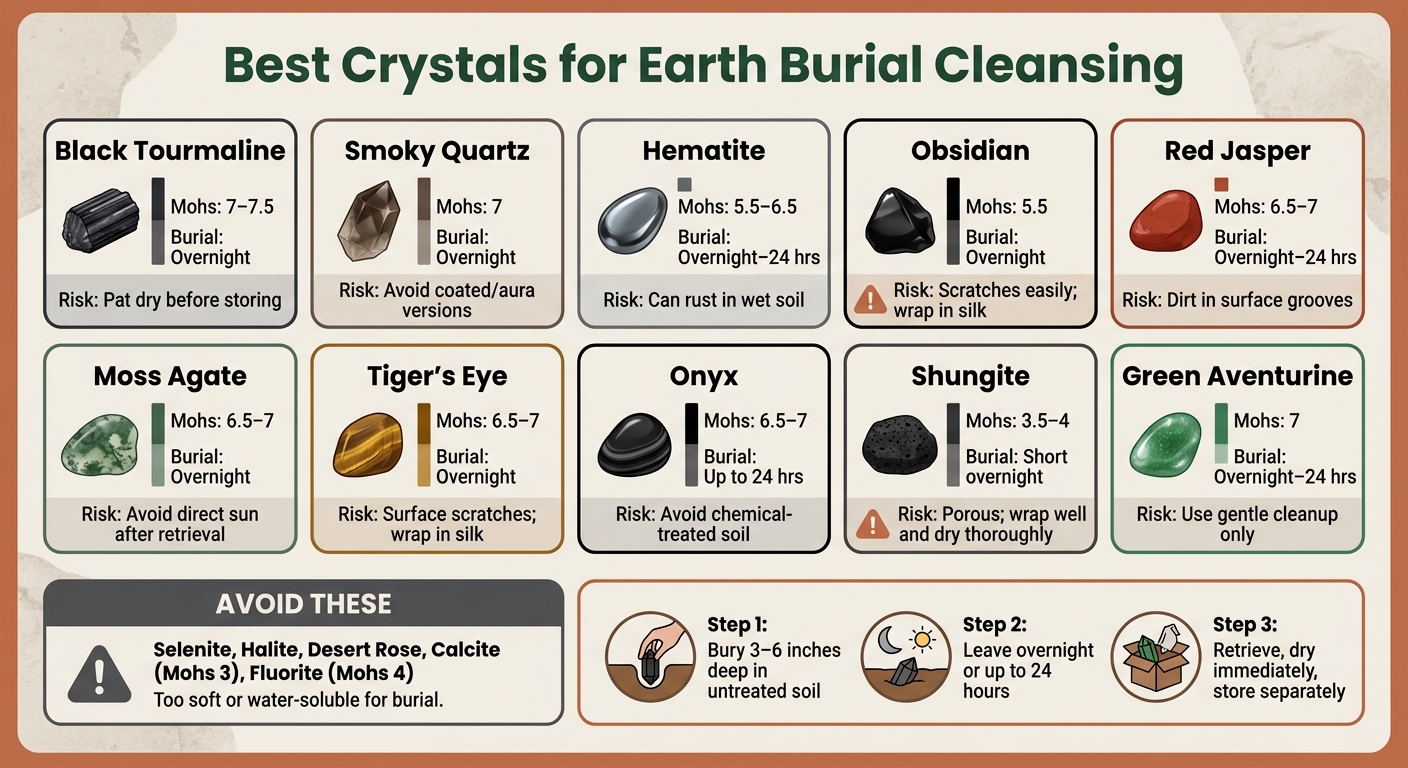
Best Crystals for Earth Burial: Hardness, Burial Time & Key Risks
How Earth Burial Cleansing Is Thought to Work
Earth burial is thought to work by allowing a crystal to release built-up energy into the soil, which helps it reconnect with the grounding energy of the earth. Because of that, people often use earth burial for grounding stones like black onyx, Jasper, and Obsidian.
This is a spiritual practice, not a scientific or medical treatment. It comes from energy-based beliefs, not science.
Before you bury any stone, check the soil, the location, and the weather.
What to Know Before You Bury a Crystal
Once you know why earth burial is used, a few basics can help you do it with less risk. Keep your focus on three things: clean soil, a safe place to bury it, and dry weather.
Choose safe soil and a legal location
Use natural, untreated soil in a private garden, planter, or another place where digging is allowed. Stay away from soil exposed to fertilizers, pesticides, harsh cleaners, or other chemicals. Those can harm a crystal’s surface and luster.
Also, skip protected public land or any area where you don’t have permission to dig. That part matters just as much as the soil itself.
Mark the burial spot clearly
A flowerpot or planter makes things much easier. It helps you keep track of the stone, keeps the ritual simple, and lowers the chance of losing it in the dirt.
You can also wrap the crystal in a silk pouch before burial. That can help shield it from soil debris and make it easier to retrieve later.
Bury the crystal 3 to 6 inches deep. Around 3 inches is easier if you want to get it back without much hassle. 4 to 6 inches gives the stone more contact with the earth.
Pick a burial time that fits the stone and the weather
Leave the crystal buried overnight or for about 24 hours. Then retrieve it before the weather shifts. It’s smart to check the forecast first. Dry weather lowers the risk of water damage and makes the whole process easier.
Rain and extreme heat are best avoided. Dry conditions are simply easier on the crystal.
With those basics in place, the next step is choosing which stones are the best fit for earth burial.
1. Black Tourmaline
Black Tourmaline is a dense, grounding stone that people often use for protection. It's also widely linked to absorbing negative energy. Because of that grounded, heavy feel, it stands out as one of the clearest stones for earth burial.
Why earth burial suits it
Its dense, grounding nature pairs well with soil cleansing. Burying it in earth is thought to reconnect the stone with the ground it came from and help reset it in soil.
Durability in soil
Black Tourmaline is a hard, dense silicate mineral, so it tends to hold up well in soil without breaking down. That staying power makes it a safer pick for longer burial than softer, more delicate stones.
Special care precautions
After you retrieve it, pat the stone dry before storing it on its own. If it starts to look dull, that may be a sign it's ready for another cleansing.
2. Smoky Quartz
Smoky Quartz is another sturdy grounding stone that does well with earth burial. People often use it when they want to feel steadier, calmer, and more connected to the ground beneath them.
Its stable structure makes it a good fit for this method. When you bury it in raw soil, many people believe the stone can reset there and reconnect with the earth’s natural energy.
Durability in soil
Smoky Quartz has a Mohs hardness rating of 7, so it can handle burial better than softer stones such as selenite, calcite, or fluorite. In plain terms, it’s tough enough for soil. A short burial in raw soil is usually a good choice for Smoky Quartz.
Special care precautions
Skip aura-coated versions. That metallic or oily finish is a surface treatment, and soil acidity can wear it down.
If you plan to charge the stone after burial, stay away from harsh direct sun right after. The main issue here isn’t Smoky Quartz itself. It’s the surface treatment.
3. Hematite
Like smoky quartz, hematite feels dense and grounding. But it also needs a bit more care around moisture. Hematite is an iron-rich stone with a metallic sheen, and people often use it for focus, stability, and determination.
Why earth burial suits it
Hematite is a natural fit for earth burial because of its weight and iron-rich makeup. Burying it is said to help clear stagnant energy and bring back its grounding feel. A 24-hour or overnight burial in raw, untreated soil is a common recommendation.
That same density is part of why people like working with hematite. It feels solid in the hand. Still, once you dig it back up, handle it with care.
Durability in soil
To help protect its metallic finish, wrap hematite in a silk pouch before burial. Place it about 3 to 6 inches deep so it has good contact with the earth.
Special care precautions
Moisture is the main issue here. Because hematite is iron-based, long exposure to water can affect it. After you retrieve it, rinse it briefly, dry it right away, and store it away from harder stones.
The short version is simple:
- Use a silk pouch
- Keep the burial brief
- Dry hematite immediately after digging it up
4. Obsidian
Obsidian belongs with the grounding stones above, but its glass-like surface calls for a gentler touch. It’s a volcanic glass formed from cooled lava, which is why many people connect it with the earth’s core. It’s often used for grounding and protection. And because obsidian is said to absorb stagnant energy, regular cleansing can help.
Why earth burial suits it
Earth burial makes sense for obsidian. Its link to lava and the earth gives this method a natural fit. The soil may help discharge what the stone has taken on and let it recharge with the earth’s natural vibrations.
Durability in soil
This is where you need to be careful. Obsidian’s glassy structure makes it more likely to mark up in soil. It has a Mohs hardness of 5.5, so it’s softer than quartz and more prone to scratching from rough soil particles. Before burying it, wrap it in a silk pouch or another soft cloth.
Special care precautions
Once you remove it from the soil, handle it with care so the surface doesn’t get dulled or scratched. Skip water and sunlight, and keep it away from hard contact. It also helps to store obsidian on its own so it doesn’t get scratched by other stones.
5. Red Jasper
Red Jasper is often linked to the Root Chakra, the energy center tied to stability and a sense of safety. Because it has a strong earth connection, burial cleansing tends to suit it well. If you want a stone that generally handles direct contact with soil without much fuss, this is one of the easier picks.
Why earth burial suits it
Red Jasper is known for grounding, earth-linked energy, so earth burial is often seen as a good match. The idea is simple: the stone rests in the soil, lets go of stagnant energy, and reconnects with the earth. That grounding symbolism lines up neatly with burial cleansing.
A common method is to bury it about 3 inches deep in raw, untreated soil overnight. If you want a deeper reset, some people leave it buried for a full 24-hour cycle.
Durability in soil
Red Jasper is a microcrystalline quartz with a Mohs hardness of 6.5 to 7, which means it generally holds up well in soil. It is also chemically stable, so burial is less likely to cause problems during the cleansing process.
Special care precautions
To keep dirt from getting stuck in small surface grooves, bury the stone in a silk pouch. After you take it out, rinse it and gently brush away any remaining soil. Skip harsh cleaners, since they can dull the finish.
Its toughness also makes cleanup pretty straightforward, which is handy if you plan to use this method more than once.
6. Moss Agate
For a stone that leans more toward growth than protection, Moss Agate is a natural pick. Often called the Gardener's Stone, it pairs well with earth burial because it's tied to growth, renewal, and the earth itself.
Why earth burial suits it
Moss Agate brings a different feel than the heavier protective stones mentioned earlier. Its focus is renewal and growth, which makes earth burial a strong match. It's linked to both the Heart Chakra and the Root Chakra, and burial is believed to reconnect the stone with earth energy while clearing stagnant energy.
It's also often tied to new beginnings and prosperity. So if you're stepping into a new project, a life shift, or a new chapter, Moss Agate fits that moment well.
Durability in soil
Moss Agate is part of the quartz family and has a Mohs hardness of 6.5 to 7. In plain English: it handles damp soil well. That makes it a low-risk stone for burial, with sun exposure being the main thing to watch.
Special care precautions
After you retrieve it, brush off the soil gently. Also keep it out of prolonged direct sun, which can discolor the stone.
sbb-itb-cb05739
7. Tiger's Eye
After Moss Agate’s renewal-focused energy, Tiger’s Eye brings the focus back to protection and stability. It has a grounded, earthy look that lines up well with practices tied to the Root Chakra. Because of that, it’s a strong match for earth burial cleansing.
Why earth burial suits it
Tiger’s Eye is often tied to protection and grounding, so placing it in soil fits its usual energy profile well.
Durability in soil
Tiger’s Eye is a quartz stone with a Mohs hardness of 6.5 to 7. That gives it enough hardness for burial in raw soil without much concern.
Special care precautions
Place the stone in a silk pouch before burial to help avoid scratches. After you take it out, dry it with a soft cloth.
8. Onyx
Onyx, like the other dark grounding stones on this list, does well with earth burial. It’s a dense stone tied to protection, strength, and confidence. People also use it to take in stagnant energy, which makes burial in soil a fitting way to clear what it may have picked up.
Why earth burial suits it
Onyx is connected to the Root Chakra, so placing it in the earth lines up with its grounding nature and returns it to the element most closely linked to it. Many sources point to a full 24-hour burial as an ideal reset for its grounding feel. And because Onyx is tough, this method is usually low-risk in untreated soil.
Durability in soil
Onyx is a durable chalcedony with a Mohs hardness of 6.5 to 7. That makes it a good fit for burial in untreated soil. Just skip treated ground or any area with harsh chemicals, since those can dull the surface.
Special care precautions
Before burying Onyx, place it in a silk pouch to help protect the polished surface from scratches. Once you take it out of the soil, rinse it briefly, dry it all the way, and store it on its own so it doesn’t get scratched by other stones.
9. Shungite
Shungite follows the same grounding theme as the other dark protective stones, but it tends to do best with a short, gentle burial. It’s often used to ground both the body and mind, and many people turn to it to absorb and release stagnant energy.
Why earth burial suits it
Shungite has a close link to grounding, so placing it in soil can feel like a natural reset. In simple terms, you’re returning it to the element it’s most tied to.
Durability in soil
Bury shungite in untreated soil, and keep the burial brief so its surface stays in good shape.
Special care precautions
Leave it overnight for a short reset. Then brush off any soil and store it by itself.
10. Green Aventurine
Green Aventurine shifts the focus from protection to renewal. This quartz stone is often linked with growth, abundance, and emotional balance, so earth burial feels like a natural match.
Why earth burial suits it
Burying Green Aventurine in untreated garden soil is thought to help the stone let go of stale energy and reconnect with the earth.
Durability in soil
Because it’s a quartz stone, Green Aventurine usually holds up well in raw, untreated soil. Bury it about 3 inches deep for 24 hours or overnight.
Special care precautions
After you dig it up, rinse the stone and gently brush away any dirt with a soft toothbrush. Skip harsh chemicals. Its gentle nature also makes it a good example of which stones tend to do well in soil and which ones need more care.
Crystals to Avoid or Use with Care for Earth Burial
Once you've picked stones that can handle burial, the next step is simple: rule out anything the soil can wear down. If a crystal is soft, porous, or sensitive to moisture, burial can lead to cracks, dissolving, or surface damage.
Soft or porous stones that can break down in soil
Avoid stones with a Mohs hardness of 4 or less. Common examples include calcite (Mohs 3) and fluorite (Mohs 4). Fluorite needs extra caution because it splits along flat planes, which means pressure in the soil or temperature changes can crack it.
Agate geodes can also be a problem. Their hollow pockets may hold soil and moisture, which makes them harder to clean and can lead to damage inside the stone.
Salt-based or water-soluble minerals to skip
Some stones just don't belong in damp soil. Selenite, Desert Rose, and halite are clear examples. If a crystal is salt-based or water-soluble, it's best to skip earth burial altogether.
Safer cleansing options for delicate stones
For fragile stones, gentler methods make more sense. Good options include:
- Smoke cleansing
- Sound cleansing
- Moonlight on a windowsill
- A 24-hour rest on a selenite charging plate
Use these methods for delicate crystals, then move on to the burial steps below only for stones that can handle it.
Step-by-Step Earth Burial Cleansing Guide
Use this method only for crystals that can handle soil and moisture.
1. Clean the crystal and set an intention
Wipe the crystal with a soft microfiber cloth. If the stone is water-safe, give it a quick rinse under running water. Then hold it in both hands, pause for a moment, and set a clear intention for the cleanse.
Keep it simple. You might say, "Clear anything that no longer serves this stone." As you do, picture the crystal clearing out and resetting.
2. Bury it a few inches deep in untreated soil
Place the crystal in a silk or other soft fabric pouch. Bury the pouch 3 to 6 inches deep in the marked spot. Then leave it alone until it's time to dig it up.
3. Leave it overnight or for a longer cycle
Overnight is the usual starting point. For a lighter cleanse, leave it buried overnight. For a deeper reset, leave it for 24 hours.
4. Retrieve, brush off soil, and store properly
Dig the crystal up gently, unwrap it, and brush off the soil. Use warm water only for water-safe stones. Dry it right away with a clean cloth.
Skip soap and harsh cleaners. Once the crystal is dry, store it in a soft cloth or in its own compartment so harder stones don't scratch it.
Quick Reference Table
Use this table when you want a fast side-by-side look at each stone's focus, burial time, toughness, and the main thing to watch out for.
| Crystal | Energetic Theme | Suggested Burial Duration | Durability (Mohs) | Special Precautions |
|---|---|---|---|---|
| Black Tourmaline | Protection, energy absorption | Overnight | 7–7.5 | Pat dry before storing; cleanse regularly |
| Smoky Quartz | Grounding, calm | Overnight | 7 | Durable; avoid extreme heat |
| Hematite | Grounding, vitality | Overnight | 5.5–6.5 | Can rust in very wet soil |
| Obsidian | Protection, grounding | Overnight | 5.5 | Fragile glass structure; wrap in silk; avoid water and direct sunlight |
| Red Jasper | Strength, passion, courage | Overnight | 6.5–7 | Generally very stable; use raw soil |
| Moss Agate | Growth, renewal | Overnight | 6.5–7 | Wrap in silk; avoid direct sunlight after retrieval |
| Tiger's Eye | Protection, grounding | Overnight | 6.5–7 | Wrap in silk; dry with a soft cloth |
| Onyx | Protection, grounding | Full day (24 hrs) | 6.5–7 | Avoid salt-heavy soil and chemical exposure |
| Shungite | Grounding, purification | Overnight–24 hrs | 3.5–4 | Porous; wrap well and dry thoroughly after retrieval |
| Green Aventurine | Growth, opportunity | Overnight–24 hrs | 7 | Shares quartz-family durability; generally low-maintenance |
A few cautions stand out right away. Obsidian scratches easily. Shungite is porous, so it needs extra care. Moss Agate shouldn't sit in direct sun after retrieval. And Onyx doesn't do well with chemicals or salt-heavy soil.
Conclusion
Earth burial is best for sturdy, grounding stones. They hold up well in soil and fit this earth-based cleansing method. Good choices include Moss Agate, Red Jasper, Onyx, Shungite, and Black Tourmaline.
Good results come down to careful handling. Use untreated soil, place polished stones in a silk pouch, mark the burial spot, and leave the stone in the ground for about 24 hours. No garden? A planter or pot filled with soil can work too. For delicate stones, gentler cleansing methods are the safer pick.
If a crystal is too soft, too porous, or artificially treated, skip burial. Sound and smoke work well for many delicate stones, and moonlight is a low-risk choice for most crystals. The best cleansing method matches the stone itself and the way it's made.
FAQs
Can I bury more than one crystal together?
Yes, as long as every crystal in the group can handle earth burial safely. Some softer or porous stones can get damaged by soil or moisture.
For the best results, wrap each crystal in a natural cloth before burial. Also, leave a bit of space between them so each one has direct, even contact with the earth’s energy.
What should I do if my crystal gets wet in the soil?
If your crystal gets wet while buried in soil, dry it as soon as you can.
To help prevent moisture damage next time, wrap it in a natural cloth before burial. If the crystal is water-sensitive, skip moist soil and use dry cleansing methods instead, like sound, moonlight, or smoke from herbs or incense.
How often should I use earth burial cleansing?
Earth burial cleansing works best after intense emotional work or when energy feels heavy and stuck. It can also help when a crystal feels oddly heavy, warm, or uncomfortable in your hand.
A lot of practitioners also use this method as a deep cleanse about once a month. If you bury a crystal, leave it in the soil for 24 hours.
