


Mining has fueled economies for centuries, but its aftermath often leaves behind lasting damage. Abandoned mines pollute water, degrade soil, and destroy habitats, with cleanup costs often falling on taxpayers. For example, the Anaconda Copper Mine in Nevada has required $45 million in cleanup efforts so far, with work expected to continue until 2030. Acid mine drainage contaminates rivers and groundwater, while toxic dust spreads through the air, harming ecosystems and communities.
Local economies also suffer after mines close, with property values dropping and health risks rising. Indigenous communities, like the Navajo Nation, face severe challenges from abandoned uranium mines, while some areas, such as Oklahoma’s Tar Creek, are seeing success through community-led remediation efforts.
Consumers can help by choosing ethically sourced crystals and gemstones. Brands that disclose specific origins and avoid exploitative practices are key to reducing harm. Supporting these efforts can align purchases with values, promoting better practices in mining and sourcing industries.
Environmental Damage from Legacy Mining
Water and Groundwater Contamination
When sulfide-rich rocks come into contact with air and water, a chemical reaction occurs, producing sulfuric acid. This reaction, known as acid mine drainage (AMD), is the primary driver of long-term water contamination from abandoned mines. The acid dissolves heavy metals like lead, arsenic, copper, and cadmium, which then seep into nearby rivers, streams, and underground aquifers.
The damage caused by AMD often goes unnoticed. Surprisingly, over 90% of mining-related metals are transported via river sediments instead of being dissolved directly in the water. This means a river might look clear, but its sediments can hold toxic metals for centuries.
"Rivers remember mining." - Mark Macklin, Professor Emeritus, University of Lincoln
Take the Summitville Mine in Colorado as an example. This abandoned site left the Alamosa River contaminated with heavy metals, including copper, cadmium, manganese, and zinc, rendering it lifeless for decades. Globally, it's estimated that 23 million people live on floodplains polluted by toxic mine waste. The contamination doesn't stop at the water - it spreads into nearby soils and even the air, amplifying the environmental damage.
Soil Degradation and Air Pollution
The legacy of abandoned mines extends beyond water pollution, leaving a toxic imprint on both soil and air. Acidic soils with pH levels as low as 3.5 are common near these sites, stunting plant growth and spreading toxic metals into surrounding ecosystems. Tailings and waste heaps left behind are also highly vulnerable to wind erosion. For instance, in Spain's Sierra Minera district, researchers discovered that heavy-metal-rich dust from mine tailings is carried by the wind during dry summer months, contaminating nearby farmland and natural habitats.
Even decades after closure, the impact persists. At Mount Lyell in Tasmania, studies revealed that sediment in the area still contains lead and copper levels over 50 times higher than natural background levels - classified as "extremely severe enrichment".
Habitat Destruction and Loss of Biodiversity
Legacy mining doesn't just pollute; it permanently alters landscapes. From 2001 to 2022, mining activities wiped out 16,268 km² (about 6,283 square miles) of forest, with 65% of this destruction occurring in tropical and subtropical regions. In Appalachia, contour mining has compacted hillsides and left behind rubble-filled areas. These disturbed landscapes are often overrun by invasive species like autumn olive, which outcompete native plants. Efforts to restore these areas, such as The Nature Conservancy's Cumberland Forest Project spanning 253,000 acres in Kentucky, Tennessee, and Virginia, have required intensive soil treatment using bulldozers to create conditions suitable for native plant regrowth.
Aquatic ecosystems are also hit hard by abandoned mines. In South Korea, streams near these sites have seen species richness drop from an average of 32 species in clean areas to as few as 2 species in heavily contaminated zones. Sensitive species like mayflies, stoneflies, and caddisflies are often the first to disappear, signaling a breakdown of the local food web.
"The benthic macroinvertebrate community complexity was lower in streams affected by mining activity... accumulated heavy metal in streambeds due to past mining activities cannot be removed for several decades." - Mi-Jung Bae et al., Freshwater Biodiversity Research Bureau
Mine waste and rivers: The legacy toxins re-entering our waterways
Economic and Social Costs of Abandoned Mines
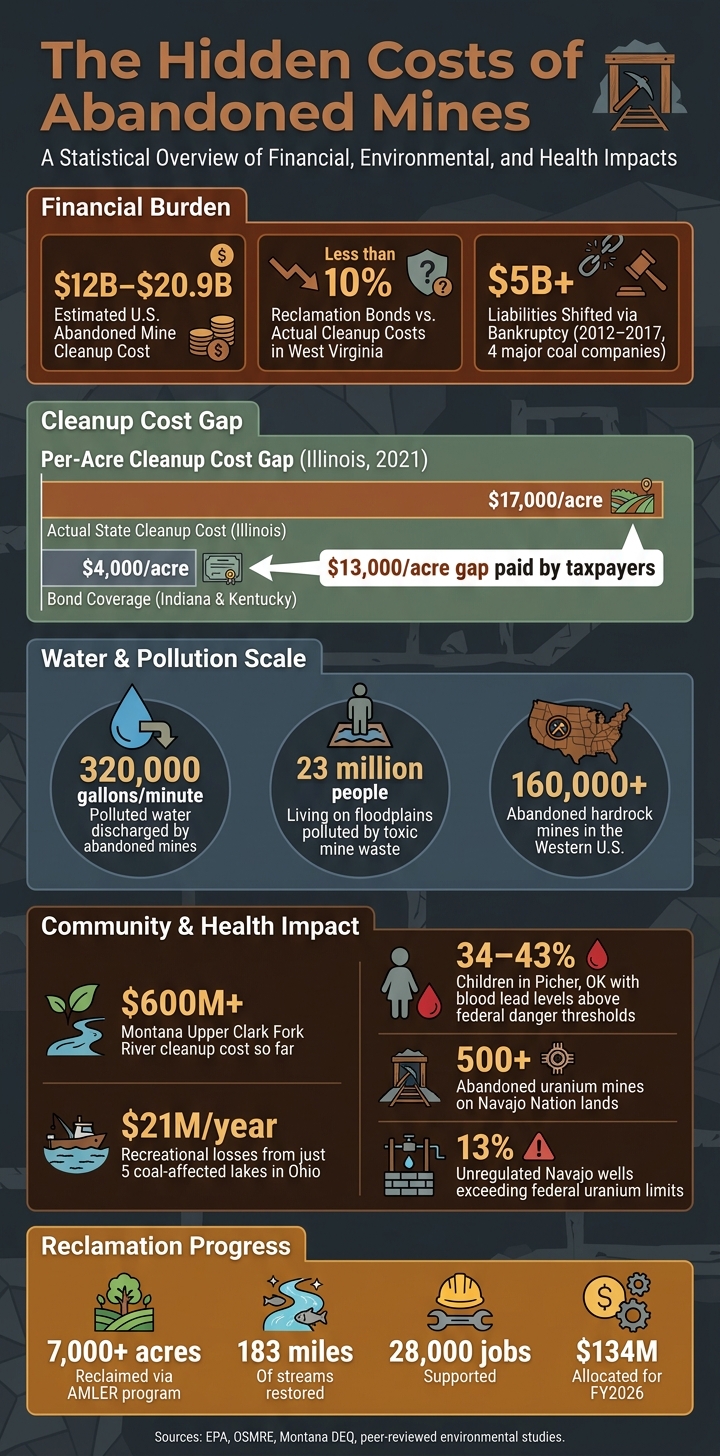
Hidden Costs of Abandoned Mines: Key Stats & Environmental Impact
The Financial Burden of Abandoned Sites
The cost of cleaning up abandoned mines has skyrocketed, now estimated between $12 billion and $20.9 billion. Unfortunately, taxpayers are left to shoulder much of this burden. When coal companies declare bankruptcy, their reclamation bonds often fall far short of what’s needed. For instance, in West Virginia, these bonds cover less than 10% of actual cleanup costs. Between 2012 and 2017, four major coal companies shifted over $5 billion in cleanup and healthcare liabilities through bankruptcy filings alone.
"Whether you know it or not, you're paying for healthcare benefits that have been dumped on [federal mining agencies] by the bankruptcy code." - Joe Pizarchik, Former Head, Office of Surface Mining Reclamation and Enforcement
The financial shortfall is stark. In Illinois, the state spent an average of $17,000 per acre on cleanup in 2021, while neighboring states like Indiana and Kentucky held bonds of only $4,000 per acre. This $13,000-per-acre gap is ultimately covered by taxpayers. On top of this, abandoned mines discharge a staggering 320,000 gallons of polluted water every minute, requiring constant and expensive water treatment. These challenges hit local residents hard, creating a ripple effect of economic and social strain.
How Abandoned Mines Affect Local Communities
Communities near abandoned mines face serious challenges, including declining property values, physical dangers, and health risks. In the Western United States alone, there are over 160,000 abandoned hardrock mines. Residents near these sites deal with hazardous mine shafts, unstable land, and lingering public health problems.
A striking example comes from Montana’s Upper Clark Fork River. A 1908 flood carried mine tailings downstream, contaminating over 120 miles of the watershed with arsenic, cadmium, and lead. Cleanup efforts have already cost the Montana Department of Environmental Quality more than $600 million, and the work is far from over. In Ohio, contaminated waterways from mining have damaged recreational areas, with just five coal-affected lakes incurring $21 million in annual recreational losses. These polluted waters have devastated fishing and tourism industries that rural communities rely on.
"Without the reclamation project, the 2022 flood would have caused an 'ecological disaster of almost biblical proportions.'" - Bill Snoddy, Abandoned Mine Lands Program, Montana Department of Environmental Quality
Cultural and Generational Impacts
The effects of abandoned mines go beyond financial costs - they alter the social fabric of communities. When mines close, the local economy often collapses. Jobs disappear, and with them go the schools, roads, and services that once supported the area. This decline leaves behind long-term health and economic challenges for residents.
For Indigenous communities, the damage runs even deeper. On Navajo Nation lands, over 500 abandoned uranium mines remain. About 13% of unregulated wells on the reservation exceed federal uranium contamination limits. After the 1979 United Nuclear Corporation mill tailings spill, the community of Sanders endured uranium exposure above federal safety levels for over a decade without any notification. In response to these injustices, the Navajo Nation passed the Natural Resources Protection Act in 2005, banning new uranium mining on their lands.
The Tri-State Mining District in Oklahoma tells another tragic story. From 1908 to 1950, the district produced over $1 billion worth of lead and zinc but left behind 70 million tons of toxic tailings. Studies conducted in the 1990s revealed that 34% to 43% of children in Picher, Oklahoma had blood lead levels exceeding federal danger thresholds. Lead poisoning in children causes irreversible neurological damage - an impact no cleanup effort can fully undo.
"Mine closure is more than a managerial-technical-engineering aspect... It is a social episode in the lives of individuals, households, families, communities and local governments." - M. Chaloping-March, Researcher
Amid these challenges, some communities have taken action. The Quapaw Nation stepped up to lead remediation efforts at the Tar Creek Superfund site in Oklahoma. Through a Cooperative Agreement with the EPA in 2012, the tribe has removed roughly 8 million tons of toxic mine waste since 2013. This effort has transformed contaminated land into agricultural fields and restored tallgrass prairies, reclaiming not just the land but also a sense of control and hope for the future.
sbb-itb-cb05739
Reclamation Methods and Ethical Sourcing
Land Reclamation Methods That Work
Restoring mined land is no small feat, but some methods have proven effective. Take phytoremediation, for instance - this technique uses plants to clean up contaminated soil. A great example is the fern species Pteris vittata, which can remove up to 90% of arsenic from the soil through volatilization. This method is not only effective but also cost-efficient. A two-year phytoremediation project targeting arsenic, cadmium, and lead contamination costs about $75,375 per hectare (around $30,500 per acre). Compare that to soil flushing or vitrification, which are pricier and can permanently alter the soil's structure.
Mechanical methods like soil ripping are also impactful, especially for large-scale projects. These techniques improve soil health and encourage native plants to regrow.
A real-world example of successful reclamation comes from Peru. Between 2022 and 2024, Activos Mineros S.A.C. (AMSAC) carried out the Caridad Project in the Carampoma district. At an altitude of 13,000 feet, the team tackled 91 abandoned mining sites. Their efforts included closing 90 sites, restoring 16 hectares (roughly 40 acres) of lagoon ecosystems, installing water treatment systems to remove heavy metals, and training 100 local residents in land stewardship.
"The application of the standard is valuable because it confirms our way of working: communities must participate throughout the entire process to build trust and achieve shared benefits." - Deymer Barturén Huamán, Quality and Process Improvement Specialist, AMSAC
These local projects are often supported and amplified by broader federal initiatives.
Government Programs and Legal Frameworks
Federal and state programs provide critical support for reclaiming abandoned mine lands. The Surface Mining Control and Reclamation Act (SMCRA) established the Abandoned Mine Reclamation Fund, which is financed by fees on active coal operators - 22.4 cents per ton for surface mining and 9.6 cents per ton for underground mining. In fiscal year 2022 alone, $11.293 billion was allocated to this fund to assist state and tribal cleanup projects.
The Abandoned Mine Land Economic Revitalization (AMLER) program goes a step further by linking cleanup efforts with community development. Since its inception in 2016, AMLER has reclaimed over 7,000 acres of abandoned mine land, restored 183 miles of streams, and supported nearly 28,000 jobs as of late 2024. For fiscal year 2026, $134 million has been earmarked for this program, with direct payments to states and tribal nations. For example, Kentucky, Pennsylvania, and West Virginia each received $29.5 million, while the Navajo Nation was awarded $3.91 million.
Hardrock mining - covering resources like gold, silver, and copper - has also seen progress. The Good Samaritan Remediation of Abandoned Hardrock Mines Act of 2024 allows volunteers with no prior responsibility for a site to clean it up without facing liability under the Clean Water Act or CERCLA. The EPA has been authorized to issue up to 15 pilot permits under this act. Additionally, the Infrastructure Investment and Jobs Act allocated $3 billion specifically for abandoned hardrock mine cleanup.
Ethical Sourcing and Consumer Choices
While reclamation and regulations address environmental damage, consumers can play an active role by supporting ethical sourcing. Even though crystal mining is smaller in scale compared to coal or metal mining, it can still harm ecosystems, contaminate water, and hide exploitative labor practices through opaque supply chains.
"Many of the people that consume crystals are people that care about energy. They care about karma; they care about other people. And it is so logical that there should be a specialist market for them to access ethical products that align with their values." - Estelle Levin-Nally, CEO of Levin Sources
Traceability is a key factor in determining whether crystals are ethically sourced. Sellers who can only provide vague origins, like "Brazil" or "Africa", without specifying the mine, raise red flags. Similarly, unusually low prices might signal unethical labor practices or synthetic stones being marketed as natural.
Brands like Conscious Items are addressing these concerns by offering 100% authentic, ethically sourced gemstones. They also contribute to environmental efforts through initiatives like their tree-planting program, which has resulted in 439,754 trees planted so far. The brand boasts a 4.9/5 rating from over 9,200 customers.
"You can be quite certain that at the bottom of the barrel of that supply chain, someone is making next to nothing." - Martina Gutfreund, Crystal Vendor
Choosing responsibly sourced crystals might not solve every environmental issue, but it shifts demand toward more ethical practices. This small step helps create a more transparent and sustainable supply chain, paving the way for a better future.
Conclusion: Connecting Spirituality to Responsible Consumption
Key Points for Conscious Consumers
Abandoned mines often leave behind severe damage to ecosystems and disrupt local communities. Understanding where a stone comes from plays a crucial role in ensuring transparency within the supply chain.
Unregulated crystal mining adds to habitat destruction and exploitative labor conditions, as highlighted by Martina Gutfreund. Beyond environmental concerns, ethical dilemmas also arise. For instance, over 90% of the world's rubies come from Myanmar, a trade historically tied to funding a militarized regime. Additionally, diamond mining generates an estimated 350 pounds of carbon dioxide per carat. Raquel Alonso-Perez, Curator at the Harvard Mineralogical and Geological Museum, aptly stated:
"Unethical is when you are not respecting the environment and you are not respecting the people."
This ongoing legacy of harm - both environmental and economic - emphasizes the need for responsible consumption and mindful decision-making.
How Your Purchases Support a Better Future
Tackling these hidden costs starts with making informed purchasing decisions. Asking sellers for the specific mine of origin, not just the country, is a simple yet effective way to assess supply chain transparency. Be cautious of unusually low prices, as they can signal compromised authenticity or unethical practices.
Brands like Conscious Items show that ethical sourcing and environmental responsibility can go hand in hand with business success. Their "one order = one tree planted" initiative has resulted in 439,754 trees planted for over 500,000 customers, earning a 4.9/5 rating from 9,229 verified reviews. When your purchase supports tree planting and fair sourcing, it transforms your spiritual values into meaningful action - a real-world reflection of your commitment to both ethics and the planet.
FAQs
How can I tell if a river is still polluted by an old mine?
Determining whether a river is polluted by an old mine often calls for professional water testing since many contaminants are not visible to the naked eye. However, there are some telltale signs you can look for. A rainbow-like sheen on the water's surface, orange or yellow stains on the streambed, or a noticeable absence of aquatic life - like fish and insects - can all point to potential pollution. This type of contamination is often caused by acid mine drainage or runoff. To evaluate safety levels, local authorities rely on Environmental Quality Standards, which provide guidelines for assessing water quality.
Who is responsible for cleaning up abandoned mines in the U.S.?
The responsibility for cleaning up abandoned mines in the U.S. varies based on the type of mine and when it was left behind. For coal mines, operators are required to post financial bonds to ensure reclamation efforts. Additionally, a federal fee on coal production helps fund the cleanup of sites abandoned before 1977.
When no responsible party can be identified, the cost often falls on taxpayers. In these cases, government agencies like the Environmental Protection Agency (EPA), the Bureau of Land Management, or the U.S. Forest Service step in to handle the cleanup.
What should I ask a seller to verify an ethically sourced crystal?
When buying crystals, it’s important to ask the right questions to ensure they’re ethically sourced. Start by asking the seller where the crystal was mined - knowing the country or region can give insight into mining practices. Next, inquire whether they work directly with miners or rely on brokers. Sellers who have direct relationships with miners are often more transparent about sourcing.
Another key step is to request chain-of-custody documentation or certifications. These can help verify the crystal’s journey from the mine to the seller. Additionally, find out if the crystal has been treated with dyes or chemical coatings. Such treatments may not only affect the crystal’s authenticity but can also pose risks to workers and the environment.
If the seller struggles to provide clear answers or avoids your questions, consider it a warning sign. Transparency is crucial when it comes to ethical sourcing.
