


If love feels tense, distant, or hard to talk through, the right gemstone can work as a simple daily reminder of what you want to bring back: calm, trust, warmth, or healing.
Here’s the short answer:
- Rose Quartz: for softness, care, and emotional closeness
- Amethyst: for calm during stress and arguments
- Moonstone: for change, empathy, and getting back in sync
- Rhodochrosite: for old hurt, breakup pain, and trust repair
- Emerald: for loyalty, honesty, and long-term love
- Garnet: for passion, devotion, and reconnecting
- Pink Tourmaline: for gentleness, self-love, and easing jealousy
This works best when you match the stone to the main issue. Not every love problem needs the same kind of support. If the problem is conflict, I’d look at Amethyst. If it’s distance, Rose Quartz or Pink Tourmaline fit better. If trust feels shaky, Emerald makes more sense.
One data point stands out: a JETIR paper cited in the article said 55% of respondents strongly agreed gemstones had a positive effect on their well-being. That does not make gemstones medical tools. But it does help explain why many people use them as small emotional cues during daily life.
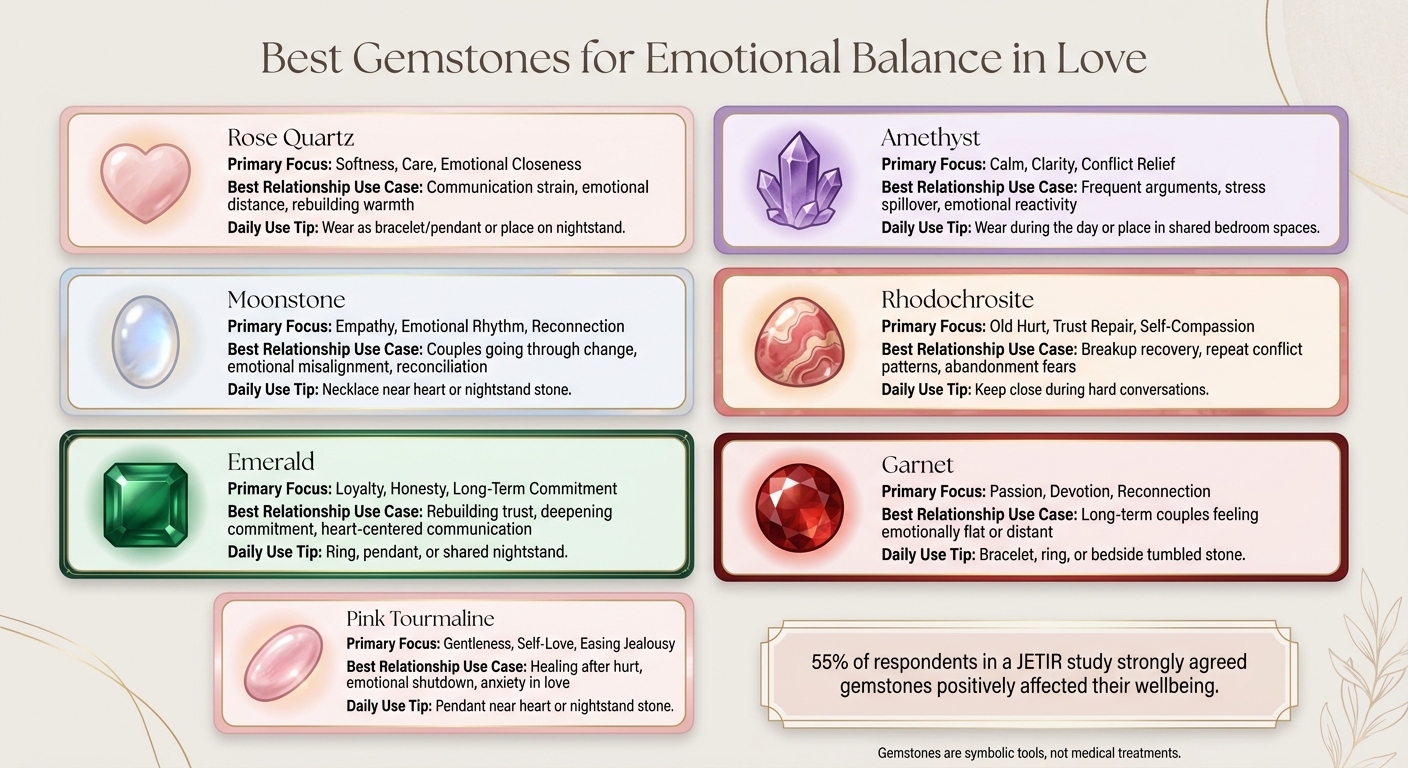
Best Gemstones for Emotional Balance in Love: Quick Reference Guide
Top 7 Love Crystals & How They Differ
sbb-itb-cb05739
Quick comparison
| Stone | Best for | Simple use |
|---|---|---|
| Rose Quartz | Healing, warmth, closeness | Wear it or keep it by the bed |
| Amethyst | Stress, overreaction, conflict | Wear an Amethyst pendant during the day or place near shared spaces |
| Moonstone | Change, emotional rhythm, reconnection | Nightstand, necklace, or during check-ins |
| Rhodochrosite | Old pain, breakup recovery, repeat patterns | Keep close during hard talks |
| Emerald | Trust, loyalty, commitment | Ring, pendant, or shared room |
| Garnet | Passion, steady devotion, reconnection | Jewelry or bedside stone |
| Pink Tourmaline | Softness after hurt, jealousy, self-love | Necklace, ring, or nightstand |
Bottom line: I’d use one stone, not many, and tie it to a small habit you already do - like a nightly check-in, journaling after an argument, or pausing before you reply.
Why People Use Gemstones for Emotional Balance in Relationships
People use gemstones as physical reminders of the emotional state they want to practice. A rose quartz ring, for example, can act like a small pause button during a tense moment. You look down, take a breath, and think twice before replying.
Crystal healing is a symbolic practice, not a clinical one. Scientific support for emotional claims is limited, but many people still find the ritual meaningful. One JETIR paper reported that about 55% of respondents strongly agreed that gemstones positively affected their wellbeing.
That matters because most people pick a stone based on the relationship issue they want to work on. The easiest way to think about it is simple: match the stone to the emotional challenge.
| Stone | Traditional Focus | Common Use Case |
|---|---|---|
| Rose Quartz | Love, compassion, forgiveness | Softening guarded feelings and healing emotional wounds |
| Amethyst | Calm, clarity, emotional balance | Reducing reactivity during arguments |
| Moonstone | Intuition, emotional balance, fresh starts | Reconnecting after distance or change |
| Emerald | Loyalty, stability, heart-centered communication | Deepening trust and commitment |
| [Garnet | Passion, intimacy, emotional vitality](https://consciousitems.com/blogs/crystal-guides/garnet) | Reigniting warmth and desire |
A lot of people like wearable stones - bracelets, pendants, and rings - because they stay with them all day. No extra setup, no separate ritual. Others keep stones in shared spaces, like a bedroom or living room, so the intention stays visible in everyday life.
Still, gemstones are best used alongside actual relationship work: honest talks, steady effort, and, when it helps, therapy or counseling. The stone can support the intention. It can't do the work for you. That distinction shows up more clearly in the stone-by-stone breakdown below.
1. Rose Quartz
Rose Quartz is the best fit when a relationship needs more warmth, patience, and emotional safety.
It supports compassion, emotional safety, and a calmer tone during stress. It tends to help most when partners feel tense, distant, or a bit guarded with each other.
Best for: communication strain, mild conflict, or emotional distance. It can be a good match for couples who want to reconnect, rebuild day-to-day closeness, or support self-worth after a hard relationship.
For daily support, keep the stone close and easy to see. A Rose Quartz Crystal set keeps it nearby during the day and can serve as a quiet reminder to respond with care instead of heat.
In shared spaces, placing Rose Quartz on a nightstand is a common choice. Some couples also use a simple nightly ritual: hold the stone during a short check-in and share one thing you appreciate about each other. Small habit, simple idea, but it can make the intention feel more concrete.
If Rose Quartz is about softening conflict, the next stone is a better fit when calm and clarity matter most.
2. Amethyst
Where Rose Quartz eases tension, Amethyst helps you stay steady when tension shows up. It’s often used when overthinking starts running the show. The idea is simple: slow the reaction, clear the mental noise, and make a little more space for calm, grounded connection. Crystal practitioners have long turned to it as a way to pause before reacting, which is why it’s a common pick when emotions start moving fast and thoughts get too loud.
Best for: couples who argue often, partners dealing with outside stress like work or money problems that spill into the relationship, or anyone trying to work through conflict or betrayal. You can wear it or keep it in the spaces where you talk, rest, and wind down most.
A simple Amethyst bracelet or necklace can work as a daily cue to take a breath before responding. At home, a cluster or geode on a shared nightstand or in the bedroom keeps that intention in sight during the moments that matter most.
3. Moonstone
Moonstone is often used to support emotional balance and a closer bond. In crystal practice, people link it with intuition, empathy, and a steadier emotional rhythm. That can help partners stay in step when shifting feelings start pulling them in different directions.
Best for: couples going through change, like a move, new family roles, or reconciliation. It also works well for emotionally sensitive couples who misread each other or keep falling into the same pattern. A small nightly ritual can help turn that idea into something you can actually do.
Place a small Moonstone on the nightstand and use it for a quick check-in. Each partner shares one appreciation. That’s it - one each, then stop. Keeping it short matters. Some couples also leave one in sight during tense talks as a simple reminder to speak calmly and say what they mean.
Best forms and placements: Moonstone necklaces are a common pick because wearing one near the chest keeps the stone close to the heart chakra all day. Tumbled stones or palm stones are good to hold during stress. In shared spaces, a small piece on a bedroom dresser or beside a relationship journal keeps that intention in view where it counts.
If emotional balance is the goal, the next stone speaks to the deeper heart wound underneath it.
4. Rhodochrosite
If Moonstone helps you stay emotionally steady, Rhodochrosite goes a layer deeper. It’s often used for crystals for emotional healing that still shape current relationships. So when the problem isn’t just present-day tension, but old pain coming back to the surface, this stone is often the one people turn to.
Rhodochrosite centers on the inner hurts that can make love hard to receive. People often use it for self-compassion, especially when shame, fear of abandonment, or old pain keeps repeating in love. It’s also a common pick for honest, gentle communication.
Best for: breakup recovery, trust repair, and breaking repeat conflict patterns. It can be especially helpful when push-pull patterns keep showing up, even when both people are making a real effort to change.
For day-to-day use, keep your focus on one healing intention at a time. During a hard conversation, place it between you as a simple reminder to stay calm and honest.
Pendants, bracelets, and tumbled stones make it easy to keep Rhodochrosite close during the day. You can also place it on a nightstand or bedroom dresser so that intention stays in sight.
5. Emerald
After old hurt starts to heal, Emerald supports the slower work of trust and commitment. It fits relationships that need loyalty, honesty, and lasting stability. Rather than pulling away or slipping into defensiveness, partners are encouraged to stay open, grounded, and honest with each other.
In relationships, Emerald is often used as a symbol of heart-centered connection. It tends to suit committed, long-term partnerships where the aim is to deepen trust and maintain closeness. One simple way to use it: place it on a table during serious conversations to help set the tone for calm, honest dialogue.
Best for: sustaining long-term commitment, rebuilding trust after conflict, and building closeness between partners who are actively working on their relationship.
Emerald rings and pendants are common for daily wear, keeping the stone close from morning to night. Tumbled Emerald stones can also work well as a small pocket piece during dates or hard conversations. At home, placing Emerald on a shared nightstand keeps that intention in view where it matters most.
If Emerald strengthens trust, Garnet restores heat and desire.
6. Garnet
Garnet is a good match when a relationship feels flat, distant, or worn out. It’s most linked with passionate love, devotion, and commitment - not the flashy kind, but the steady love that helps two people keep choosing each other over time.
Love Intention
Use Garnet when love is still there, but the spark has dimmed. Garnet fits when a relationship feels emotionally flat, distant, or drained; it symbolizes rekindling and chosen commitment. In plain English, it’s about choosing each other again, on purpose.
Emotional Support Theme
Garnet speaks to grounded passion: enough warmth to help two people reconnect, and enough steadiness to keep things calm. It can serve as a symbolic support for couples dealing with stress, trying to rebuild trust, or working to get their emotional energy back after a rough patch.
Best Relationship Use
Garnet works best when the problem isn’t a lack of love, but a lack of energy to show it. Best for: long-term couples who want to reconnect physically and emotionally, partners rebuilding after a difficult period, and people looking to bring more consistency and devotion into their love life.
Choose Garnet for rekindling, grounding, and steady devotion.
Common Form or Placement
Wear Garnet as a bracelet, ring, or pendant. You can also keep a tumbled stone nearby as a small daily reminder of steady commitment.
If Garnet brings back heat, the next stone softens that feeling into gentler, steadier affection.
7. Pink Tourmaline
Where Garnet brings back heat, Pink Tourmaline turns that energy into trust, self-love, and a calmer kind of closeness.
Love Intention
Pink Tourmaline is often tied to compassionate love and the heart chakra. The idea is simple: it supports emotional openness and self-love first, then carries that gentler energy into relationships. That makes it a strong fit when past pain has left someone guarded. In those moments, Pink Tourmaline is often used to support softer self-regard and help reopen the door to connection after hurt.
Emotional Support Theme
This stone is often linked with easing anxiety, jealousy, and emotional shutdown. At the same time, it's used to support calmer boundaries and clearer communication. Think of it as a softer emotional tone, not less honest, just less reactive.
Best Relationship Use
For singles, Pink Tourmaline is often chosen to attract healthier partnerships. For new couples, it can help make vulnerability and trust feel a little safer. For long-term partners, it may help ease emotional friction and bring back warmth, especially when the focus is reconciliation or a stronger emotional bond. It works best when love doesn't need more intensity, but more emotional repair and warmth.
Common Form or Placement
Wear Pink Tourmaline as a pendant or necklace so it stays close to the heart during the day. Bracelets and rings are also common picks for steady daily contact. And a tumbled stone on a nightstand can offer quiet support in a shared space.
Use Pink Tourmaline when love needs softness after hurt.
How to Pick the Right Love Gemstone for Your Situation
Once you’ve read through the stone profiles, the next step is simple: match the stone to the main issue you want to work on most.
Start with the core problem. Is it self-love? Conflict? Trust? Passion? That gives you a clear place to begin.
For heartbreak or emotional healing, go with rose quartz or rhodochrosite. If the issue is tension or emotional strain, amethyst or moonstone make more sense. For trust and loyalty, choose emerald. If you want more passion, or you’re trying to steady passion that spills into conflict, look at garnet or pink tourmaline.
If two stones seem like a fit, don’t overthink it. Choose the one you feel more drawn to. In plain terms: pick the stone that feels easiest to trust and keep using.
After that, think about how you’ll keep it close. The format matters just as much as the stone. Jewelry is a good fit for steady, day-to-day contact. A bedside stone can support your nighttime routine. And a shared stone in a living area keeps the intention in sight for both partners.
Before you buy jewelry, check durability. Amethyst, garnet, and emerald tend to handle daily wear well. Softer stones like rhodochrosite scratch more easily and need gentler care. Once you’ve picked both the stone and the format, it gets much easier to use it every day.
| Relationship Challenge | Best Stone(s) | Suggested Use |
|---|---|---|
| Self-love, healing heartbreak | Rose quartz, rhodochrosite | Jewelry or bedside |
| Tense communication, emotional overwhelm | Amethyst, moonstone | Bedside or worn during talks |
| Trust, loyalty, long-term commitment | Emerald | Ring, bracelet, or shared space |
| Passion that tips into conflict | Garnet or pink tourmaline | Bedside or jewelry |
Simple Ways to Use Gemstones in Your Daily Relationship Routine
The best gemstone habit is the one you’ll stick with. Start small, then tie the stone to something you already do each day.
Pick the form that fits your routine. A rose quartz bracelet can act like a gentle nudge toward compassion when things get tense. A moonstone necklace can remind you to stay calm during hard conversations. Rings are especially handy because you can see them while you talk, which gives you a quick signal to slow down and answer with patience. Conscious Items offers bracelets, necklaces, and rings with genuine stones for daily wear.
A stone on your nightstand keeps that intention in sight at the end of the day. In a shared space, one stone placed where both partners will notice it can serve as a quiet reminder to stay steady with each other.
When tension starts to build, let the stone be your pause button. After an argument, hold it while you journal. Write down the emotion that hit hardest, what you actually needed, and one small step that could help move things forward. Amethyst can support quiet reflection and clarity, while garnet can stand for renewed warmth and commitment.
You can also pair stones when you want support in two areas at once. Rose quartz and amethyst bring tenderness with clear perspective. Moonstone and emerald connect emotional openness with grounded communication. Each partner can wear one stone, which helps you share the same intention while still keeping a personal anchor.
Keep it simple. That’s what makes it easy to use every day.
Conclusion
Taken together, gemstones can help as symbols and reminders. But they don't replace honest talks, healthy boundaries, or help from a trained professional. If a relationship is under serious strain, therapy or counseling may do the most good.
Each stone lines up with a different need in a relationship. Rose Quartz can soften tension. Amethyst can calm conflict. Moonstone can steady periods of change. Rhodochrosite supports healing. Emerald strengthens loyalty. Garnet can spark passion again. And Pink Tourmaline brings a gentler sense of empathy.
You don't need all seven. Start with one that fits the main issue you're dealing with. If arguments keep flaring up, Amethyst or Emerald may make the most sense. If the problem feels more like emotional distance, Rose Quartz or Pink Tourmaline may be a better match.
If you want a simple daily cue, jewelry can keep that intention close. Conscious Items offers bracelets, necklaces, and rings made with genuine gemstones and ethically sourced materials for everyday wear.
The hard part of love is still human. A stone won't do the work for you. But worn with a clear intention, it can serve as a small daily prompt for the emotional balance you want to bring into your relationship.
FAQs
How do I choose the right gemstone for my relationship?
Start by naming the emotional need you want to work on, then trust your gut.
- Garnet for vitality and confidence
- Green aventurine for communication and forgiveness
- Sunstone for anger and productive energy
- Carnelian for intimacy and moving past toxic patterns
Pick the stone that feels most in sync with where you are right now.
Can I use more than one love gemstone at a time?
Yes. You can use more than one gemstone at the same time to support emotional balance and relationships.
A lot of crystals pair well together. For example, Crazy Lace Agate is often used with other stones, and Green Calcite can also be used alongside other crystals. The best approach is simple: trust your gut and test a few combinations to see what feels like the right fit for your needs.
What’s the best way to use a gemstone every day?
The easiest way to use a gemstone every day is to wear it as jewelry, like a ring, necklace, or bracelet. That way, it stays close to your body and heart throughout the day.
You can also keep a stone in your pocket, place it on your desk or somewhere in your home, or use it during meditation or yoga to support balance and harmony.
